New nature deal needs co-operation between Ottawa, provinces, First Nations: experts

Advertisement

Advertise with us

Now that the world has come together for a new deal to protect what's left of the planet's biodiversity, observers say Canada's various layers of government will have to do the same.

Read this article for free:


or

Already have an account? Log in here »

To continue reading, please subscribe:

Subscribe and receive a limited-edition Free Press branded hat or tote.

Digital Subscription

One year of digital access for only $205*

  • Enjoy unlimited reading on winnipegfreepress.com
  • Read the E-Edition, our digital replica newspaper
  • Access News Break, our award-winning app
  • Play interactive puzzles

*First annual payment billed as $205.00 + GST for one year. This annual subscription will automatically renew at $233.00 + GST every 52 weeks (10% off the regular annual price of $259.35). Offer available to new and qualified returning subscribers only. Cancel any time.

To continue reading, please subscribe:

Add Free Press access to your Brandon Sun subscription for only an additional

$1 for the first 4 weeks*

  • Enjoy unlimited reading on winnipegfreepress.com
  • Read the E-Edition, our digital replica newspaper
  • Access News Break, our award-winning app
  • Play interactive puzzles
Start now

*Your next Brandon Sun subscription payment will increase by $1.00 and you will be charged $17.95 plus GST for four weeks. After four weeks, your payment will increase to $24.95 plus GST every four weeks.

Hey there, time traveller!
This article was published 19/12/2022 (1365 days ago), so information in it may no longer be current.

Now that the world has come together for a new deal to protect what’s left of the planet’s biodiversity, observers say Canada’s various layers of government will have to do the same.

Ottawa can make the international promises, but it’s the provinces and territories that control activities that have the most impact on ecosystems such as agriculture, forestry and resource development, said Melanie Snow of Ecojustice.

“The provinces and territories do have the most jurisdiction over biodiversity protection,” she said. “National and provincial governments do need to work together.

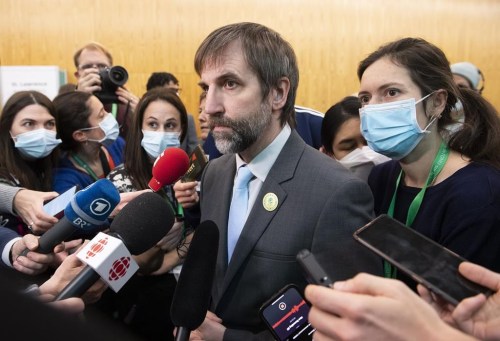
Steven Guilbeault, Minister of Environment and Climate Change of Canada speaks to reporters at the COP15 UN Biodiversity Conference in Montreal, Sunday, December 18, 2022. THE CANADIAN PRESS/Graham Hughes

“I’m sure the federal government will be consulting with the provinces and territories.”

Over the weekend, 196 countries came together on a deal to protect Earth’s biodiversity at the COP15 meeting in Montreal. That deal includes a pledge to protect 30 per cent of the globe’s lands and oceans by 2030 — a promise Ottawa will find difficult to implement if other levels of government, including First Nations, aren’t on board.

“It is achievable if all levels of government get together,” said Sandra Schwartz of the Canadian Parks and Wilderness Society.

The new biodiversity pact calls on the world to phase out at least $700 billion in subsidies that work to degrade biodiversity, often those that go to industries like forestry, farming and fishing. That will force Canadian governments to reconsider policies in all departments, not just environment ministries, said Schwartz.

“A whole-of-government approach is needed.”

Schwartz said governments already consider the potential effects of new projects and policies on greenhouse gas targets. Now, the same has to be done for biodiversity.

“(Officials) don’t currently look at biodiversity or nature outcomes as part of the analysis that’s done to see if the federal government should be investing,” Schwartz said.

That same “biodiversity lens” will have to be turned on current subsidies and tax programs, she added.

“If there are tax incentives that are given that are harmful to areas that may have key biodiversity, we want to make sure those subsidies don’t continue.”

New legislation will have to be developed to bring COP15 into Canadian law, said Snow. Similar legislation already exists for climate targets.

Snow said drafting the new bills will force levels of government to sit down together and work out how the COP15 agreement will be implemented. She said that will be an opportunity for leaders to decide what kinds of development will be permitted where — and if some areas should be off-limits — in advance of proposals coming forward.

That’s better than the current piecemeal approach, where Ottawa decides project by project if it will assess environmental impact.

“What we often see is that there is a tension when the federal government comes in at the last moment,” Snow said.

Federal Environment Minister Steven Guilbeault said such legislation will be a priority for his department in the new year.

“I have team members who have started looking into that and that have started having conversations with NGOs and the department about how would that look and what would be the timeline to develop legislation,” he said.

Guilbeault also said next year Canada will vet its various subsidies to see which harm nature.

Canada made similar promises to phase out subsidies to fossil fuel producers, and has been heavily criticized for taking too long to do it.

It just recently moved to eliminate Canada’s support for international fossil fuel projects and Guilbeault said the domestic subsidies will end by June.

Guilbeault said phasing out fossil fuel subsidies took too long, but that experience should make removal quicker for subsidies that damage biodiversity.

“It will happen more rapidly on for nature subsidies,” he promised.

This report by The Canadian Press was first published Dec. 19, 2022.

— with files from Mia Rabson in Montreal. Follow bob Weber on Twitter at @row1960.

Report Error Submit a Tip

More Stories

Canadians loving Carney’s decision to stand tall against floundering U.S. bully

Tom Brodbeck 5 minute read Preview

Canadians loving Carney’s decision to stand tall against floundering U.S. bully

Tom Brodbeck 5 minute read Friday, Sep. 11, 2026

It’s hard to imagine a more dramatic political contrast than the one unfolding on opposite sides of the Canada-U.S. border.

Mark Carney is fighting a trade war with Donald Trump, taking the occasional verbal punch from the American president and imposing retaliatory tariffs on U.S. products.

And the prime minister is being rewarded for it politically.

Trump, meanwhile, is fighting pretty much everyone he can find — including some of America’s closest allies — and his own voters are increasingly giving him the political equivalent of a raised middle finger. That’s quite a tale of two leaders.

Read
Friday, Sep. 11, 2026

The port of Churchill — but done right

Editorial 4 minute read Preview

The port of Churchill — but done right

Editorial 4 minute read Saturday, Sep. 12, 2026

The seagoing grain carrier wasn’t christened with a champagne bottle. There was no confetti or streamers. Nevertheless, the Aug. 31 event marking the first shipment of grain to be loaded at the Port of Churchill since 2020 was celebrated like the launch of a brand new vessel.

The presence of the federal minister of northern and arctic affairs, provincial cabinet ministers and leaders and elders from several northern First Nations signalled that the fast-tracked process of refurbishing and buffing up Manitoba’s deep-water seaport gem is gaining momentum.

For OneNorth, the partnership of 29 First Nations and 12 northern communities which owns the Port of Churchill and the Hudson Bay Railway (both operated by the Arctic Gateway Group) the event heralded a new beginning. It’s been eight years since OneNorth purchased the port and railroad, and six years since grain was moved by rail through Manitoba and then by ship to European markets. Two more grain shipments, plus shipments of potash and critical minerals, will continue through the fall.

When Prime Minister Mark Carney solicited the premiers to suggest “nation-building” projects following his election in 2025, Premier Wab Kinew pitched a Manitoba trade corridor that would move wheat, critical minerals, potash and energy (oil or liquid natural gas) through the Port of Churchill.

Read
Saturday, Sep. 12, 2026

Tory health critic ‘disappointed’ after being rebuffed by health officials

Carol Sanders 4 minute read Preview

Tory health critic ‘disappointed’ after being rebuffed by health officials

Carol Sanders 4 minute read Saturday, Sep. 12, 2026

The health critic for the Progressive Conservative party says her ability to get information about the accelerated reopening of Dauphin’s emergency department was stymied by Prairie Mountain Health officials because they refused to meet with her.

“I wanted to meet with PMH staff to discuss the status of the facility and the challenges they’re facing and getting services back online,” Kathleen Cook said Friday.

“I was very disappointed that Prairie Mountain Health declined me that opportunity.”

Cook said she asked for a meeting a few days after the Sept. 7 reopening of a temporary ER at the hospital, that was severely damaged by flooding.

Read
Saturday, Sep. 12, 2026

Nifty neighbours also jonesing for geniality

Maureen Scurfield 4 minute read Saturday, Sep. 12, 2026

DEAR MISS LONELYHEARTS: Recently, a new couple with no children moved onto our cul de sac, and everybody is taking notice! This attractive pair with no kids both drive amazing cars, work from home and leave their garage doors up a lot. Everybody on the street walks by to sneak a peek into the big garage at just about any time of day.

Lately, the man’s been out on his front lawn in a muscle shirt in the late afternoon, planting shrubs and putting up stylish fall-themed ornaments. At night they often leave the living-room curtains open. That makes for convenient viewing for curious neighbours like us!

A few days ago, my wife invited the new couple over for a barbecue and swim in our pool. They are really nice people, but mentioned that other people nearby have been pretty stand-offish. They wonder why. Should I tell them it’s probably just jealousy over their beautiful vehicles and enviable lifestyle, or should I just shut up?

—Wanting to Help, Sage Creek

Drug recovery centre opens office in ‘heart of the city’

Morgan Modjeski 4 minute read Preview

Drug recovery centre opens office in ‘heart of the city’

Morgan Modjeski 4 minute read Saturday, Sep. 12, 2026

Richard Halverson found his freedom from addiction through Adult & Teen Challenge and, six years later, he hopes a new Winnipeg location will bring hope to the city.

Dozens gathered Saturday morning to mark the grand opening of the recovery centre’s community services office on Main Street.

Located inside the former Wojcik funeral home, the bright-white building — which was also formerly a liquor store — will serve as an access point for people fighting drug addiction. That includes connecting them to addictions support, housing and training.

“For me, I always start with: ‘What’s your story?’” said Halverson, who now works for the faith-based organization.

Read
Saturday, Sep. 12, 2026

New nature deal needs co-operation between Ottawa, provinces, First Nations: experts

Bob Weber, The Canadian Press 4 minute read Preview

New nature deal needs co-operation between Ottawa, provinces, First Nations: experts

Bob Weber, The Canadian Press 4 minute read Monday, Dec. 19, 2022

Now that the world has come together for a new deal to protect what's left of the planet's biodiversity, observers say Canada's various layers of government will have to do the same.

Ottawa can make the international promises, but it's the provinces and territories that control activities that have the most impact on ecosystems such as agriculture, forestry and resource development, said Melanie Snow of Ecojustice.

"The provinces and territories do have the most jurisdiction over biodiversity protection," she said. "National and provincial governments do need to work together.

"I'm sure the federal government will be consulting with the provinces and territories."

Read
Monday, Dec. 19, 2022