UN chief: Rising seas risk ‘death sentence’ for some nations
Advertisement
Read this article for free:
or
Already have an account? Log in here »
To continue reading, please subscribe:

Digital Subscription
One year of digital access for only $205*
- Enjoy unlimited reading on winnipegfreepress.com
- Read the E-Edition, our digital replica newspaper
- Access News Break, our award-winning app
- Play interactive puzzles
*First annual payment billed as $205.00 + GST for one year. This annual subscription will automatically renew at $233.00 + GST every 52 weeks (10% off the regular annual price of $259.35). Offer available to new and qualified returning subscribers only. Cancel any time.
To continue reading, please subscribe:
Add Free Press access to your Brandon Sun subscription for only an additional
$1 for the first 4 weeks*
- Enjoy unlimited reading on winnipegfreepress.com
- Read the E-Edition, our digital replica newspaper
- Access News Break, our award-winning app
- Play interactive puzzles
*Your next Brandon Sun subscription payment will increase by $1.00 and you will be charged $17.95 plus GST for four weeks. After four weeks, your payment will increase to $24.95 plus GST every four weeks.
Read unlimited articles for free today:
or
Already have an account? Log in here »
Hey there, time traveller!
This article was published 14/02/2023 (1339 days ago), so information in it may no longer be current.
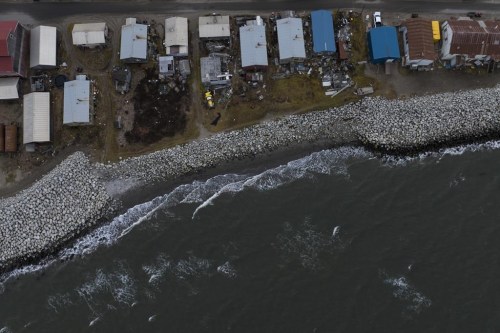
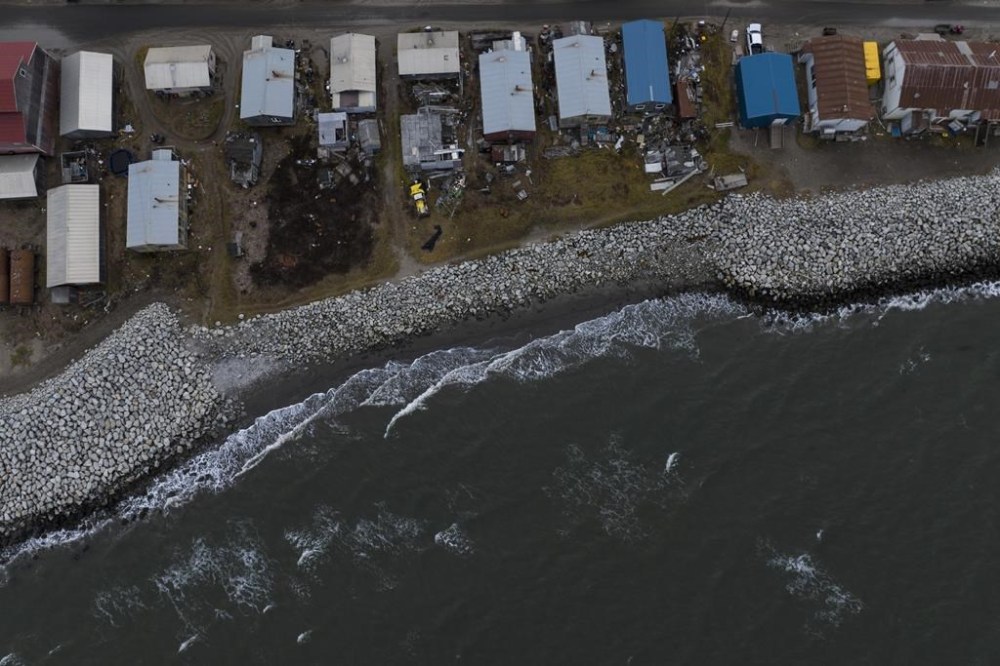
UNITED NATIONS (AP) — The United Nations chief warned Tuesday that global sea levels have risen faster since 1900 and their relentless increase puts countries like Bangladesh, China, India and the Netherlands at risk and acutely endangers nearly 900 million people living in low-lying coastal areas.
In a grim speech to the Security Council’s first-ever meeting on the threat to international peace and security from rising sea levels, Secretary-General Antonio Guterres declared that sea levels will rise significantly even if global warming is “miraculously” limited to 1.5 degrees Celsius (2.7 degrees Fahrenheit), the elusive international goal.
He warned the Earth is more likely on a path to warming that amounts to “a death sentence” for countries vulnerable to that rise, including many small island nations.
In addition to threatened countries, Guterres said, “mega-cities on every continent will face serious effects, including Cairo, Lagos, Maputo, Bangkok, Dhaka, Jakarta, Mumbai, Shanghai, Copenhagen, London, Los Angeles, New York, Buenos Aires and Santiago.”
The U.N. chief stressed that every fraction of a degree in global warming counts, since sea level rise could double if temperatures rise by 2 degrees Celsius (3.6 degrees Fahrenheit), and could increase exponentially with further temperature increases.
The World Meteorological Organization released data Tuesday spelling out the grave danger of rising seas, Guterres said.
“Global average sea levels have risen faster since 1900 than over any preceding century in the last 3,000 years,” he said. “The global ocean has warmed faster over the past century than at any time in the past 11,000 years.”
According to the data cited by Guterres, the global mean sea level will rise by about 2 to 3 meters (about 6.5 to 9.8 feet) over the next 2,000 years if warming is limited to 1.5 degrees Celsius. With a 2-degree Celsius increase, seas could rise up to 6 meters (19.7 feet), and with a 5-degree Celsius increase, seas could rise up to 22 meters (72 feet), according to the WMO.
“Our world is hurtling past the 1.5-degree warming limit that a livable future requires, and with present policies, is careening towards 2.8 degrees — a death sentence for vulnerable countries,” Guterres said.
The consequences are unthinkable, Guterres said. Low-lying communities and entire countries could disappear, the world would witness a mass exodus of entire populations on a biblical scale, and competition would become ever fiercer for fresh water, land and other resources.
Guterres has been trying to call the world’s attention to the dangers posed by climate change, to spur action.
In October, he warned that the world is in “a life-or-death struggle” for survival as “climate chaos gallops ahead” and accused the world’s 20 wealthiest countries of failing to do enough to stop the planet from overheating. In November, he said the planet is heading toward irreversible “climate chaos” and urged global leaders to put the world back on track to cut emissions, keep promises on climate financing and help developing countries speed their transition to renewable energy.
The landmark Paris agreement adopted in 2015 to address climate change called for global temperatures to rise a maximum of 2 degrees Celsius by the end of the century compared to pre-industrial times, and as close as possible to 1.5 degrees Celsius.
Guterres said the world must address the climate crisis as the root cause of rising seas, and the Security Council has a critical role to play in building the political will required.
The Security Council meeting, organized by Malta, which holds the council presidency this month, heard speakers from some 75 countries, large and small, endangered and landlocked, all voicing concern about the impact of the contining rising seas on the future of the world — and for some, the survival of their own countries.
Samoa’s U.N. ambassador, Fatumanava-o-Upolu III Pa’olelei Luteru, speaking on behalf of the Alliance of Small Island States which he chairs, told the council: “There is a litany of new examples of the sudden and slow onset impact of climate change on small islands, from king tides, to super hurricanes to the unstoppable and unprecedented rise in sea levels.”
The impact on people and the economies of the islands “will continue to be extraordinary,” he said, raising issues of their survival and continuation as states.
Alliance members “are among the lowest emitters of greenhouse gases that drive climate change and sea level rise. Yet, we face some of the most severe consequences of rising sea levels,” Lutero said. “To expect small island state to shoulder the burden of sea level rise, without assistance from the international community will be the pinnacle of inequities.”
He said that cooperation to address rising seas is “a legal obligation” for every country, and that there is an urgent need for nations to fulfill their international commitments on climate change and finance.
Ambassador Amatlain Kabua of the Marshall Islands said many of the tools to address climate change and rising seas are already in from of the Security Council, and “more focused action from the international system can be invited.” But she said, “What is needed most in the political will to start the job, supported by a U.N. special representative” to spur global action.
U.S. Ambassador Linda Thomas-Greenfield said that “the threat of sea level rise is real, it is a direct result of our climate crisis, and it is a matter of international peace and security.”
“The council must take action,” she said, pointing to the threat of hundreds of millions in low-lying coastal areas losing their homes, livelihoods and communities.
“Fortunately, the worst impacts can be avoided, but we have to act now, and we have to act together,” Thomas-Greenfield said.
General Assembly President Csaba Kőrösi said, “At the current rate, sea levels will be 1 to 1.6 meters higher by 2100, according to the World Climate Research Program.”
“In the Nile and Mekong Deltas — some of the richest agricultural regions in the world — ten to twenty percent of arable land will sink beneath the waves,” he said.
“Climate induced sea-level rise is also provoking new legal questions that are at the very core of national and state identity. What happens to a nation’s sovereignty — including U.N. membership — if it sinks beneath the sea?” he asked.
“Science tells us that whether cities or countries disappear depends on whether we as humans counteract the threat,” Kőrösi said.
___
McDermott reported from Providence, R.I.
Related Articles
Climate crisis key issue in upcoming election
Advertisement Advertise With Us
Advertisement Advertise With Us