California farmers flood fields to boost groundwater basin
Advertisement
Read this article for free:
or
Already have an account? Log in here »
To continue reading, please subscribe:

Digital Subscription
One year of digital access for only $205*
- Enjoy unlimited reading on winnipegfreepress.com
- Read the E-Edition, our digital replica newspaper
- Access News Break, our award-winning app
- Play interactive puzzles
*First annual payment billed as $205.00 + GST for one year. This annual subscription will automatically renew at $233.00 + GST every 52 weeks (10% off the regular annual price of $259.35). Offer available to new and qualified returning subscribers only. Cancel any time.
To continue reading, please subscribe:
Add Free Press access to your Brandon Sun subscription for only an additional
$1 for the first 4 weeks*
- Enjoy unlimited reading on winnipegfreepress.com
- Read the E-Edition, our digital replica newspaper
- Access News Break, our award-winning app
- Play interactive puzzles
*Your next Brandon Sun subscription payment will increase by $1.00 and you will be charged $17.95 plus GST for four weeks. After four weeks, your payment will increase to $24.95 plus GST every four weeks.
Read unlimited articles for free today:
or
Already have an account? Log in here »
Hey there, time traveller!
This article was published 28/03/2023 (1284 days ago), so information in it may no longer be current.
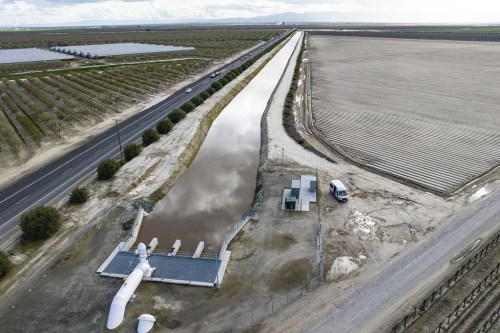
A field that has long grown tomatoes, peppers and onions now looks like a wind-whipped ocean as farmer Don Cameron seeks to capture the runoff from a freakishly wet year in California to replenish the groundwater basin that is his only source to water his crops.
Taking some tomatoes out of production for a year is an easy choice if it means boosting future water supplies for his farm about 35 miles (56 kilometers) southwest of Fresno. He’s pumping 300 acre-feet a day — enough to supply hundreds of households for a year — from the gushing North Fork of the Kings River onto former vegetable fields and others dotted with pistachio trees, which can withstand heavy flooding.
“We knew long-term if we didn’t have water, we’d be out of business,” Cameron said. “We’re doing our part to protect communities downstream, but we’re also putting the water in the ground.”
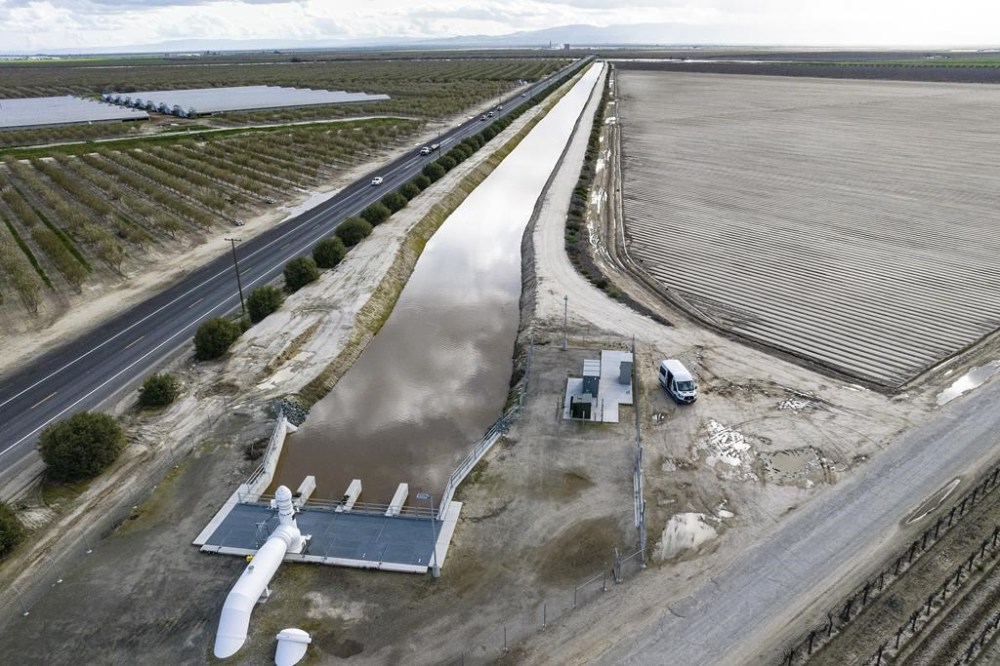
The 70-year-old has spent more than a decade building and expanding a system to divert floodwaters from nearby rural communities and is a pioneer in the practice of on-farm recharge, or flooding agricultural lands during rainy periods to help restore the groundwater basin.
But he isn’t alone. Government agencies, water district officials and nonprofits are eyeing the practice as a way to weather swings in climate, especially as California muddles through a winter that has experts forecasting the Sierra Nevada snowpack could last for months.
Groundwater supplies are essential to both farms and communities across the fertile Central Valley, a key source of food for the United States.
That’s even more the case during drought years, when groundwater accounts for up to 60% of the state’s water supply, compared with 40% in non-drought, said Wade Crowfoot, secretary of California’s Natural Resources Agency.
But farmers have pumped ever deeper through years of drought, depleting what’s left and leaving wells dry.
Hoping to reverse that trend, valley water agencies have built basins to try to capture water in rainy years and allow it to seep back into the ground. Now many are hoping to enlist vast tracts of farmland for a similar purpose.
Groundwater recharge projects are a “critical, important part of our infrastructure future,” Crowfoot said.
The Tulare Irrigation District for example, has doubled the amount of water it can divert this year thanks to farmers who are willing to take it, said Daniel Mountjoy, director of resource stewardship at the nonprofit Sustainable Conservation, which supports expanding on-farm recharge.
“Farmlands are the thing you can expand to when you have a freak year like this,” he said. “They are the solution.”
The idea of using farmland to recharge groundwater has percolated for years. After California enacted a law in 2014 requiring regional agencies to manage their aquifers sustainably to avoid overpumping, more farmers faced with the prospect of fallowing fields began considering it.
With the potential for flooding in small towns and rural communities this season, Gov. Gavin Newsom signed an order this month making it easier for farmers to divert floodwater to their fields.
While some farmers like Cameron are ready to flood their fields now, many others aren’t. Still, the rains and looming pumping limits have galvanized interest, said Wendy Rash, state water quality specialist at the U.S. Department of Agriculture’s Natural Resources Conservation Service.
Last year her agency started a pilot program for 20 farmers, and more than two dozen in Fresno County alone recently were on a call about how to join the expanding effort in its second year. If successful, the program could be replicated in other Western states.
The McMullin Area Groundwater Sustainability Agency, which operates in a portion of the Central Valley, has developed an on-farm recharge university to train farmers in the practice. One of them, Mark Pitman, said he has always used water sparingly but may eventually flood his orange grove, which is close to a proposed canal.
“If you don’t flood it, you may not be able to water your crop next year when it’s rough,” Pitman said. “It’s six of one, half dozen of another.”
Some environmental groups support on-farm recharge but urge caution over concerns that pesticides or other contaminants could be flushed into a system that is also a drinking water source.
The worry is “you may cause a groundwater quality problem when you try to solve a groundwater supply problem,” said Michael Claiborne, directing attorney at Leadership Counsel, a nonprofit focused on valley communities.
With such concerns in mind, Newsom’s recent order makes dairy lands and fields where pesticides were recently applied ineligible. Also, farmers are required to report to the state when they divert water.

It isn’t immediately clear how farmers will be compensated, but some say they expect to receive a water credit in the future. Not all the water will come back to those who participate, but experts anticipate they will see a benefit and so will their neighbors.
Some soil conditions and crops are better suited for recharge than others. Grapes, for example, can withstand large amounts of water, especially in cold temperatures, and so can pecan trees, said Philip Bachand, an environmental engineer who has worked with Cameron on recharge.
In 2017, another wet year, Cameron tried flooding almonds, pistachios, walnuts and winegrapes and found they could survive so long as the water remained cold. He said it’s hard to track where all the water went, but he measured a 40-foot (12-meter) increase in the water table beneath his flooded vineyard.
Back then, Cameron said, he moved the water with a much smaller system that he has since expanded with help from a $5 million state grant to significantly boost his recharge capacity.
“We have the location, we have the soils.” Cameron said. “And we have the will to do it.”