Japan, US agree to cooperate on geothermal energy
Advertisement
Read this article for free:
or
Already have an account? Log in here »
To continue reading, please subscribe:

Digital Subscription
One year of digital access for only $205*
- Enjoy unlimited reading on winnipegfreepress.com
- Read the E-Edition, our digital replica newspaper
- Access News Break, our award-winning app
- Play interactive puzzles
*First annual payment billed as $205.00 + GST for one year. This annual subscription will automatically renew at $233.00 + GST every 52 weeks (10% off the regular annual price of $259.35). Offer available to new and qualified returning subscribers only. Cancel any time.
To continue reading, please subscribe:
Add Free Press access to your Brandon Sun subscription for only an additional
$1 for the first 4 weeks*
- Enjoy unlimited reading on winnipegfreepress.com
- Read the E-Edition, our digital replica newspaper
- Access News Break, our award-winning app
- Play interactive puzzles
*Your next Brandon Sun subscription payment will increase by $1.00 and you will be charged $17.95 plus GST for four weeks. After four weeks, your payment will increase to $24.95 plus GST every four weeks.
Read unlimited articles for free today:
or
Already have an account? Log in here »
Hey there, time traveller!
This article was published 15/04/2023 (1263 days ago), so information in it may no longer be current.
SAPPORO, Japan (AP) — Japan and the United States agreed Saturday to cooperate on developing geothermal energy, one of the most plentiful resources on this volcanic island chain.
The memorandum of commitment was signed Saturday on the sidelines of a meeting of the Group of Seven energy and environment ministers in the northern city of Hokkaido.
Japan’s famed hot springs reflect its abundant geothermal activity, but the spas and resorts clustered around them have slowed efforts to use that resource to generate power.
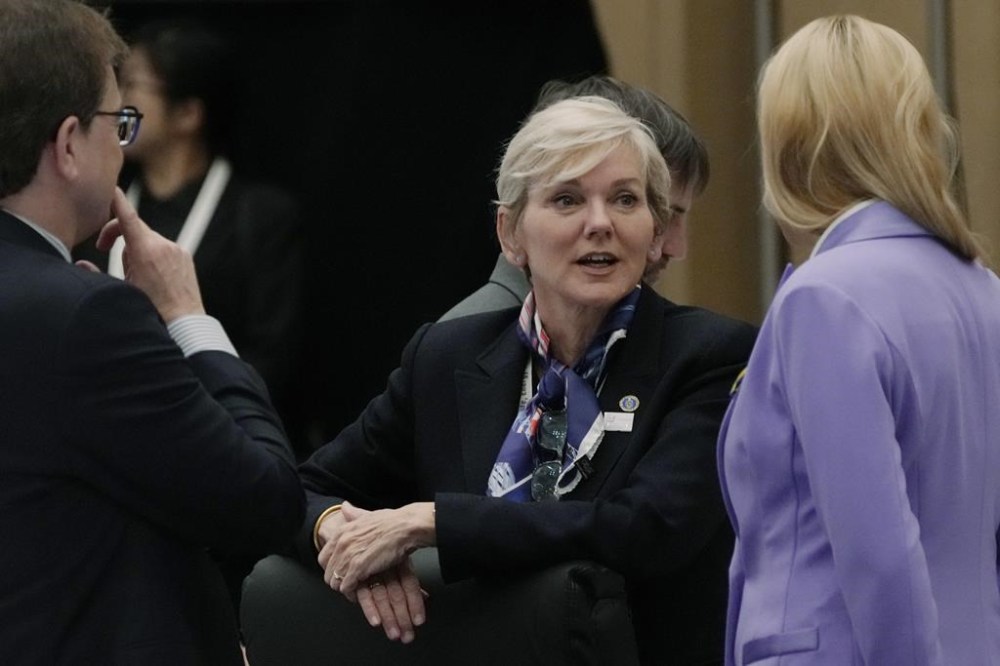
The pact signed by Energy Secretary Jennifer Granholm and Japan’s minister of economy, trade and industry, Yasutoshi Nishimura, says that geothermal energy is recognized as a “renewable energy technology that the United States and Japan can work together to advance.”
It calls for collaborating in research and development and exchange of information and in pursuing geothermal projects in the U.S., Japan and other countries. It’s one of an array of areas where the two countries intend to collaborate in reducing reliance on fossil fuels and cutting carbon emissions that contribute to climate change.
“The prospects of offshore wind are enormous. The prospects of geothermal. We’re very excited about partnering with Japan on these kinds of issues,” Granholm said in an interview with The Associated Press on Friday ahead of the G-7 meetings.
The agreement did not specify expected spending but said each side would bear the costs associated with their own activities.
Adding more geothermal power could make it possible for Japan to provide 90% of its power generation from renewable sources, according to an estimate by the Lawrence Berkeley National Laboratory. That would amount to a 92% reduction in the country’s greenhouse gas emissions, it said in a recent study.

So far, Japan’s geothermal capacity has been underutilized: it has dozens of small power plants run on the steaming hot springs dotted across the country, but together they account for less than 1% of its total power generating capacity.
Both Japan and the U.S. are looking to export geothermal technology.
Japanese companies are participating in a joint project to build what is expected to be the world’s largest geothermal power station, in Indonesia’s Sumatra, with 320 gigawatts of electricity.
Biomass and geothermal power also contribute less than 1% of U.S. generating capacity, according to the U.S. Energy Information Administration.
The U.S. has the largest estimated geothermal potential, according to Japan’s National Industrial Institute of Science and Technology, followed by Indonesia and Japan. But Japan ranks 9th in installed geothermal power generating capacity, while the U.S. is the global leader.