Amazon Indigenous woman wins Goldman environment prize
Advertisement
Read this article for free:
or
Already have an account? Log in here »
To continue reading, please subscribe:

Digital Subscription
One year of digital access for only $205*
- Enjoy unlimited reading on winnipegfreepress.com
- Read the E-Edition, our digital replica newspaper
- Access News Break, our award-winning app
- Play interactive puzzles
*First annual payment billed as $205.00 + GST for one year. This annual subscription will automatically renew at $233.00 + GST every 52 weeks (10% off the regular annual price of $259.35). Offer available to new and qualified returning subscribers only. Cancel any time.
To continue reading, please subscribe:
Add Free Press access to your Brandon Sun subscription for only an additional
$1 for the first 4 weeks*
- Enjoy unlimited reading on winnipegfreepress.com
- Read the E-Edition, our digital replica newspaper
- Access News Break, our award-winning app
- Play interactive puzzles
*Your next Brandon Sun subscription payment will increase by $1.00 and you will be charged $17.95 plus GST for four weeks. After four weeks, your payment will increase to $24.95 plus GST every four weeks.
Read unlimited articles for free today:
or
Already have an account? Log in here »
Hey there, time traveller!
This article was published 24/04/2023 (1250 days ago), so information in it may no longer be current.
SÃO PAULO (AP) — When Alessandra Korap was born in the mid-1980s, her Indigenous village nestled in the Amazon rainforest in Brazil was a haven of seclusion. But as she grew up, the nearby city of Itaituba, with its bustling streets and commercial activity, crept closer and closer.
It wasn’t just her village feeling the encroachment of non-Indigenous outsiders. Two major federal highways paved the way for tens of thousands of settlers, illegal gold miners and loggers into the region’s vast Indigenous territories, which cover a forested area roughly the size of Belgium.
The influx posed a grave threat to Korap’s Munduruku people, 14,000-strong and spread throughout the Tapajos River Basin, in Para and Mato Grosso states. Soon illegal mining, hydroelectric dams, a major railway and river ports for soybean exports choked their lands — lands they were still struggling to have recognized.
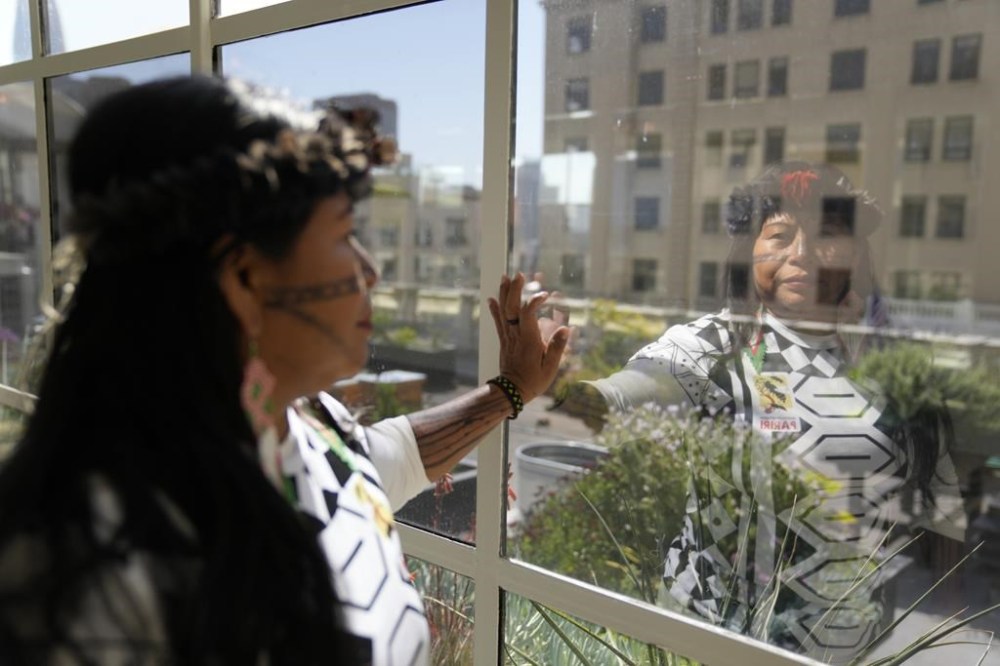
Korap and other Munduruku women took up the responsibility of defending their people, overturning the traditionally all-male leadership. Organizing in their communities, they orchestrated demonstrations, presented compelling evidence of environmental crime to the Federal Attorney General and Federal Police, and vehemently opposed illicit agreements and incentives offered to the Munduruku by unscrupulous miners, loggers, corporations, and politicians seeking access to their land.
Korap’s defense of her ancestral territory was recognized with the Goldman Environmental Prize on Monday. The award honors grassroots activists around the world who are dedicated to protecting the environment and promoting sustainability.
“This award is an opportunity to draw attention to the demarcation of the Sawre Muybu territory,” Korap told The Associated Press. “It is our top priority, along with the expulsion of illegal miners.”
Sawre Muybu is an area of virgin rainforest along the Tapajos River spanning 178,000 hectares (440,000 acres). Official recognition for the land, or demarcation, began in 2007 but was frozen during the far-right presidency of Jair Bolsonaro, which ended in January.
Still, the Munduruku people celebrated a victory in 2021 when the British mining company Anglo American gave up trying to mine inside Indigenous territories in Brazil, including Sawre Muybu.
Studies have shown that Indigenous-controlled forests are the best preserved the in Brazilian Amazon.
Almost half of Brazil’s climate pollution comes from deforestation. The destruction is so vast now that the eastern Amazon, not far from the Munduruku, has ceased to be a carbon sink, or net absorber of the gas and is now a carbon source, according to a study published in 2021 in the journal Nature.
Korap, however, knows that land rights alone don’t protect the land.
In the neighboring Munduruku Indigenous Territory, illegal miners have destroyed and contaminated hundreds of miles of waterways in search of gold, even though it was officially recognized in 2004.
Now Brazil’s new government has created the country’s first Ministry of Indigenous Peoples and more recently mounted operations to drive out miners. But Korap remains skeptical of President Luiz Inácio Lula da Silva. She sees his actions as contradictory, noting that while he advocates for forest protection, he also negotiates trade deals with other countries to sell more of the country’s top exports — beef and soybeans — which are the main drivers of deforestation in Brazil.
“When Lula travels abroad, he is sitting with rich people and not with forest defenders. A ministry is useless if the government negotiates our lands without acknowledging we are here,” she said.
Other Goldman Environmental Prize recipients this year are:
— Tero Mustonen, a university professor and environmental activist from Finland, who led the purchase of peatland damaged by state-sponsored industrial activity.
—Delima Silalahi, a Batak woman from North Sumatra, Indonesia, who organized Indigenous communities across the country to advocate for their rights to traditional forests.
—Chilekwa Mumba, a Zambian community organizer who has fought for and won compensation for residents harmed by copper mining before the UK Supreme Court.
—Zafer Kizilkaya of Turkey, a marine conservationist and conservation photographer who established Turkey’s first community-managed marine protected area in the Mediterranean.

—Diane Wilson, an American shrimp boat captain who won a landmark case against petrochemical giant Formosa Plastics over the discharge of plastic waste on the Texas Gulf Coast.
___
Isabella O’Malley contributed from Philadelphia.
___
Associated Press climate and environmental coverage receives support from several private foundations. See more about AP’s climate initiative here. The AP is solely responsible for all content.