EPA: New pollution limits proposed for US coal, gas power plants reflect ‘urgency’ of climate crisis
Advertisement
Read this article for free:
or
Already have an account? Log in here »
To continue reading, please subscribe:

Digital Subscription
One year of digital access for only $205*
- Enjoy unlimited reading on winnipegfreepress.com
- Read the E-Edition, our digital replica newspaper
- Access News Break, our award-winning app
- Play interactive puzzles
*First annual payment billed as $205.00 + GST for one year. This annual subscription will automatically renew at $233.00 + GST every 52 weeks (10% off the regular annual price of $259.35). Offer available to new and qualified returning subscribers only. Cancel any time.
To continue reading, please subscribe:
Add Free Press access to your Brandon Sun subscription for only an additional
$1 for the first 4 weeks*
- Enjoy unlimited reading on winnipegfreepress.com
- Read the E-Edition, our digital replica newspaper
- Access News Break, our award-winning app
- Play interactive puzzles
*Your next Brandon Sun subscription payment will increase by $1.00 and you will be charged $17.95 plus GST for four weeks. After four weeks, your payment will increase to $24.95 plus GST every four weeks.
Read unlimited articles for free today:
or
Already have an account? Log in here »
Hey there, time traveller!
This article was published 11/05/2023 (1242 days ago), so information in it may no longer be current.
WASHINGTON (AP) — The Biden administration proposed new limits Thursday on greenhouse gas emissions from coal- and gas-fired power plants, its most ambitious effort yet to roll back planet-warming pollution from the nation’s second-largest contributor to climate change.
A rule announced by the Environmental Protection Agency could force power plants to capture smokestack emissions using a technology that has long been promised but is not used widely in the United States.
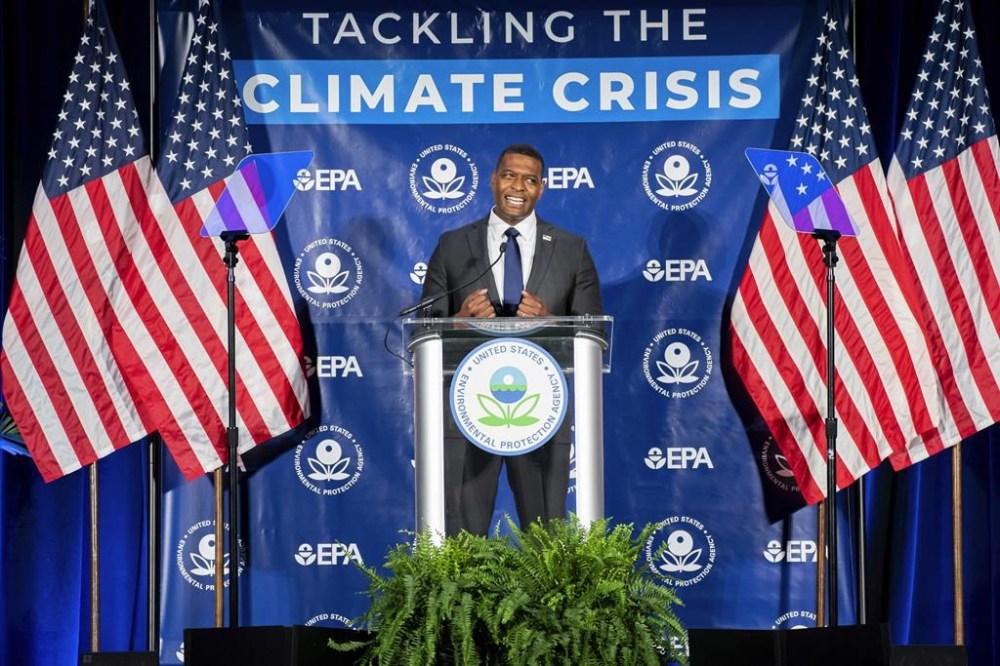
“This administration is committed to meeting the urgency of the climate crisis and taking the necessary actions required,” said EPA Administrator Michael Regan.

The plan would not only “improve air quality nationwide, but it will bring substantial health benefits to communities all across the country, especially our front-line communities … that have unjustly borne the burden of pollution for decades,” Regan said in a speech at the University of Maryland.
President Joe Biden called the plan “a major step forward in the climate crisis and protecting public health.”
If finalized, the proposed regulation would mark the first time the federal government has restricted carbon dioxide emissions from existing power plants, which generate about 25% of U.S. greenhouse gas pollution, second only to the transportation sector. The rule also would apply to future electric plants and would avoid up to 617 million metric tons of carbon dioxide through 2042, equivalent to annual emissions of 137 million passenger vehicles, the EPA said.
Almost all coal plants — along with large, frequently used gas-fired power plants — would have to cut or capture nearly all their carbon dioxide emissions by 2038, the EPA said. Plants that cannot meet the new standards would be forced to retire.
The plan is likely to be challenged by industry groups and Republican-leaning states. They have accused the Democratic administration of overreach on environmental regulations and warn of a pending reliability crisis for the electric grid. The power plant rule is one of at least a half-dozen EPA rules limiting power plant emissions and wastewater treatment.
“It’s truly an onslaught” of government regulation “designed to shut down the coal fleet prematurely,” said Rich Nolan, president and CEO of the National Mining Association.
Regan denied that the power plant rule — or any other regulation — was aimed at shutting down the coal sector, but acknowledged, “We will see some coal retirements.”
The proposal “relies on proven, readily available technologies to limit carbon pollution” and builds on industry practices already underway to move toward clean energy, he said.
Coal provides about 20% of U.S. electricity, down from about 45% in 2010. Natural gas provides about 40% of U.S. electricity. The remainder comes from nuclear energy and renewables such as wind, solar and hydropower.
Environmental groups hailed EPA’s action as urgently needed to protect against devastating harms of climate change, from increasingly severe flooding, hurricanes and drought to worsening wildfires. The proposal “will bring us closer to a clean energy future with healthier air, a safer climate, good jobs and affordable, reliable electricity,” said Fred Krupp, president of the Environmental Defense Fund.
But Jim Matheson, CEO of the National Rural Electric Cooperative Association, said the plan would further strain America’s electric grid and “undermine decades of work to reliably keep the lights on across the nation.”
Matheson, whose association represents 900 local electric cooperatives across the country, said EPA’s plan could “force critical, always-available power plants into early retirement, and make new natural gas plants exceedingly difficult to permit, site and build.”
Tom Kuhn, president of the Edison Electric Institute, which represents hundreds of investor-owned electric companies, said the group was reviewing the proposal.
The EPA rule would not mandate use of equipment to capture and store carbon emissions — a technology that is expensive and still being developed. Instead, the agency would set caps on carbon dioxide pollution that plant operators would have to meet. Some natural gas plants could start blending gas with another fuel source such as hydrogen, which does not emit carbon, although specific actions would be left to the industry.
Still, the regulation is expected to lead to greater use of carbon capture equipment, a technology that the EPA said has been “adequately demonstrated” to control pollution.
Jessie Stolark, executive director the Carbon Capture Coalition, said the proposed rules “elevate the role of carbon capture by naming it as one of the available technologies for reaching emissions standards.” Even with aggressive growth of renewables over the next decade, fossil fuels, especially natural gas, “will be in the domestic energy mix for decades,” said Stolark, whose coalition includes industry, labor and environmental groups.
Groups on both ends of the political spectrum questioned whether carbon capture and storage is a realistic solution. Only a handful of projects are operating in the country despite years of research.
“Billions of dollars have been wasted trying to prove that this technology is real — and all we have to show for it are a series of spectacular failures,” said Wenonah Hauter, executive director of Food & Water Watch, a left-leaning advocacy group.

Marty Durbin, president of the U.S. Chamber’s Global Energy Institute, said EPA regulations “must be grounded in what is technologically feasible and commercially available. Going beyond that, as this regulation does, could threaten electric reliability and raise energy prices to unsustainable levels.”
About 60% of the electricity generated in the U.S. last year came from burning fossil fuels at the nation’s 3,400 coal and gas-fired plants, according to the U.S. Energy Information Administration.
“We need to do this to meet the climate crisis,″ said David Doniger, senior strategic director for climate and clean energy at the Natural Resources Defense Council. The power plant rules are crucial to meeting Biden’s goals to cut greenhouse gas emissions in half by 2030 and eliminate carbon emissions from the power grid by 2035, he and other advocates said.
The proposal comes weeks after the administration announced strict new tailpipe pollution limits that would require up to two-thirds of new vehicles sold in the U.S. to be electric by 2032 and months after Biden announced rules to curb methane leaks from oil and gas wells.
The rules follow climate action by the 2021 infrastructure law and billions of dollars in tax credits and other incentives from the Inflation Reduction Act, approved last year.
While Biden has made fighting global warming a top priority, he has faced sharp criticism from environmentalists — particularly young climate activists — for a recent decision to approve the contentious Willow oil project in Alaska. The massive drilling plan by oil giant ConocoPhillips could produce up to 180,000 barrels of oil a day on Alaska’s petroleum-rich North Slope. Environmental groups call Willow a “carbon bomb” and have mounted a social media #StopWillow campaign.
The new plan comes 14 years after the EPA declared that carbon dioxide and other greenhouse gases endanger public health. President Barack Obama tried to set limits on carbon pollution from U.S. power plants, but his 2015 Clean Power Plan was blocked by the Supreme Court and later was rolled back by President Donald Trump.
Last year, the Supreme Court limited how the Clean Air Act can be used to reduce climate-altering emissions from power plants. The 6-3 ruling confirmed the EPA’s authority to regulate carbon emissions from power plants but said it could not force a nationwide transition away from the use of coal to generate electricity.
Vickie Patton, general counsel at the Environmental Defense Fund, said the rule relies on EPA’s traditional authority to regulate air pollution and “what you see here is a proposal that takes great care to address the Supreme Court’s concerns.”

The EPA said its new rule will give plant operators flexibility to meet the new standards in a method of their choosing. And instead of creating one limit that all power plants must meet, the agency said it will set a range of targets based on the size of the plant, how often it is used and whether it is already scheduled for retirement.
___
Associated Press writer Chris Megerian contributed to this report.
___
Follow the AP’s coverage of climate change at https://apnews.com/hub/climate-and-environment