Pacific Island leaders say rich countries are not doing enough to control climate change

Advertisement

Advertise with us

BANGKOK (AP) — Pacific Island leaders are criticizing rich countries for not doing enough to control climate change despite being responsible for much of the problem, and for profiting from loans provided to vulnerable nations to mitigate the effects.

Read this article for free:


or

Already have an account? Log in here »

To continue reading, please subscribe:

Subscribe and receive a limited-edition Free Press branded hat or tote.

Digital Subscription

One year of digital access for only $205*

  • Enjoy unlimited reading on winnipegfreepress.com
  • Read the E-Edition, our digital replica newspaper
  • Access News Break, our award-winning app
  • Play interactive puzzles

*First annual payment billed as $205.00 + GST for one year. This annual subscription will automatically renew at $233.00 + GST every 52 weeks (10% off the regular annual price of $259.35). Offer available to new and qualified returning subscribers only. Cancel any time.

To continue reading, please subscribe:

Add Free Press access to your Brandon Sun subscription for only an additional

$1 for the first 4 weeks*

  • Enjoy unlimited reading on winnipegfreepress.com
  • Read the E-Edition, our digital replica newspaper
  • Access News Break, our award-winning app
  • Play interactive puzzles
Start now

*Your next Brandon Sun subscription payment will increase by $1.00 and you will be charged $17.95 plus GST for four weeks. After four weeks, your payment will increase to $24.95 plus GST every four weeks.

Hey there, time traveller!
This article was published 15/05/2023 (1237 days ago), so information in it may no longer be current.

BANGKOK (AP) — Pacific Island leaders are criticizing rich countries for not doing enough to control climate change despite being responsible for much of the problem, and for profiting from loans provided to vulnerable nations to mitigate the effects.

Leaders and representatives from Pacific Island nations demanded at a U.N. climate change conference Monday in Bangkok that the world make more effort to put aside differences in combating the environmental impact, especially as their countries emerge from the economic devastation of the COVID-19 pandemic.

Prime Minister Mark Brown of the Cook Islands said the finance model for combatting climate change — giving out loans to reduce the impact — is “not the way to go” for countries in his region with such small populations that produce “inconsequential amounts of carbon emissions” but suffer the most from the effects.
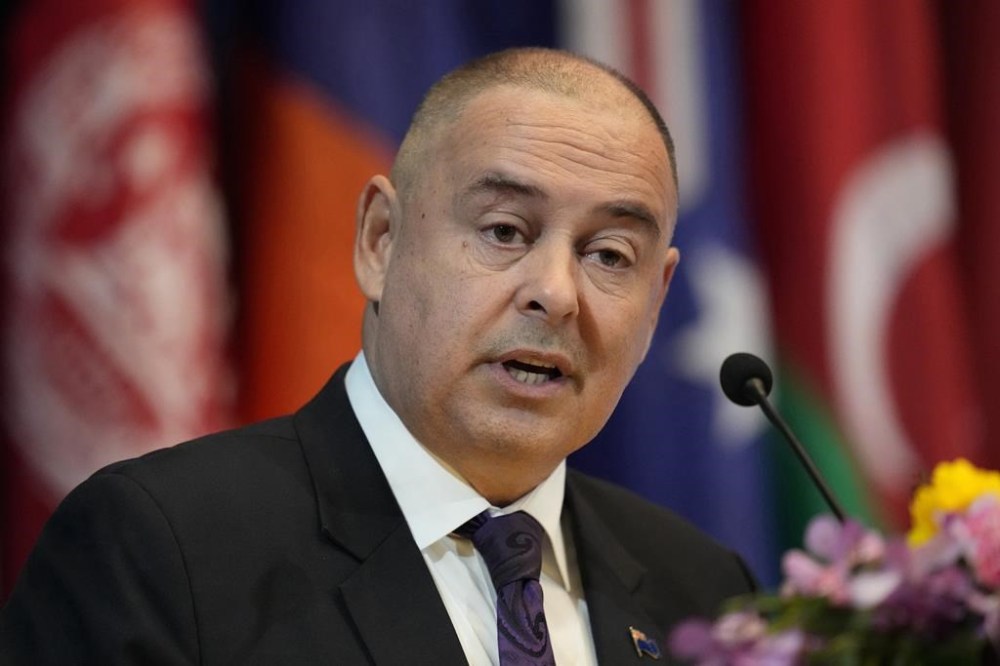
Cook Islands Prime Minister Mark Stephen Brown attends The 79th commission session of the Economic and Social Commission for Asia and the Pacific (ESCAP)at U.N. regional office in Bangkok, Thailand, Monday, May 15, 2023. Pacific Island leaders called at a U.N. climate change conference in Thailand for more efforts by rich countries to combat global warming's environmental impact, especially as their vulnerable countries are just emerging from the economic devastation of the COVID-19 pandemic. (AP Photo/Sakchai Lalit)

He encouraged a shift toward grants or interest-free loans to help ease the financial burden on poorer countries.

“All we’re doing is adding debt to countries that have come out of COVID with increased debt, and to me it is actually quite offensive that we would be required to borrow money to build resilience, and to borrow from the very countries that are causing climate change,” he told The Associated Press.

Brown said his country lost an estimated 41% of its GDP because of the pandemic, “a loss of a decade’s worth of prosperity.”

He said he will give this message to leaders when he represents his tiny South Pacific nation with a population of about 17,000 at a summit later this week of the Group of Seven leading industrialized nations in Japan, where he hopes to be able to speak on a more equal footing to the leaders than as “a grateful recipient” to “benevolent donors.”

Palau President Surangel S. Whipps Jr. agreed that financing opportunities are “few and difficult,” and criticized wealthy countries for failing to commit to provide the financial help they had promised, which he said represents only a tiny portion of their prioritized expenditures such as the military.

“We didn’t cause the problem, but now they’re going to make money off of us by giving us a loan so we can pay back with interest,” he told The Associated Press. “So now you have to adapt, but we’ll give you money and make money off of you by giving you that money to adapt. That doesn’t make sense.”

Whipps said Palau’s economy relies heavily on tourism, which is greatly threatened by the impact of climate change. The country’s economic security is also a major issue in Palau’s negotiations with the U.S. on the “Compacts of Free Association,” a broader agreement that will govern its relations with Washington for the next two decades. Those ties grant the U.S. unique military and other security rights in the islands in return for substantial aid.
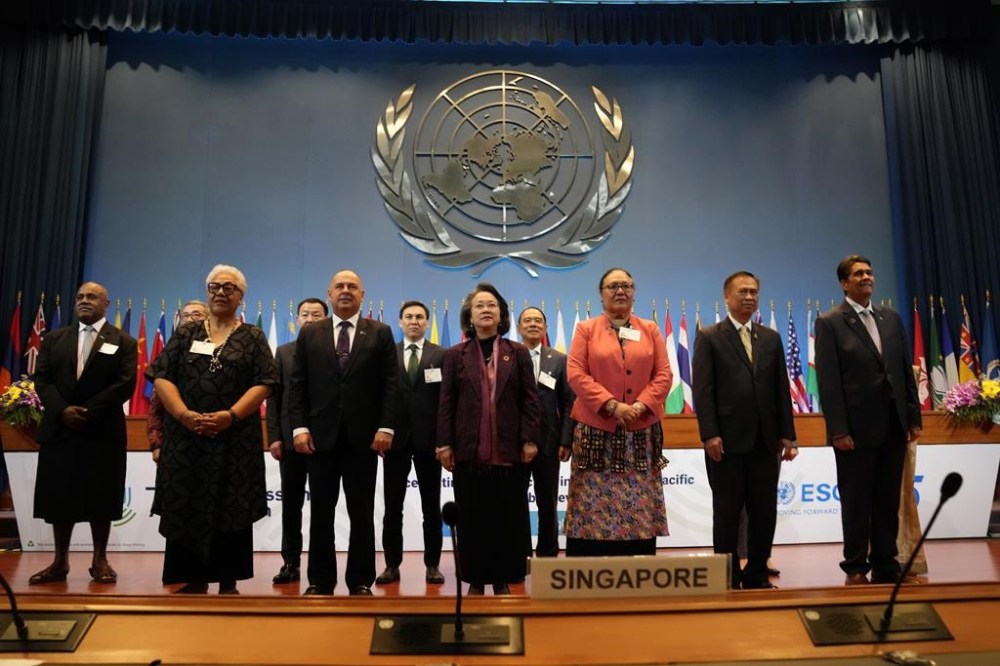
Front row from left, Samoa Prime Minister Fiame Naomi Mata'afa, Cook Islands Prime Minister Mark Stephen Brown, Under-Secretary-General of the United Nations and Executive Secretary of ESCAP Armida Salsiah Alisjahbana, Tonga Minister for Foreign Affairs and Minister for Tourism Fekitamoeloa Katoa 'Utoikamanu, Thailand Vice Minister for Foreign Affairs Vijavat Isarahakdi, Palau President Strangle S. Whipps Jr.. Second row from left, Republic of Fiji Assistant Minister office of the Prime Minister Sakiusa Tubuna, Embassy of Indonesia to Thailand Rachmat Budiman, Mongolia Head of human right Division Ankhbayar Nyamdorj, Kazakhstan vice minister of digital development, innovation and aerospace industry Askar Zhambakin, Cambodia Senior Minister & First Vice President, Cambodian Mine Action & Victim Assistance Authority Ly Thuch pose for group photo The 79th commission session of the Economic and Social Commission for Asia and the Pacific (ESCAP) at U.N. regional office in Bangkok, Thailand, Monday, May 15, 2023. Pacific Island leaders called at a U.N. climate change conference in Thailand for more efforts by rich countries to combat global warming environmental impact, especially as their vulnerable countries are just emerging from the economic devastation of the COVID-19 pandemic. (AP Photo/Sakchai Lalit)

Whipps said the administration of President Joe Biden has promised approximately $900 million over the 20-year period. While the amount is “definitely less” than what his country would have wanted, Whipps said he is largely satisfied with the terms, renegotiated from what was achieved during the administration of former President Donald Trump.

While there are some concerns that the U.S. Congress will cut foreign aid and in turn affect this funding, Whipps said he expects Washington will honor the agreement, which he hopes can be signed by both sides in Papua New Guinea next week.

Brown said efforts to tackle climate change and build resilience to its impact, such as better infrastructure and greater water and food security, require lots of money, especially for island nations with small populations. He said $1.2 billion a year for the region to spend on climate adaptation and mitigation measures would be “a starter.”

“The fact remains that the underlying solution to assist countries that are facing the impacts of climate change is to build resilience, and building resilience takes money,” he said.

Report Error Submit a Tip

More Stories

A 22-year-old man is dead and an 18-year-old is in hospital in critical condition after a two-vehicle crash on Highway 8 on Thursday evening.

A Gimli RCMP officer was driving north on the highway, near Riverton, when he witnessed the collision at about 6:45 p.m.

A vehicle headed north had passed the Mountie at a high speed before colliding with an SUV that was turning west onto Provincial Road 329 from Highway 8.

The driver of the first vehicle, an 18-year-old man from Arborg, was rushed to hospital by a helicopter ambulance with injuries RCMP describe as serious and life-threatening.

Gordon Bell rings in a century

Maggie Macintosh 13 minute read Preview

Gordon Bell rings in a century

Maggie Macintosh 13 minute read Updated: Yesterday at 8:06 PM CDT

Mischka Valencia had gotten used to the hum of heavy machinery at Gordon Bell High School.

“Ever since I’ve been here, it’s all been under construction,” the Grade 12 student said, standing on the sidelines of the brightly painted revamped outdoor basketball court. “I had no idea this was a court.”

The Filipina teenager landed in Winnipeg several months after the inner-city campus had transformed into a construction site.

It was the fall of 2023 and Mischka’s priorities were fitting in, befriending classmates and learning a third language via first-period French.

Read
Updated: Yesterday at 8:06 PM CDT

International flavour: Canadian investors may want to make like Ottawa, diversify beyond U.S.

Joel Schlesinger 6 minute read Preview

International flavour: Canadian investors may want to make like Ottawa, diversify beyond U.S.

Joel Schlesinger 6 minute read 2:01 AM CDT

Canada is learning the hard way about the dangers of putting too many eggs in its U.S. economic basket.

Much has been made about the need to diversify our economy away from the United States.

Diversification is understandably beneficial. The more varied streams of revenue a nation has, the less affected the economy will be when one of those sources is interrupted.

The same can be said about investment portfolios.

Read
2:01 AM CDT

Sisters relieved hospital takes accountability after mother’s death

Scott Billeck 5 minute read Preview

Sisters relieved hospital takes accountability after mother’s death

Scott Billeck 5 minute read Thursday, Oct. 1, 2026

Eight months after losing their mother, two Winnipeg sisters say an internal hospital review has finally given them something they had been seeking since her death: accountability.

Chelsea Mann and Samantha Burns said St. Boniface Hospital officials acknowledged mistakes were made in the care of their mother, Judy Burns, during a recent meeting to discuss the findings of a critical incident review into her death.

The acknowledgement marked a significant departure from an earlier meeting with hospital officials, when they felt their concerns were largely dismissed.

Burns, 68, died on Jan. 21, three days after being admitted, after experiencing rectal bleeding.

Read
Thursday, Oct. 1, 2026

Confidence vote was gamble for MLA, Tories: political expert

Alex Lambert 5 minute read Preview

Confidence vote was gamble for MLA, Tories: political expert

Alex Lambert 5 minute read Thursday, Oct. 1, 2026

BRANDON — A Progressive Conservative MLA’s decision to put forward a confidence motion against the party’s former leader carries a lot of risk for her and the Tories, a political science expert says.

Obby Khan resigned as leader of the PCs on Monday after Jodie Byram (Agassiz) initiated a confidence vote against him the previous week.

The majority of the PC caucus voted in favour of Khan, but he resigned a few days later, citing continued efforts to undermine him by a minority of MLAs.

Brandon University political science Prof. Kelly Saunders said while she doesn’t know what Byram’s motivations were for triggering the vote, such a move carries a lot of risk.

Read
Thursday, Oct. 1, 2026

Puzzles Palace

1 minute read Monday, Jul. 27, 2026

To solve our puzzles, please subscribe with this special offer: |