Hot and dry conditions persist as wildfires rage through Western Canada

Advertisement

Advertise with us

Hot and dry conditions have worsened wildfires throughout Western Canada, forcing thousands from their homes and leaving many regions under a layer of smoke.

Read this article for free:


or

Already have an account? Log in here »

To continue reading, please subscribe:

Subscribe and receive a limited-edition Free Press branded hat or tote.

Digital Subscription

One year of digital access for only $205*

  • Enjoy unlimited reading on winnipegfreepress.com
  • Read the E-Edition, our digital replica newspaper
  • Access News Break, our award-winning app
  • Play interactive puzzles

*First annual payment billed as $205.00 + GST for one year. This annual subscription will automatically renew at $233.00 + GST every 52 weeks (10% off the regular annual price of $259.35). Offer available to new and qualified returning subscribers only. Cancel any time.

To continue reading, please subscribe:

Add Free Press access to your Brandon Sun subscription for only an additional

$1 for the first 4 weeks*

  • Enjoy unlimited reading on winnipegfreepress.com
  • Read the E-Edition, our digital replica newspaper
  • Access News Break, our award-winning app
  • Play interactive puzzles
Start now

*Your next Brandon Sun subscription payment will increase by $1.00 and you will be charged $17.95 plus GST for four weeks. After four weeks, your payment will increase to $24.95 plus GST every four weeks.

Hey there, time traveller!
This article was published 16/05/2023 (1237 days ago), so information in it may no longer be current.

Hot and dry conditions have worsened wildfires throughout Western Canada, forcing thousands from their homes and leaving many regions under a layer of smoke.

“Prayers are needed for rain,” Chief Wilfred Hooka-Nooza of Dene Tha First Nation in northwestern Alberta said Tuesday.

Hundreds of people were forced earlier this week to flee Chateh, a community that is part of the First Nation, as a blaze approached.

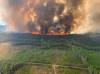
Hot and dry conditions are expected to continue as wildfires throughout western Canada have forced thousands of evacuations and air quality warnings due to smoke as far east as northern Ontario.The Bald Mountain Wildfire is shown in the Grande Prairie Forest Area on Friday May 12, 2023 this handout image provided by the Government of Alberta. THE CANADIAN PRESS/HO-Government of Alberta Fire Service **MANDATORY CREDIT **

Hooka-Nooza said the fire crept within 13 kilometres of the community and workers were using bulldozers to build a fireguard to keep flames at bay.

“The wind is in our favour at the moment, blowing in a different direction, but it could change,” the chief said.

Roughly 2,500 people were fighting fires throughout Alberta, and 24 of 86 active wildfires were considered out of control as of Tuesday afternoon.

An email was sent to all Government of Alberta employees Tuesday asking anyone with firefighting experience to volunteer. Sixty additional firefighters from Ontario also arrived in the province.

“We are pulling out all the stops that we can to try and get as many experienced people on the front line that we can,” said Forestry Minister Todd Loewen.

More than 19,470 people have been forced out of their homes, with Swan Hills, northeast of Edmonton, the latest community to order an evacuation Tuesday.

An evacuation order for Drayton Valley, where some people lost their homes as a wildfire tore through nearly two weeks ago, was partially lifted.

Wildfires have also been a concern for Alberta’s neighbours, including the Northwest Territories, where the K’atl’odeeche First Nation and town of Hay River, about 120 kilometres from the Alberta boundary, are under evacuation orders. Changing winds allowed firefighters to reach more of that blaze on Tuesday, but it’s still out of control.

A convoy of vehicles was allowed to leave a northern Saskatchewan village Tuesday after Buffalo Narrows issued a mandatory evacuation order. Mayor Sandy Ericson posted on social media that poor air quality due to smoke and the loss of electricity made it unsafe to stay.

Roy Cheecham drove along the highway near Buffalo Narrows around midnight and saw a forest of flames along the side of the road. Along the drive he saw flashes of fire burst into the smoky air from trees that had been engulfed.

“It’s devastating,” Cheecham said in a message online. “All that ground lost. All those affected. It’s not a good situation.”

The power outage means a lot of people didn’t have a way to cook indoors and there were food shortages at retailers in and around the community, he said. Those lucky enough to have generators are using them to try to stop food from spoiling.

There were 28 wildfires burning in Saskatchewan on Tuesday.

The weather has not been co-operative in battling blazes in northern British Columbia, and officials there said an ongoing heat wave is increasing the fire risk further south.

“We are going to see challenging conditions today and for the next number of days,” said Cliff Chapman, director of wildfire operations.

The city of Fort St. John, about 200 kilometres northwest of Grand Prairie, Alta., issued an evacuation alert for its roughly 21,000 residents in response to a wildfire that’s more than 130 square kilometres in size. Chapman said winds were pushing flames away from the community Tuesday.

There were 63 wildfires burning across the province. More than 500 square kilometres have burned already this year in British Columbia, Chapman added, which is higher than the 10-year average of 110 square kilometres.

“We are challenged with the fire behaviour and the conditions that we see,” he said.

An unusual May heat wave has spurred rising wildfire risk across the West as dozens of heat records were set or tied in B.C. and Alberta.

Environment Canada issued air quality statements stretching from the B.C. coast to Manitoba.

Wildfire smoke descended on Calgary with the sun appearing a vibrant red through the orange-tinged haze Tuesday morning. Environment Canada said people should take precautions.

Hooka-Nooza said the heat has been unprecedented and early this season, leaving the land in his region very dry.

“I have never seen that before way back then, in the years I used to do wildfire fighting,” the chief said.

“I have never seen something this early into the spring.”

This report by The Canadian Press was first published May 16, 2023.

— With files from Chuck Chiang in Vancouver, Colette Derworiz in Calgary and Emily Blake in Yellowknife.

Report Error Submit a Tip

More Stories

Winnipeggers witness unveiling of Japanese Canadian monument in B.C.

Morgan Modjeski 6 minute read Preview

Winnipeggers witness unveiling of Japanese Canadian monument in B.C.

Morgan Modjeski 6 minute read Yesterday at 8:39 PM CDT

As Miki Stewart gathered with her family at the Japanese Cultural Association of Manitoba on Saturday afternoon, she was thinking of her parents, Yoshimaru and Yoshi Abe.

Both Stewart, 80, and her sister Yumi Falk, 81, alongside an older brother, were born in the Tashme internment camp in British Columbia. They were among more than 2,600 Japanese Canadians who were forcefully removed and interred at the camp following the bombing of Pearl Harbour and Canada’s declaration of war on Japan in 1941.

“They didn’t talk much about how they suffered,” Stewart said of her parents. “But they did.”

She was amongst a group of more than 150 people who gathered at the association’s McPhillips headquarters on Saturday afternoon to watch the unveiling of the Japanese Canadian Monument in Victoria B.C.

Read
Yesterday at 8:39 PM CDT

Blown lead spoils Jets opener

Mike McIntyre 7 minute read Preview

Blown lead spoils Jets opener

Mike McIntyre 7 minute read Friday, Oct. 2, 2026

Younger. Faster. Stronger.

They may still be a long ways from a finished product, but it’s safe to say the new-look Winnipeg Jets made a mostly favourable first impression on Friday night in front of a sold-out crowd at Canada Life Centre.

Sure, a 4-3 overtime loss to a hard-nosed Boston Bruins outfit is going to sting a little, especially since the home team was just 98 seconds away from a regulation victory.

But if the Jets can bottle up this kind of energy and effort, they should enjoy plenty of success over the course of the 84-game campaign.

Read
Friday, Oct. 2, 2026

Broadening prediction-market gambling a bad idea

Editorial 4 minute read Preview

Broadening prediction-market gambling a bad idea

Editorial 4 minute read Yesterday at 2:01 AM CDT

Let’s make a prediction: sooner or later, when Canadian governments find a way to take their own cut of the action, prediction-contract gambling on everything from sports to entertainment to political decisions is going to come to Canada.

And that’s a horrible, dangerous, pernicious idea.

Unless you have particular access to information — either inside information or strategic information based on skills or education — you’re not likely to make money at it. In fact, structurally, you’re likely to lose. In prediction markets, you basically pay an amount, plus fees from the company involved, to bet on whether something will or will not happen within a certain time frame. The amount you pay for your contract depends on how other people are also betting.

As Wealthsimple describes it, “You buy whichever side you think is right. Prices move with demand, so if the market leans towards one outcome, the more that side costs. If a lot of people are backing the TSX to finish above 38,000, yes gets more expensive and no gets cheaper.”

Read
Yesterday at 2:01 AM CDT

Six high school hockey programs ceased operations following new Hockey Manitoba policy

Joshua Frey-Sam 7 minute read Preview

Six high school hockey programs ceased operations following new Hockey Manitoba policy

Joshua Frey-Sam 7 minute read Friday, Oct. 2, 2026

She lived the best of both worlds.

For the last three years, the 17-year-old wore a sweater for two different hockey programs — her high school team and AAA club in the Manitoba Female Hockey League — and was preparing to flourish in both colours again this winter.

Recently, however, the blue-liner was disappointed to learn she is no longer eligible to play her Grade 12 season with her school owing to a new policy imposed by Hockey Manitoba that bans players from participating in the Manitoba Women’s High School Hockey League if they are rostered on a U18 AAA team.

The rule applies to all athletes who play for both Winnipeg-based and rural AAA teams.

Read
Friday, Oct. 2, 2026

May be whiff of truth to ex’s odour ardour

Maureen Scurfield 5 minute read Yesterday at 2:01 AM CDT

DEAR MISS LONELYHEARTS: I ran into an old boyfriend I used to curl on a team with, and we went for drinks. We’ve been almost eight years apart, and I couldn’t remember why we broke up, as we always had such a great time together.

It wasn’t until the second date — this time on a weekend — that it came back to me, with a jolt. Pee-yew! I remembered he doesn’t use deodorant on weekends. Why? He enjoys his own body odour. I recalled that a bit too late, and it was just as awful as ever! I went home early.

Tonight, he called and I refused him another date. I said, “Think back. You remember why we broke up?” Then he said, “Oh yeah, you hated my no-deodorant weekend policy. Well, guess what? Some women don’t mind!” I said I really doubted that, and that ended the conversation. Miss L., wouldn’t any women find stinky underarms offensive?

— Sensitive Nose, Fort Richmond

Wildfires continue to burn across Western Canada

Kelly Geraldine Malone, The Canadian Press 5 minute read Preview

Wildfires continue to burn across Western Canada

Kelly Geraldine Malone, The Canadian Press 5 minute read Tuesday, May. 16, 2023

Hot and dry conditions have worsened wildfires throughout Western Canada, forcing thousands from their homes and leaving many regions under a layer of smoke.

"Prayers are needed for rain," Chief Wilfred Hooka-Nooza of Dene Tha First Nation in northwestern Alberta said Tuesday.

Hundreds of people were forced earlier this week to flee Chateh, a community that is part of the First Nation, as a blaze approached.

Hooka-Nooza said the fire crept within 13 kilometres of the community and workers were using bulldozers to build a fireguard to keep flames at bay.

Read
Tuesday, May. 16, 2023