‘Complacency’ blamed for N.S. struggles with flooding, other climate disasters
Advertisement
Read this article for free:
or
Already have an account? Log in here »
To continue reading, please subscribe:

Digital Subscription
One year of digital access for only $205*
- Enjoy unlimited reading on winnipegfreepress.com
- Read the E-Edition, our digital replica newspaper
- Access News Break, our award-winning app
- Play interactive puzzles
*First annual payment billed as $205.00 + GST for one year. This annual subscription will automatically renew at $233.00 + GST every 52 weeks (10% off the regular annual price of $259.35). Offer available to new and qualified returning subscribers only. Cancel any time.
To continue reading, please subscribe:
Add Free Press access to your Brandon Sun subscription for only an additional
$1 for the first 4 weeks*
- Enjoy unlimited reading on winnipegfreepress.com
- Read the E-Edition, our digital replica newspaper
- Access News Break, our award-winning app
- Play interactive puzzles
*Your next Brandon Sun subscription payment will increase by $1.00 and you will be charged $17.95 plus GST for four weeks. After four weeks, your payment will increase to $24.95 plus GST every four weeks.
Read unlimited articles for free today:
or
Already have an account? Log in here »
Hey there, time traveller!
This article was published 30/07/2023 (1146 days ago), so information in it may no longer be current.
HALIFAX – On the night floodwaters swept through his Nova Scotia county, taking lives and tearing out bridges, Doug Pynch says he had trouble believing an emergency alert that flashed across his phone.
It called for residents to evacuate to a civic centre in Newport, N.S., a community that was already seeing water accumulating in low-lying areas. The retired deputy fire chief said he soon found himself having to transport people in his large truck, as cars couldn’t cross an intersection where water was pooling.
“That alert distracted us from doing other things, rescues that needed to be done. Now we had multiple other situations we had to deal with first,” he said in an interview this week. “I couldn’t allow them to drive through that water.”
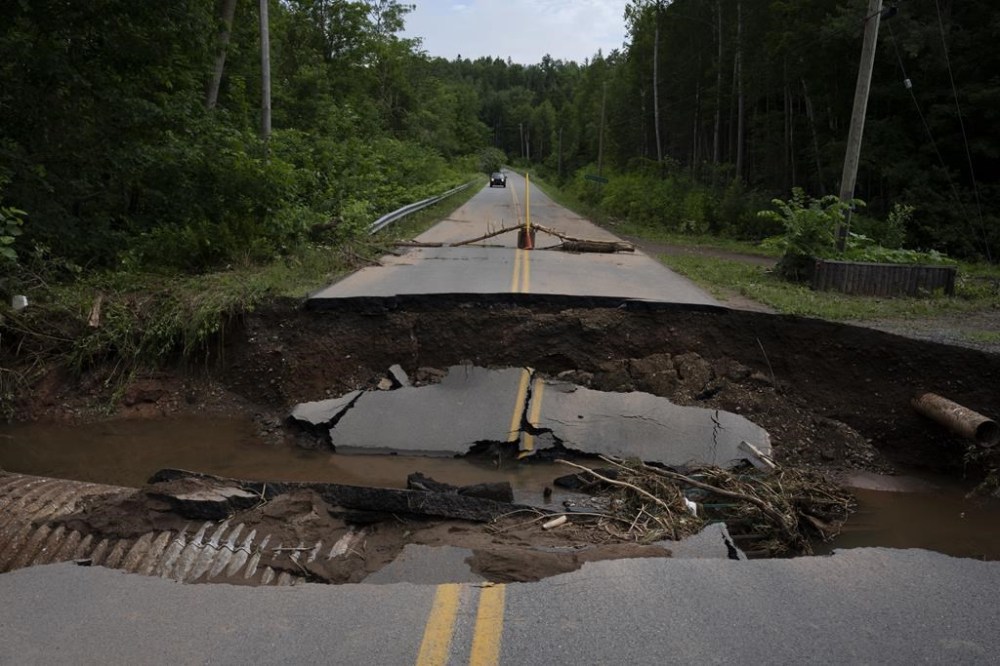
In portions of Halifax and central Nova Scotia, as an estimated 250 millimetres of rain fell last weekend, similar confusion and improvisation was unfolding, in what some experts say is the latest example of the province’s inadequate state of preparation for climate disasters.
The mayor of the Municipality of West Hants has said many residents reported they didn’t receive any emergency alert at all because of the area’s spotty cellular service.
Meanwhile, the managers of the Minas Basin Pulp and Paper Ltd.’s dam system on the St. Croix River said Thursday during a tour that two employees were assigned at about 2 a.m. on July 22 to open spillways to take pressure off a large dam facing massive water pressures about 10 kilometres upstream.
Randy MacMillan, chief executive of Scotia Investments Ltd. — the dam’s owner — told deputy prime minister Chrystia Freeland during her visit that the water coming down was far exceeding Environment Canada forecasts.
“We were told we were getting 40 millimetres of water, but I think we topped out at over 300 millimetres. If you don’t have a forecast you can rely on, you have to take safe steps to keep people safe,” he told the minister.
“It was unexpected …. Had we known we were getting that much water we would have done steps earlier that would have made our lives easier that night and that morning.”
Blair Feltmate, head of the Intact Centre on Climate Adaptation at the University of Waterloo, said in an interview Friday that poor weather forecasts, inadequate cell service and a lack of precise flooding disaster plans show that Nova Scotia remains badly prepared for climate crises — as does the country as a whole.
“There’s a sense of complacency …. We must act with urgency to prepare for climate change and extreme weather risks that are only going to get more challenging,” he said in a telephone interview on Friday.
He said as a basic starting point, rural Nova Scotia communities need adequate cellular service to ensure emergency alerts work. Just as regulators ensure banks have enough money to meet their obligations in the event of a crisis, Feltmate said, the CRTC should ensure telecommunications firms can provide emergency service during climate events.
Feltmate, whose centre has done multiple studies on flooding, also said all provinces should consider creating water conservation authorities to provide detailed knowledge of flood risks and responses, as Ontario has done.
Nova Scotia needs “a system in place to ensure there’s adequate knowledge to issue adequate flood alerts, accurately and in a manner that’s well-timed and in a manner that will allow people to put themselves out of harm’s way,” he said.
Meanwhile, questions remain about why the rainfall forecast was so far off.
Jim Prime, a forecaster for Environment Canada, said in an interview that at about 11 p.m. on July 21, the agency’s forecast for Hants County called for 40 mm “in areas with heaviest rain,” and then “30 mm in areas of heaviest rain” on July 22 . In fact, about 250 mm fell over the two days in the most affected areas.
Prime said a humid, tropical air mass was moving over the region and it encountered a low pressure system, which led to a “very slow-moving system.” He said “all the ingredients came together” for the continuing downpour, which is not usually the case.

Feltmate said he found it concerning that the forecast was so far off the mark. “I’ve never seen it off by that amount …. Usually, it’s in the right zone.”
John Lohr, the province’s minister responsible for the Emergency Management Office, said Thursday that “in the context of what was an extraordinarily confusing situation,” emergency service providers “did an outstanding job.”
“In terms of how the communication centre responded, I’m satisfied we turned those (emergency alert) requests around as quick as we can,” he said. “I think the issue is just responding to what was an entirely unprecedented situation that was not predicted in the weather forecasts either.”
This report by The Canadian Press was first published July 30, 2023.
— With files from Keith Doucette