Growing wildfire risk puts pressure on insurance industry: experts

Advertisement

Advertise with us

TORONTO - Canadian insurers are grappling with the higher risk of wildfires as this year's fire season breaks records, and experts say rising premiums are just one way the industry is seeking to adapt to the changing landscape.

Read this article for free:


or

Already have an account? Log in here »

To continue reading, please subscribe:

Subscribe and receive a limited-edition Free Press branded hat or tote.

Digital Subscription

One year of digital access for only $205*

  • Enjoy unlimited reading on winnipegfreepress.com
  • Read the E-Edition, our digital replica newspaper
  • Access News Break, our award-winning app
  • Play interactive puzzles

*First annual payment billed as $205.00 + GST for one year. This annual subscription will automatically renew at $233.00 + GST every 52 weeks (10% off the regular annual price of $259.35). Offer available to new and qualified returning subscribers only. Cancel any time.

To continue reading, please subscribe:

Add Free Press access to your Brandon Sun subscription for only an additional

$1 for the first 4 weeks*

  • Enjoy unlimited reading on winnipegfreepress.com
  • Read the E-Edition, our digital replica newspaper
  • Access News Break, our award-winning app
  • Play interactive puzzles
Start now

*Your next Brandon Sun subscription payment will increase by $1.00 and you will be charged $17.95 plus GST for four weeks. After four weeks, your payment will increase to $24.95 plus GST every four weeks.

Hey there, time traveller!
This article was published 25/08/2023 (1113 days ago), so information in it may no longer be current.

TORONTO – Canadian insurers are grappling with the higher risk of wildfires as this year’s fire season breaks records, and experts say rising premiums are just one way the industry is seeking to adapt to the changing landscape.

“The more losses, the more of these events, the higher the risk and the higher insurance premiums will trend,” said Craig Stewart, vice-president of climate change and federal issues at the Insurance Bureau of Canada.

Thousands of residents in British Columbia and the Northwest Territories were forced to evacuate their homes in recent weeks as hundreds of wildfires raged on. More than 15 million hectares have been burned so far this year by almost 5,800 fires, according to the Canadian Interagency Forest Fire Centre Inc.
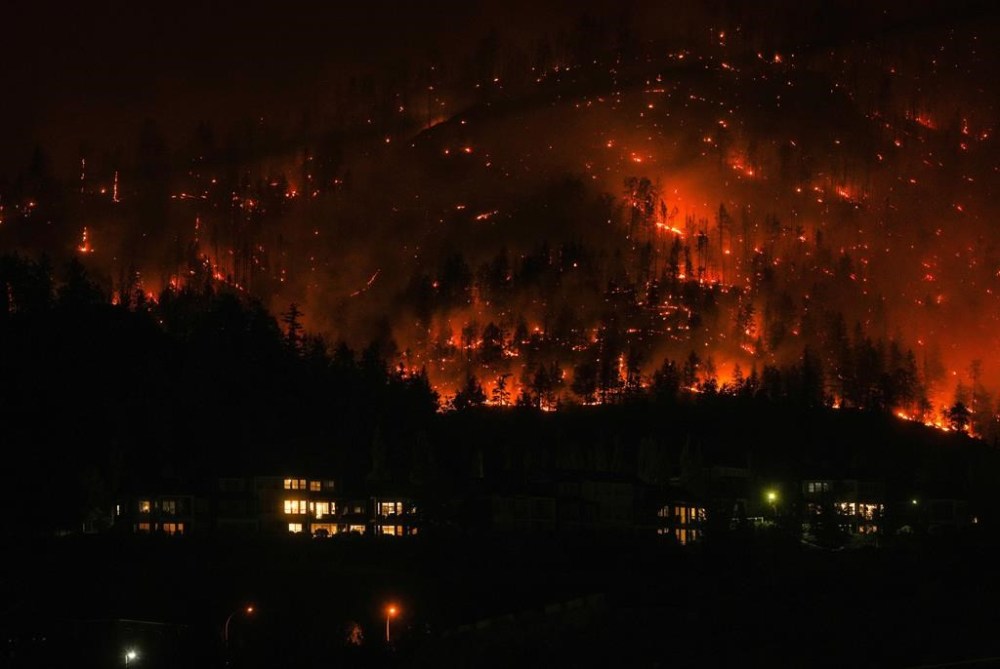
The McDougall Creek wildfire burns on the mountainside above houses in West Kelowna, B.C., on Friday, August 18, 2023. Canadian insurers are grappling with higher risk of wildfires amid a record-breaking season, and experts say rising premiums are just one part of how the industry is seeking to adapt to an ever-changing new normal. THE CANADIAN PRESS/Darryl Dyck

Nadja Dreff and Marcos Alvarez at DBRS Morningstar estimated in a reportthis week that total wildfire-related insured losses in Canada for the third quarter of 2023 will be between $700 million and $1.5 billion, which they called “manageable” for insurers.

“However, the wildfire season is not yet over and there is the potential for any of the fires to intensify and further pressure Q3 2023 results, especially if the fires affect densely populated regions, economic hubs, or key infrastructure. Larger and more frequent weather-related losses will continue to pressure property insurance prices higher in the near term,” they said.

Historically, wildfire damage has been a lot less common than flooding, said Kathryn Bakos, director of climate finance and science at the Intact Centre on Climate Adaptation.

But when it does happen, it tends to be significantly worse on average in terms of damage, she said.

“We’re seeing this right now in Kelowna, with the fires in Northwest Territories. When you have a wildfire event, you have catastrophic loss of the home,” she said.

The 2016 Fort McMurray fire is perhaps the best example of this — while flooding tends to account for a large chunk of losses every year, the Fort McMurray fire is the largest-ever insurance loss in the country, said Bakos, accounting for almost three quarters of total insured losses that year.

“What climate change means in the medium and longer term is more extreme. So you’re going to have more heat, dryness and less rain in the system, as well as more rain and storm surges,” Bakos said.

Annual catastrophic insurable loss claims have risen as a result, she said.

As fire risks rise, insurers are increasingly looking at communities’ fire defences and taking them — or a lack thereof — into consideration for premiums, said Stewart.

No single event drives insurance premiums up, but overall trends do, said Stewart. Insurers price risk, and the risk of major weather events is rising, he said.

Prices have been rising faster in the Western provinces, said Stewart: “Wildfires and floods are driving the premiums higher in the places where we’re seeing these trends now.”

In the U.S., which is seeing similar trends in extreme weather, some companies are deciding that it’s just not worth the risk. Recently some major insurers stopped offering new policies in California and other states amid rising extreme weather trends.

Those U.S. insurers left markets in part because state regulations prevented them from passing on the higher costs of increased risk, noted Stewart, making such a move less likely in Canada.

While Canadian insurers show no signs of exiting markets right now, what’s happening in the U.S. should serve as a warning signal, Bakos said, and an opportunity for companies to look at how to maintain the insurability of Canadian homes.

“We know what to do. We just have to do it,” she said.

Insurers incentivize consumers to decrease their risk of fire in order to save on their policy, said Stewart. They also offer incentives to consumers in communities with certain protections, helping indirectly pressure their communities to take those steps as well.

“Those incentives likely now need to be re-examined and expanded so that homeowners have a greater array of incentives to protect them and to encourage them to retrofit their homes to be more resilient to fire, flood, wind and other perils,” he said.

“The industry is actually taking a hard look at incentives right now in conversation with governments across the country.”

The industry is also looking at how to elevate consumer awareness of risk, said Stewart, adding that more government support is needed for both awareness and incentivization.

“The federal government needs to play much more of a leadership role in wildfire modelling, risk modelling, in providing resources to communities to develop wildfire community action plans, and to design retrofit programs,” he said.

This report by The Canadian Press was first published Aug. 25, 2023.

Report Error Submit a Tip

More Stories

Closure of Nomads field massive upset for North End

Joshua Frey-Sam 4 minute read Preview

Closure of Nomads field massive upset for North End

Joshua Frey-Sam 4 minute read Updated: 8:49 AM CDT

The North Winnipeg Nomads have a flag on the field.

The long-standing minor football club was recently informed that its field is unfit to host games and that it would need to find a new home for its five youth and adult teams until repairs are made to the playing surface.

“Our board has made every effort to address the condition of our home field,” the club wrote in a statement. “Unfortunately, following a professional assessment, the field has been determined to be unsafe and unstable for our athletes.”

All five of the club’s teams will play their 2026 season at Frank Whyte Field, part of the Northwood Community Centre, with no confirmed date for when they can play on their home field again.

Read
Updated: 8:49 AM CDT

Drug use, property crimes worry Winnipeggers most: police poll

Free Press staff 3 minute read Preview

Drug use, property crimes worry Winnipeggers most: police poll

Free Press staff 3 minute read 11:56 AM CDT

Drug use and property crimes are among the most serious problems in Winnipeg neighbourhoods, a new poll says.

The Winnipeg Police Service released the results of its 2026 public opinion survey Friday.

Respondents said officers quickly responding to calls is the most important aspect of policing.

Ninety-three per cent said it was the most important, but just 44 per cent of respondents said the service did an excellent or good job at it in 2026.

Read
11:56 AM CDT

Awareness is the first line of defence

Joseph Borsa 4 minute read Preview

Awareness is the first line of defence

Joseph Borsa 4 minute read Updated: 8:15 AM CDT

September is Prostate Cancer Awareness Month in Canada. This proclamation helps focus public attention on the very important protective role that such awareness can play in reducing the death and suffering associated with this disease.

The underlying reason for that is simple. In its beginning, prostate cancer, as is true for all cancers, starts and grows silently and stealthily, giving no indication through pain or other symptoms of its presence and of the developing pathology. Everything appears normal to the unsuspecting host until the cancer has grown to an extent that it interferes with normal function. There might then be pain, bleeding or some other manifestation of the growing tumour.

Unfortunately, by that time the disease may have reached an advanced stage, which is much more difficult to treat, and less likely to have a favourable outcome. It is a general truth in dealing with all types of cancer that the earlier it is discovered and treated, the better the likelihood of a favourable outcome. Awareness can be a major determinant of whether such early discovery happens or not.

Discovery of the cancer during its period of silent, surreptitious growth creates the opportunity for early treatment. Fortunately, in the case of prostate cancer such detection is favoured by two factors.

Read
Updated: 8:15 AM CDT

‘Dynacare sucks’: premier muses about bringing lab services back into public system

Carol Sanders 5 minute read Preview

‘Dynacare sucks’: premier muses about bringing lab services back into public system

Carol Sanders 5 minute read Wednesday, Sep. 9, 2026

Premier Wab Kinew says Manitoba may bring Dynacare’s diagnostic lab services back into the public system rather than continue to sign contracts with the for-profit company.

“Dynacare sucks. They’ve made an absolute mess of this situation,” the premier said Wednesday, the day the company’s 350 employees reported back to work after the labour board halted their strike after just one day.

Kinew first made the remark about Dynacare in a CBC radio interview Wednesday morning and added he is “not happy with them.”

Dynacare performs the majority of non-emergency blood and urine tests in the province.

Read
Wednesday, Sep. 9, 2026

‘We feel lucky — and a bit traumatized’: Tornado confirmed in River Heights Sunday

Malak Abas 6 minute read Preview

‘We feel lucky — and a bit traumatized’: Tornado confirmed in River Heights Sunday

Malak Abas 6 minute read Updated: Yesterday at 6:10 PM CDT

Tanner Lemieux wasn’t surprised to learn the violent winds that tore through River Heights and reached their peak near his home Sunday night have been classified as a tornado.

While driving back to his Lindsay Street home from a shopping trip with his wife Sunday, it became clear they were not in the middle of an ordinary thunderstorm when rain and wind started coming from every direction and hit every side of their truck.

The forceful wind made it impossible for him to open his door after they had parked. He climbed through the window, over the top of his vehicle, and the couple struggled to fight the whipping winds to make it into the house.

“As we were running in, the wind started pulling me backwards out of the door,” he told the Free Press while cleaning debris from his yard Thursday.

Read
Updated: Yesterday at 6:10 PM CDT

Lone Manitoba 9/11 victim's legacy lives on helping Inuit students become nurses

Melissa Martin 13 minute read Preview

Lone Manitoba 9/11 victim's legacy lives on helping Inuit students become nurses

Melissa Martin 13 minute read Yesterday at 5:24 PM CDT

On the night before the morning that everyone remembers, Ellen Judd spoke to her partner, Christine Egan, several times on the phone. Egan was in New York, where she’d gone to look after her nephews so her beloved brother, Michael, and his wife, Anna, could treat themselves to an anniversary vacation.

Usually, Judd would have been there, too. The couple had been together for more than 15 years, and loved sharing all the good parts of life. But at the time, she was an anthropology professor at the University of Manitoba, and the school year was just starting; she had classes the next day. Staying connected by phone would have to suffice.

In their calls that night, Judd remembers, Egan was happy. Christmas was the main topic. They were planning to spend the holiday with Judd’s family in Ontario, and talked about when to book flights. Egan was looking forward to that visit; Judd’s family “loved her to bits,” the now-retired professor says, and the affection was mutual.

The next day, Egan said, she planned to go into Manhattan with Michael. He was an executive at Aon, a global risk, retirement and health services corporation, and had an office on the 105th floor of the World Trade Centre’s South Tower.

Read
Yesterday at 5:24 PM CDT