As Africa opens a climate summit, poor weather forecasting keeps the continent underprepared

Advertisement

Advertise with us

NAIROBI, Kenya (AP) — Much of the world takes daily weather forecasts for granted. But most of Africa's 1.3 billion people live with little advance knowledge of what’s to come. That can be both deadly and expensive, with damage running in the billions of dollars.

Read this article for free:


or

Already have an account? Log in here »

To continue reading, please subscribe:

Subscribe and receive a limited-edition Free Press branded hat or tote.

Digital Subscription

One year of digital access for only $205*

  • Enjoy unlimited reading on winnipegfreepress.com
  • Read the E-Edition, our digital replica newspaper
  • Access News Break, our award-winning app
  • Play interactive puzzles

*First annual payment billed as $205.00 + GST for one year. This annual subscription will automatically renew at $233.00 + GST every 52 weeks (10% off the regular annual price of $259.35). Offer available to new and qualified returning subscribers only. Cancel any time.

To continue reading, please subscribe:

Add Free Press access to your Brandon Sun subscription for only an additional

$1 for the first 4 weeks*

  • Enjoy unlimited reading on winnipegfreepress.com
  • Read the E-Edition, our digital replica newspaper
  • Access News Break, our award-winning app
  • Play interactive puzzles
Start now

*Your next Brandon Sun subscription payment will increase by $1.00 and you will be charged $17.95 plus GST for four weeks. After four weeks, your payment will increase to $24.95 plus GST every four weeks.

Hey there, time traveller!
This article was published 03/09/2023 (1106 days ago), so information in it may no longer be current.

NAIROBI, Kenya (AP) — Much of the world takes daily weather forecasts for granted. But most of Africa’s 1.3 billion people live with little advance knowledge of what’s to come. That can be both deadly and expensive, with damage running in the billions of dollars.

The first Africa Climate Summit opens Monday in Kenya to highlight the continent that will suffer the most from climate change while contributing to it the least. Significant investment in Africa’s adaptation to climate change, including better forecasting, will be an urgent goal. At the heart of every issue on the agenda, from energy to agriculture, is the lack of data collection that drives decisions as crucial as when to plant — and when to flee.

The African continent is larger than China, India and the United States combined. And yet Africa has just 37 radar facilities for tracking weather, an essential tool along with satellite data and surface monitoring, according to a World Meteorological Organization database.
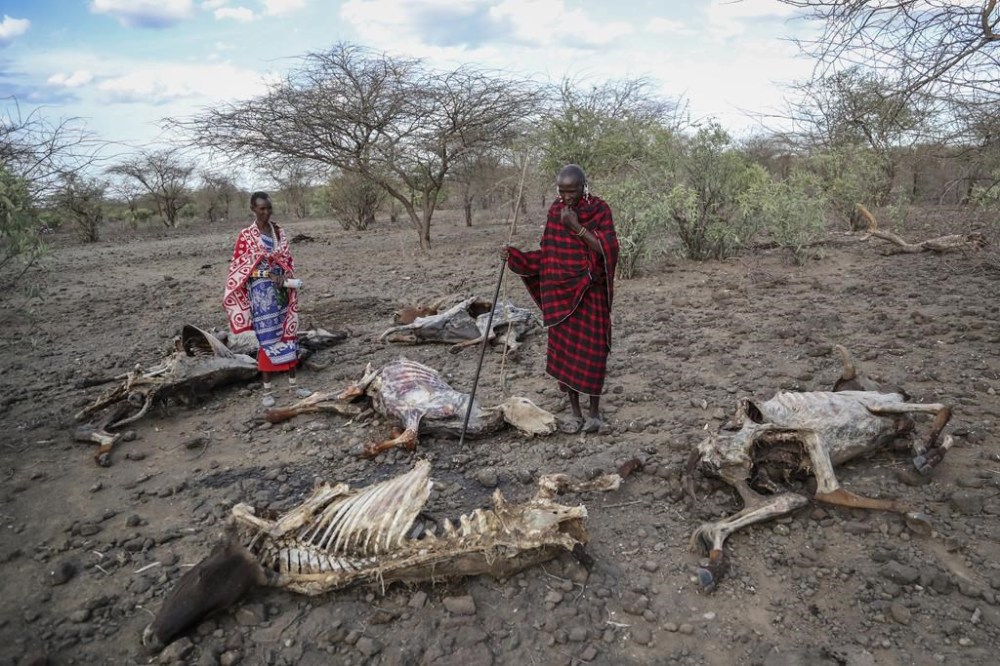
FILE - Saito Ene Ruka, right, who said he has lost 100 cows due to drought, and his neighbor Kesoi Ole Tingoe, left, who said she lost 40 cows, walk past animal carcasses at Ilangeruani village, near Lake Magadi, in Kenya, on Nov. 9, 2022. Much of the world takes daily weather forecasts for granted. But most of Africa's 1.3 billion people live with little advance knowledge of what's to come. That can be deadly, with damage running in the billions of dollars. The first Africa Climate Summit opens this week in Kenya to highlight the continent that will suffer the most from climate change while contributing to it the least. At the heart of every issue on the agenda, from energy to agriculture, is the lack of data collection that drives decisions as basic as when to plant and when to flee . (AP Photo/Brian Inganga, File)

Europe has 345 radar facilities. North America, 291.

“The continent, at large, is in a climate risk blind spot,” said Asaf Tzachor, a researcher at the Center for the Study of Existential Risk at the University of Cambridge. In August, he and colleagues warned in a commentary for the journal Nature that climate change will cost Africa more than $50 billion every year by 2050. By then, Africa’s population is expected to double.

The widespread inability to track and forecast the weather affects key development choices, their commentary said: “There is no point investing in smallholder farms, for example, if floods are simply going to wash them away.”

Kenya, the host of the climate summit, is one of the few countries in Africa seen as having a relatively well-developed weather service, along with South Africa and Morocco. Kenya has allocated about $12 million this year for its meteorological service, according to the national treasury. In contrast, the U.S. National Weather Service budget request for fiscal year 2023 was $1.3 billion.

The vast expanse of the 54-nation African continent is relatively unserved and unwarned.

“Despite covering a fifth of the world’s total land area, Africa has the least developed land-based observation network of all continents, and one that is in a deteriorating state,” the WMO said in 2019.

And because of a lack of funding, the number of observations by atmospheric devices usually used with weather balloons decreased by as much as 50% over Africa between 2015 and 2020, a “particularly serious issue,” the WMO said in a report last year.

Fewer than 20% of sub-Saharan African countries provide reliable weather services, the report said. “Weather stations are so far apart that their data cannot be extrapolated to the local level due to the varying terrain and altitude.”

Now, 13 of the most data-sparse African countries, including Ethiopia, Madagascar and Congo, are getting money to improve weather data collection and sharing from a United Nations-created trust fund, the Systematic Observations Financing Facility. An older funding mechanism with many of the same partners, Climate Risk & Early Warning Systems, has supported modernizing meteorological systems in a half-dozen West and Central African countries.

And it’s not just forecasting. As climate shocks such as Somalia’s worst drought in decades become more common, better recording of weather data is a critical need for decision-making.

“For many people in the West, accurate weather forecasts often make lives more convenient: ‘Shall I take an umbrella along?’ In Africa, where many people depend on rain-fed agriculture, that is all a bit sharper,” said Nick van de Giesen, a professor of water resources management at Delft University of Technology in the Netherlands. “With a changing climate, traditional methods to determine, say, the onset of the rainy season are becoming less reliable. So farmers regularly sow after a few rains, after which rains may fail and seeds will not germinate.”

That can be devastating during the current global food security crisis.

Van de Giesen is the co-director of the Trans-African Hydro-Meteorological Observatory, a project that has helped to set up about 650 low-cost local weather monitoring stations in collaboration with schools and other entities across 20 African countries. Not all of those surface monitoring stations are operational because of issues including threats by extremist groups that limit access for maintenance in areas such as Lake Chad.

“To be clear, TAHMO can never be a replacement of efficient and effective national weather services,” van de Giesen said, adding that many African governments still don’t have the needed resources or funding.

In countries like Somalia and Mozambique, with some of the continent’s longest and most vulnerable coastlines, the lack of effective weather monitoring and early warning systems have contributed to thousands of deaths in disasters such as tropical storms and flooding.

After Cyclone Idai ripped into central Mozambique in 2019, residents told The Associated Press they had received little or no warning from authorities. More than 1,000 people were killed, some swept away by floodwaters as loved ones clung to trees.

Cyclone Idai was the costliest disaster in Africa, at $1.9 billion, in the period from 1970 to 2019, according to a WMO report on weather extremes and their economic and personal tolls.

The lack of weather data in much of Africa also complicates efforts to link certain natural disasters to climate change.

Earlier this year, a collection of climate researchers known as World Weather Attribution said in a report that limited data made it impossible to “confidently evaluate” the role of climate change in flooding that killed hundreds of people in Congo and Rwanda around Lake Kivu in May.

“We urgently need robust climate data and research in this highly vulnerable region,” their report said.

Last year, the researchers expressed similar frustration in a study of erratic rainfall and hunger in West Africa’s Sahel region, citing “large uncertainties” in data.

They urged investments as simple as a network of rain gauges, saying that even small shifts in rainfall can affect millions of people.

___

Associated Press climate and environmental coverage receives support from several private foundations. See more about AP’s climate initiative here. The AP is solely responsible for all content.

Report Error Submit a Tip

More Stories

Bombers exact revenge in Banjo Bowl, lose Collaros to injury

Taylor Allen 6 minute read Preview

Bombers exact revenge in Banjo Bowl, lose Collaros to injury

Taylor Allen 6 minute read Yesterday at 9:20 PM CDT

Redha Kramdi downplayed the significance of his return for the Winnipeg Blue Bombers.

“I don’t think I have that big of an impact,” said Kramdi on Tuesday, who watched the club go 2-4 while he was sidelined with a cast on his left hand.

It sounded silly at the time, and it’s even sillier now considering how exceptional the 29-year-old safety from Montreal was in Saturday’s 22nd edition of the Banjo Bowl.

Kramdi caused two turnovers — a forced fumble and an interception — to lead the Bombers to a 19-6 victory over the Saskatchewan Roughriders in front of a sell-out crowd at Princess Auto Stadium.

Read
Yesterday at 9:20 PM CDT

News briefs for Sunday, September 13, 2026

1 minute read Updated: 9:47 AM CDT

A collection of breaking news briefs filed on Sunday, September 13, 2026

Suspect arrested two months after bear spray, air rifle incident at Henderson Hwy. hotel

9:47 AM

A man has been arrested and remains in police custody after being charged with spraying bear spray inside a Henderson Highway hotel in early July. The suspect is also accused of  pointing a gun, chasing people and making violent threats in the hotel's parking lot after a dispute over a VLT ticket at the licensed establishment in the 1000 block of Henderson Highway.

Pokemon thieves clear out collectibles shop

Scott Billeck 5 minute read Preview

Pokemon thieves clear out collectibles shop

Scott Billeck 5 minute read Friday, Sep. 11, 2026

Terri Settle loved watching children walk into her collectibles shop to hunt for their favourite Pokemon cards.

After the latest break in stripped her shelves of much of the inventory, she’s not sure she’ll get to see it again.

Thieves broke into Terri’s Trinkets and Toys on Tuesday evening, punching through a grate and then the store’s bathroom wall to reach the storefront.

They made off with about $6,000 worth of merchandise, including all of the store’s Pokemon cards — about 7,000 of them — along with toys, Lego, jewelry, video games, a debit machine and personal laptop. They even took her vacuum cleaner.

Read
Friday, Sep. 11, 2026

Retired sportscaster Scott Oake determined as fundraising for women's addictions treatment facility enters home stretch

Melissa Martin 4 minute read Preview

Retired sportscaster Scott Oake determined as fundraising for women's addictions treatment facility enters home stretch

Melissa Martin 4 minute read Thursday, Sep. 10, 2026

For now, the patch of land just east of the Victoria Hospital doesn’t look like much: just a field of rocks, mounded dirt, and concrete piles driven into the earth. Yet when Scott Oake looks over the site, he can already imagine how it will look in just over a year’s time, when the new Anne Oake Family Recovery Centre is expected to open.

It’s easier to picture this time around. In 2020, when the recently-retired CBC sportscaster and his late wife, Anne, were building their first labour of intermingled grief and love, the Bruce Oake Recovery Centre for men, it was hard for him to wrap his mind around how a raw construction site could transform into a welcoming addictions treatment facility.

When that centre opened in 2021, Oake found it looked “almost identical” to the architect’s renderings. So it’s easy to hope the Anne Oake Centre will be the same. It will be the first facility of its kind, its founders believe, not only in Canada but in North America: a place where 50 to 70 women can pursue sobriety while staying with their children.

“At Bruce Oake there’s a culture of love, and most of all a culture of hope,” Oake said, speaking at the site Thursday after a media conference to announce the final push of the centre’s fundraising campaign. “I can feel it every time I walk into that building. And I know it will be the same here.”

Read
Thursday, Sep. 10, 2026

Downtown no place to be after dark, huge majority of Winnipeggers say in survey

Joyanne Pursaga 8 minute read Preview

Downtown no place to be after dark, huge majority of Winnipeggers say in survey

Joyanne Pursaga 8 minute read Friday, Sep. 11, 2026

Most Winnipeggers are afraid to walk alone downtown and believe the city needs more police officers, a new survey finds.

Winnipeg Police Service released its 2026 citizen survey Friday.

Downtown safety appears to remain a major concern, with just 44 per cent saying they feel very or reasonably safe walking alone in the area during the day. The number plummets to eight per cent overall at night, down from nine per cent in 2024, the last time the survey was conducted.

This year, 14 per cent of men felt very or reasonably safe walking alone downtown at night, compared to just three per cent of women.

Read
Friday, Sep. 11, 2026

The port of Churchill — but done right

Editorial 4 minute read Preview

The port of Churchill — but done right

Editorial 4 minute read Yesterday at 2:00 AM CDT

The seagoing grain carrier wasn’t christened with a champagne bottle. There was no confetti or streamers. Nevertheless, the Aug. 31 event marking the first shipment of grain to be loaded at the Port of Churchill since 2020 was celebrated like the launch of a brand new vessel.

The presence of the federal minister of northern and arctic affairs, provincial cabinet ministers and leaders and elders from several northern First Nations signalled that the fast-tracked process of refurbishing and buffing up Manitoba’s deep-water seaport gem is gaining momentum.

For OneNorth, the partnership of 29 First Nations and 12 northern communities which owns the Port of Churchill and the Hudson Bay Railway (both operated by the Arctic Gateway Group) the event heralded a new beginning. It’s been eight years since OneNorth purchased the port and railroad, and six years since grain was moved by rail through Manitoba and then by ship to European markets. Two more grain shipments, plus shipments of potash and critical minerals, will continue through the fall.

When Prime Minister Mark Carney solicited the premiers to suggest “nation-building” projects following his election in 2025, Premier Wab Kinew pitched a Manitoba trade corridor that would move wheat, critical minerals, potash and energy (oil or liquid natural gas) through the Port of Churchill.

Read
Yesterday at 2:00 AM CDT