Loss of bison herds still affecting Plains First Nations, research suggests

Advertisement

Advertise with us

The collapse of the teeming bison herds that once blackened the prairie was an economic catastrophe that still affects those who once depended on them, new research suggests.

Read this article for free:


or

Already have an account? Log in here »

To continue reading, please subscribe:

Subscribe and receive a limited-edition Free Press branded hat or tote.

Digital Subscription

One year of digital access for only $205*

  • Enjoy unlimited reading on winnipegfreepress.com
  • Read the E-Edition, our digital replica newspaper
  • Access News Break, our award-winning app
  • Play interactive puzzles

*First annual payment billed as $205.00 + GST for one year. This annual subscription will automatically renew at $233.00 + GST every 52 weeks (10% off the regular annual price of $259.35). Offer available to new and qualified returning subscribers only. Cancel any time.

To continue reading, please subscribe:

Add Free Press access to your Brandon Sun subscription for only an additional

$1 for the first 4 weeks*

  • Enjoy unlimited reading on winnipegfreepress.com
  • Read the E-Edition, our digital replica newspaper
  • Access News Break, our award-winning app
  • Play interactive puzzles
Start now

*Your next Brandon Sun subscription payment will increase by $1.00 and you will be charged $17.95 plus GST for four weeks. After four weeks, your payment will increase to $24.95 plus GST every four weeks.

Hey there, time traveller!
This article was published 16/09/2023 (1101 days ago), so information in it may no longer be current.

The collapse of the teeming bison herds that once blackened the prairie was an economic catastrophe that still affects those who once depended on them, new research suggests.

“Economic opportunity is determined in part by history,” said Donn Feir, an economic historian at the University of Victoria and one of three authors of a recently published paper on the lingering economic impact of that near-extinction.

“When you look at the landscape of economic development and Indigenous economic growth in Canada and the U.S., you have to keep in mind that history is still very much with us.”
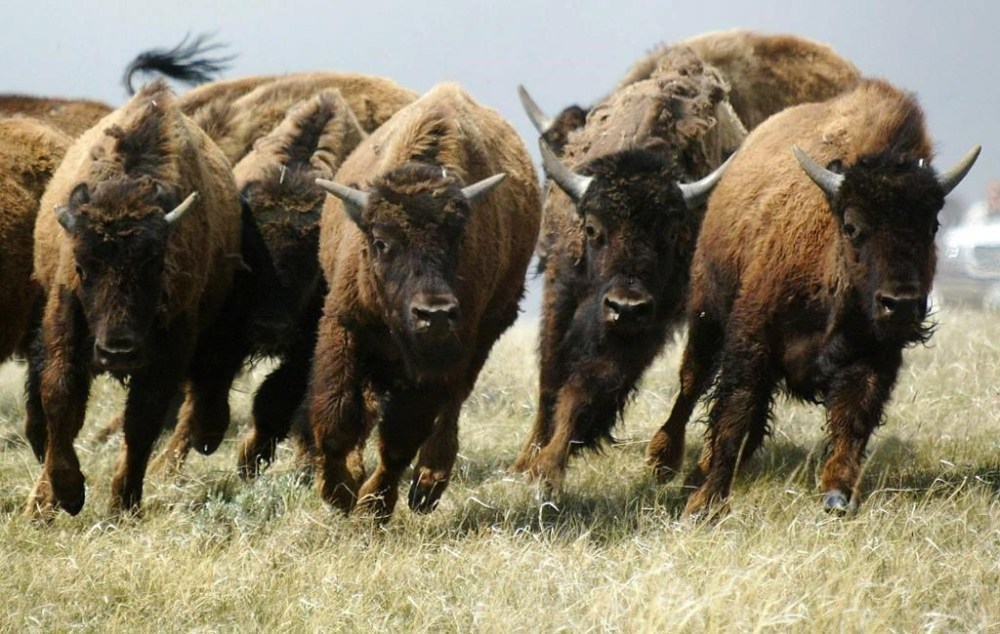
Purebred plains bison run through the prairie grasses near Eastend, Sask., Monday, May 16, 2004. The collapse of the teeming bison herds that once blackened the prairie was an economic catastrophe that still affects those who once depended on them, new research suggests. THE CANADIAN PRESS/Jeff McIntosh

Feir and her colleagues used data collected by long-ago government agents and anthropologists to compare how the loss of the bison affected First Nations that depended on them with those that didn’t. They conclude that loss, together with reduced access to institutions such as banks, marked those nations physically and economically.

“Those historical injustices are being perpetuated today through poverty traps,” said Feir, whose paper is published in Oxford University Press’ Review of Economic Studies.

Tasha Hubbard, a filmmaker and native studies scholar at the University of Alberta, said the paper’s conclusions are valid — as far they go.

“This is part of it,” she said. “(Loss of bison) was a hugely negative impact on Indigenous people.”

But she cautioned that ongoing loss has to be seen in a larger context. To Plains First Nations, bison were a cultural as well as an economic resource and their loss went beyond property and jobs and incomes.

“Yes, economy,” Hubbard said. “But also wellness.”

As many as eight million bison roamed the plains in the mid-19th century. Plains First Nations depended on them for food, clothing, trade goods, homes and tools.

Bison made them rich. Anthropologists say their living standards and lifespans were comparable to contemporary Europeans.

But by the turn of the century, all but about 500 bison had been slaughtered — a collapse that happened in some regions within a decade.

To examine the effect of that collapse, the authors looked at data collected between 1889 and 1903 from about 9,000 Indigenous people across the continent. They found bison-dependent nations lost, on average, more than two centimetres in height — a commonly used proxy for measuring poverty, Feir said.

Other sources reveal that in the early 20th century, infant mortality was higher among formerly bison-dependent nations. A U.S. survey from 1900 found men in those nations were 19 percentage points less likely to have an occupation.

People lost the bison around the same time they were being moved onto difficult-to-leave reservations. As well, those bison-dependent nations had relatively fewer nearby banks than other nations, Feir said.

“Imagine all oil and gas evaporated from North America and you told everyone who lived in Houston (Texas) that they had to stay in Houston and couldn’t borrow any capital from banks and then said, ‘Now feed yourself.'”

The result, said Feir, would be massive job loss, drops in production and external trade, lack of capital for people to retrain or launch new ventures and an end to people moving in with new ideas and resources.

“Because there was this large economic shock and you restricted the ability of people to adjust to this shock, you end in a poverty trap.”

That trap persisted over the decades, Feir argues.

American data suggests the bison-dependent nations lagged behind other First Nations in manufacturing and employment industries. In-migration was lower until the 1980s. That data suggests economic hardship persists, with per capita income 25 per cent lower for bison-dependent nations than other First Nations.

Although the paper relies heavily on U.S. data, Feir said the same patterns apply in Canada. Earlier working versions of the paper included more Canadian sources and similar threads emerged.

“We did see very similar impacts,” she said.

Still, Hubbard warns, that’s not the whole story. Bison were a big part of how Plains First Nations related to the world and the herds underpinned much more than getting and spending.

“Wealth is not accumulation,” Hubbard said. “Wealth is overall well-being and there’s a need to think expansively about what Indigenous economies mean.”

The authors used statistical techniques to adjust for the impacts of factors such as where reservations were located, local self-governance, railways or European settlement. The dominant factor in the economic history of bison-dependent nations remained the loss of their primary resource and the restrictions placed on their ability to cope.

“No one set of regressions or data findings is definitive,” said Feir.

“But I’m convinced that bison and its loss and the restrictions on mobility and access to capital is what drives this persistent difference.”

This report by The Canadian Press was first published Sept. 16, 2023.

Report Error Submit a Tip

More Stories

Botterill’s memoir Why Not You is sure to inspire future rosters in women’s sports

Grace Anne Paizen 8 minute read Preview

Botterill’s memoir Why Not You is sure to inspire future rosters in women’s sports

Grace Anne Paizen 8 minute read Yesterday at 5:36 PM CDT

Decorated Olympian. Hard-hitting hockey analyst. Inspiring author. Winnipeg’s own Jennifer Botterill is adding yet another chapter in her historic and storied career.

Botterill’s autobiography Why Not You: My Story of Perseverance, Hockey, and Olympic Gold, that hits the shelves Sept. 22, takes a step-by-step look back at the former forward’s many sports lives — from her days as a ringette player growing up in Winnipeg in the 1980s, to her Olympic debut as a fresh-faced 18-year-old at the 1998 Nagano Games, to her burgeoning career as a hockey analyst as part of the beloved Hockey Night in Canada broadcast crew.

And wrapping up her long resumé was something she already had in the works before she was inducted into the Canadian Hockey Hall of Fame last November.

“It was just nice timing on how it all worked out,” Botterill told the Free Press last week.

Read
Yesterday at 5:36 PM CDT

Hellebuyck standoff caused by… Nathan MacKinnon?

Mike McIntyre 6 minute read Preview

Hellebuyck standoff caused by… Nathan MacKinnon?

Mike McIntyre 6 minute read Friday, Sep. 18, 2026

Looking for someone to blame in the Connor Hellebuyck fiasco and cast as public enemy No. 1? How about long-time Winnipeg Jets nemesis Nathan MacKinnon?

Allow us to explain as we fire up the time machine and head back to February in Italy.

Oh, what could have been if MacKinnon had been able to score on what appeared to be an open net late in the third period of the men’s gold medal game with Hellebuyck down and seemingly out of position.

Instead, the star forward fired wide, keeping the score deadlocked at 1-1 as the clock ticked down on regulation.

Read
Friday, Sep. 18, 2026

U.S. expats in city prepare to cast their ballots

Nicole Buffie 4 minute read Preview

U.S. expats in city prepare to cast their ballots

Nicole Buffie 4 minute read 6:00 AM CDT

American expats are making their voices heard from north of the border for the upcoming U.S. midterm elections.

Jean Dunmire sported a button emblazoned with the word “VOTE” and an American and Canadian flag as she walked out of the Bill and Helen Norrie Library Sunday afternoon. She had just registered to vote in the midterms from afar for the first time.

“I think it’s really important this time around because a lot of the senators and representatives in the House of Representatives are being reelected and I definitely want to see some changes. Things have gone way off the rails with (U.S. President Donald) Trump and he’s just destroying the country,” Dunmire said.

The 76-year-old moved to Lethbridge, Alta., from California in 1969 before settling in Manitoba in 1973. She’s voted in the last two presidential elections but felt it important to cast a ballot in the midterms owing to ongoing conflict in her home country.

Read
6:00 AM CDT

‘We’re small, but we’re strong and mighty’: Lögberg-Heimskringla newspaper celebrates 140 years in Manitoba

Aaron Epp 6 minute read Preview

‘We’re small, but we’re strong and mighty’: Lögberg-Heimskringla newspaper celebrates 140 years in Manitoba

Aaron Epp 6 minute read 6:00 AM CDT

A “friend” of the Icelandic community is now 140 years old.

Lögberg-Heimskringla, a Winnipeg-based newspaper that serves the Icelandic diaspora throughout North America, has published continuously for nearly a century-and-a-half. Staff and supporters celebrated the anniversary Saturday afternoon during a gathering at the Scandinavian Cultural Centre.

“Whatever else it may be, Lögberg-Heimskringla is a friend in print — a familiar cultural institution that has enriched our lives and understanding, informing us and entertaining us at the same time,” editor Stefan Jonasson wrote in the paper’s anniversary issue, published on Sept. 15.

“It has served as a vessel to convey the Icelandic culture and heritage in North America through the course of several generations and changing circumstances, preserving memories from the past, imagining what lies ahead and reinventing itself along the way.”

Read
6:00 AM CDT

New Jets show promise despite loss to experienced Oilers

Mike McIntyre 8 minute read Preview

New Jets show promise despite loss to experienced Oilers

Mike McIntyre 8 minute read Updated: Yesterday at 9:34 AM CDT

Preseason hockey games are always more about the process than the result, and that’s especially true when the opposing rosters appear to be a major mismatch on paper.

So a 5-2 loss by an inexperienced group of Winnipeg Jets skaters against a star-studded Edmonton Oilers squad on Saturday night in the Alberta capital was neither surprising nor alarming.

There was, however, plenty to like from the visitors’ perspective despite the outcome.

Let’s break it down.

Read
Updated: Yesterday at 9:34 AM CDT

Former Bombers linebacker Gauthier enjoying career as electrician

Taylor Allen 6 minute read Preview

Former Bombers linebacker Gauthier enjoying career as electrician

Taylor Allen 6 minute read Friday, Sep. 18, 2026

Most professional football players don’t ride off into the sunset on their own terms.

Shayne Gauthier was well aware of that, but it didn’t make it sting any less when the Winnipeg Blue Bombers informed the veteran linebacker that they weren’t bringing him back for 2026.

“I was really hoping to play one more (season) because it would have been my 10th season, so, I’d say it didn’t really end the way I wanted,” Gauthier recently told the Free Press.

“It left a little sour taste in my mouth, but that’s part of pro sports. If everybody got the ending that they wanted, then it wouldn’t really work.”

Read
Friday, Sep. 18, 2026