Things to know about the Klamath River dam removal project, the largest in US history

Advertisement

Advertise with us

SACRAMENTO, Calif. (AP) — The largest dam removal project in United States history is underway along the California-Oregon border.

Read this article for free:


or

Already have an account? Log in here »

To continue reading, please subscribe:

Subscribe and receive a limited-edition Free Press branded hat or tote.

Digital Subscription

One year of digital access for only $205*

  • Enjoy unlimited reading on winnipegfreepress.com
  • Read the E-Edition, our digital replica newspaper
  • Access News Break, our award-winning app
  • Play interactive puzzles

*First annual payment billed as $205.00 + GST for one year. This annual subscription will automatically renew at $233.00 + GST every 52 weeks (10% off the regular annual price of $259.35). Offer available to new and qualified returning subscribers only. Cancel any time.

To continue reading, please subscribe:

Add Free Press access to your Brandon Sun subscription for only an additional

$1 for the first 4 weeks*

  • Enjoy unlimited reading on winnipegfreepress.com
  • Read the E-Edition, our digital replica newspaper
  • Access News Break, our award-winning app
  • Play interactive puzzles
Start now

*Your next Brandon Sun subscription payment will increase by $1.00 and you will be charged $17.95 plus GST for four weeks. After four weeks, your payment will increase to $24.95 plus GST every four weeks.

Hey there, time traveller!
This article was published 29/09/2023 (1094 days ago), so information in it may no longer be current.

SACRAMENTO, Calif. (AP) — The largest dam removal project in United States history is underway along the California-Oregon border.

The project will remove four dams on the Klamath River. Work has already begun on removing the smallest of the four dams. The other three will come down next year.

The project is part of a larger trend across the U.S. to remove dams blocking the natural flow of rivers and streams. Some things to know as the project gets going:
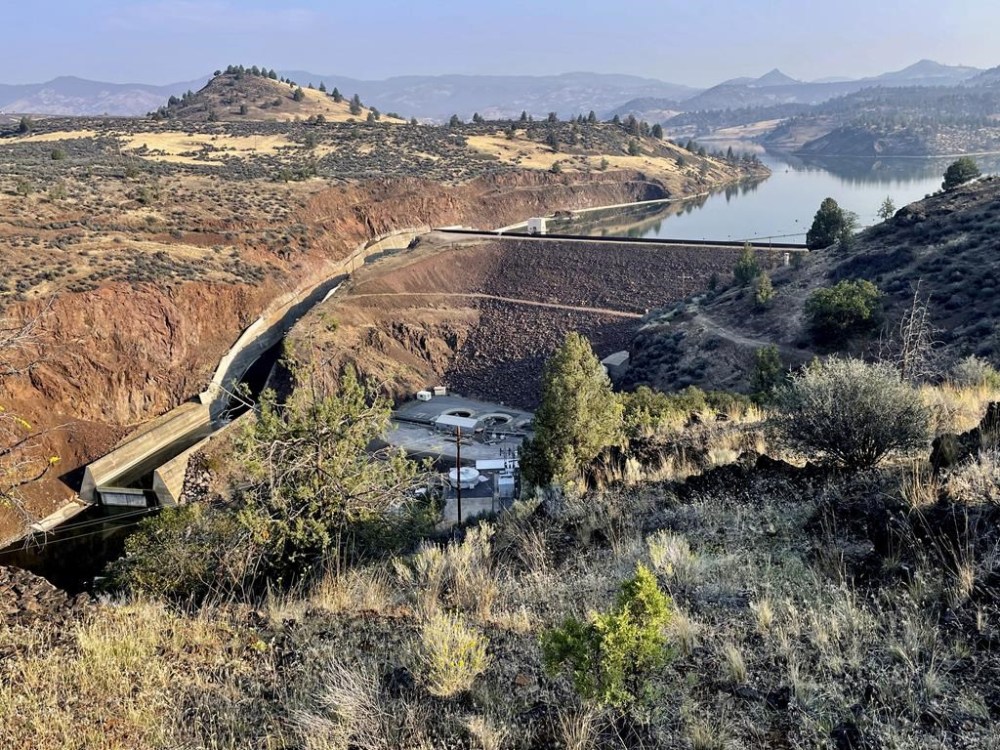
The Iron Gate Dam is seen in Hornbrook, Calif., Sept. 17, 2023. The dam is one of a series of four dams along the Klamath River which are part of the largest dam removal project in United States history. Now underway along the Oregon border, the process won't conclude until the end of next year with the help of heavy machinery and explosives. (AP Photo/Haven Daley)

WHY ARE THE DAMS BEING REMOVED?

The dams were built decades ago to generate electricity. But they also halted the natural flow of the river and disrupted the lifecycle of salmon. The fish are culturally and spiritually important to several Native American tribes in the area.

In 2002, a combination of low water levels and warm temperatures caused a bacterial outbreak that killed more than 34,000 fish. That propelled Native American tribes to campaign for removal of the dams.

After much negotiation, federal regulators approved a plan last year to remove the dams. PacifiCorp transferred the dams to a nonprofit that will oversee the project.

WHEN WILL THE DAMS BE REMOVED?

Work already has begun on removing the smallest of the four dams, known as Copco 2.

Removing the other three dams will take longer because those dams are much larger. Work is scheduled to begin in January and the dams should be removed by the end of 2024.

HOW WILL THE DAMS BE REMOVED?

There won’t be one giant explosion. Instead, workers will slowly drain the reservoirs behind the dams this spring. Once that work is done, crews will begin dismantling the dams, mostly using heavy machinery and some small explosives.

The work includes more than just demolition. Crews also will try to restore the area to the conditions before the dams were built. For years, Native American tribes have gathered seeds of native plants by hand. Those seeds were sent to nurseries, which grew more seeds to plant along the riverbanks.

HOW MUCH WILL THIS COST AND WHO WILL PAY FOR IT?

The project has a $450 million budget, with a $50 million contingency fund. The cost is split between taxpayers and ratepayers of utility company PacifiCorp.
Report Error Submit a Tip

More Stories

‘In Normandy, we remember’

Aaron Epp 4 minute read Preview

‘In Normandy, we remember’

Aaron Epp 4 minute read Yesterday at 6:23 PM CDT

Travelling nearly 7,000 km from his home in France to Winnipeg gave Gabriel Zaranski a new perspective on warfare.

“It’s very different to speak about war in school (than) to speak with real people who (have fought) in a war,” he said. “We can feel the emotion when they speak … The testimony has more impact when it’s real soldiers.”

Zaranski is one of 14 Grade 12 students from Bayeux, a town in France’s Normandy region, in Winnipeg this week for a learning tour.

The students, who attend Lycée Arcisse de Caumont high school, met on Saturday with veterans from the Queen’s Own Cameron Highlanders of Canada, a local military regiment, to discuss their studies and the regiment’s role in the Second World War.

Read
Yesterday at 6:23 PM CDT

‘Scared to Snitch’ could take subtler approach

Maureen Scurfield 3 minute read Yesterday at 2:01 AM CDT

DEAR MISS LONELYHEARTS: I just read the letter from “Scared to Snitch” and have some comments. The mother-in-law who gambles is an adult with a decent income. Nowhere does the letter say her gambling is causing her problems.

If that is the way she wants to spend her time, using her money, and it’s not impacting her life, what about letting it be? She’s an adult making her own decisions.

Options? Have a conversation with her, and ask, “Why those tears at the thought of others knowing?” That may be an opening to explore things more deeply. Why is she fearful?

I’m speaking from experience, having had a loved one deep into the addiction, which caused obvious and big consequences.

Special teams woes hurt Bombers in loss to Argos

Ken Wiebe 7 minute read Preview

Special teams woes hurt Bombers in loss to Argos

Ken Wiebe 7 minute read Yesterday at 8:06 PM CDT

They’ve been the most consistent of the three phases in the Winnipeg Blue Bombers arsenal this season.

A port in the proverbial storm, throughout this topsy-turvy campaign of ups-and-downs, the special-teams units have been supplying strength to a group that is still searching for consistency with only four games left in the regular season.

That’s what made this momentary lapse so costly in a 30-28 loss to the Toronto Argonauts on Friday at Princess Auto Stadium.

“We didn’t keep up our end of the bargain. And that hurts our football team, hurts our chances of winning games,” said Blue Bombers special teams ace Tanner Cadwallader. “And if we want to win close games. we’ve got to be a whole lot better than that. And we will. We’re going to come in (on Saturday for the film session) and go through it with a fine-tooth comb and just work a little bit harder.”

Read
Yesterday at 8:06 PM CDT

Gillingham outlines big plan for Seine River in a second-term as mayor

Joyanne Pursaga 5 minute read Preview

Gillingham outlines big plan for Seine River in a second-term as mayor

Joyanne Pursaga 5 minute read Friday, Sep. 25, 2026

Scott Gillingham promises to turn the Seine River into a permanent recreation and nature attraction, if re-elected as mayor.

At a riverside campaign announcement Friday, Gillingham said a long-term plan would be to create Rivière-Seine Historic Municipal Riverway encompassing the entire Winnipeg section of the Seine, building on past volunteer efforts to clean up the river and make it a paddle-friendly attraction.

The Seine, which winds through St. Boniface and St. Vital, originates in the Sandilands Provincial Forest, passes through southeastern Manitoba, crosses the Red River Floodway and joins the Red River in St. Boniface just north of The Forks.

“What we want to do, really, is to establish the permanence of this river and allow its beauty and the opportunity to enjoy it, to be something that we don’t just leave to volunteers alone, but come together and focus on establishing it as, really, a place that gets focused attention and investment,” said Gillingham.

Read
Friday, Sep. 25, 2026

Positive anticipation is growing about major housing developments underway in Winnipeg’s downtown

Gabrielle Piché 10 minute read Preview

Positive anticipation is growing about major housing developments underway in Winnipeg’s downtown

Gabrielle Piché 10 minute read Friday, Sep. 25, 2026

If traffic is light and the wind is down, Somia Sadiq is able to hear the roar of Winnipeg Jets fans twice: first through her window, then on TV.

From her apartment view high above downtown, she can look out at Graham Avenue’s painted pedestrian landscape, see construction cranes and hear the heavy equipment at work as massive housing projects take shape at The Forks, at what used to be Portage Place shopping centre and at the former Hudson’s Bay building.

Sadiq has lived at 300 Main for 2 1/2 years, a few steps from the city’s famous, windy and reopened-to-pedestrians Portage Avenue intersection. At 42 storeys, it’s the tallest building in Winnipeg.

She is among 18,000 downtown residents who will soon be joined by thousands of others attracted to the city’s core by the new wave of major construction projects.

Read
Friday, Sep. 25, 2026

The never-ending, continuing war in Ethiopia

Gwynne Dyer 5 minute read Yesterday at 2:01 AM CDT

Another October coming up, and still the Nobel Peace Prize Committee refuses to give Donald Trump his prize. They even gave one to Barak Obama, who was Black and a Democrat and had only been in office for 20 minutes. Meanwhile, they ignore a man truly worthy of the prize, a man who ended eight wars last year alone. (He said so himself.)

Unfortunately the prize committee has a long record of backing the wrong person.

They gave it to Aung Sang Suu Kyi of Myanmar, who defended the Rohingya genocide: “I don’t think there is ethnic cleansing going on,” she said.

They gave it to former U.S. secretary of state Henry Kissinger, who ordered the secret carpet-bombing of Cambodia: “The illegal we do immediately; the unconstitutional takes a little longer.”