B.C. moves up zero-emission vehicle target, with 100-per-cent sales goal by 2035

Advertisement

Advertise with us

VICTORIA - The British Columbia government is taking steps to accelerate the transition to zero-emission vehicles to meet its 100-per-cent sales target five years sooner than initially planned.

Read this article for free:


or

Already have an account? Log in here »

To continue reading, please subscribe:

Subscribe and receive a limited-edition Free Press branded hat or tote.

Digital Subscription

One year of digital access for only $205*

  • Enjoy unlimited reading on winnipegfreepress.com
  • Read the E-Edition, our digital replica newspaper
  • Access News Break, our award-winning app
  • Play interactive puzzles

*First annual payment billed as $205.00 + GST for one year. This annual subscription will automatically renew at $233.00 + GST every 52 weeks (10% off the regular annual price of $259.35). Offer available to new and qualified returning subscribers only. Cancel any time.

To continue reading, please subscribe:

Add Free Press access to your Brandon Sun subscription for only an additional

$1 for the first 4 weeks*

  • Enjoy unlimited reading on winnipegfreepress.com
  • Read the E-Edition, our digital replica newspaper
  • Access News Break, our award-winning app
  • Play interactive puzzles
Start now

*Your next Brandon Sun subscription payment will increase by $1.00 and you will be charged $17.95 plus GST for four weeks. After four weeks, your payment will increase to $24.95 plus GST every four weeks.

Hey there, time traveller!
This article was published 24/10/2023 (1078 days ago), so information in it may no longer be current.

VICTORIA – The British Columbia government is taking steps to accelerate the transition to zero-emission vehicles to meet its 100-per-cent sales target five years sooner than initially planned.

If passed, the legislation to amend the Zero-Emission Vehicles Act would increase access and choice for electric vehicle buyers, as new provincial funding expands the charging network, a statement from the Energy Ministry said.

B.C. would require all new light-duty vehicles sold in the province, including passenger cars and trucks, to be emission-free by 2035, it said, five years before the initial goal of 2040.
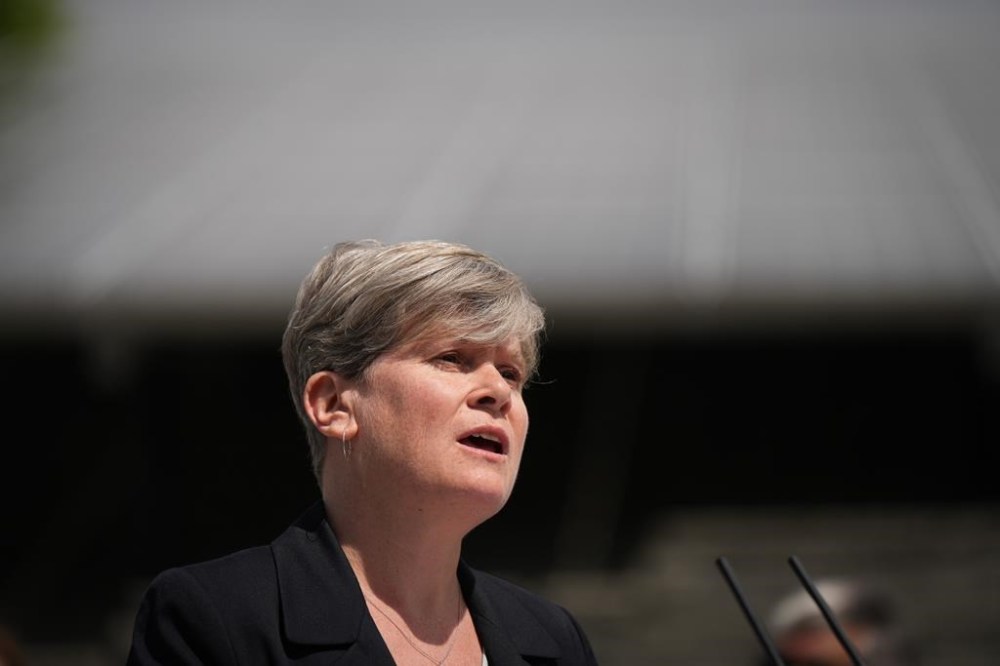
Josie Osborne, minister of energy, mines and low carbon innovation, speaks during an announcement at the Tsleil-Waututh Nation, in North Vancouver, B.C., on Thursday, June 15, 2023. British Columbia's government is accelerating its zero-emission vehicle targets so it can hit its goal five years sooner. Osborne says the province is the
Josie Osborne, minister of energy, mines and low carbon innovation, speaks during an announcement at the Tsleil-Waututh Nation, in North Vancouver, B.C., on Thursday, June 15, 2023. British Columbia's government is accelerating its zero-emission vehicle targets so it can hit its goal five years sooner. Osborne says the province is the "first in the world" to put EV sales target into law. THE CANADIAN PRESS/Darryl Dyck

The accelerated timeline would mandate automakers to meet an escalating annual percentage for light-duty zero-emission vehicle sales and leases, with targets of 26 per cent by 2026, 90 per cent by 2030 and 100 per cent by 2035.

A statement from Energy Minister Josie Osborne said the province is the “first in the world” to put an EV sales target into law, and the proposed amendments would make it easier for people purchasing their next vehicle to choose electric.

After the announcement of the new timeline, the New Car Dealers Association of BC issued a news release encouraging the province to take a more flexible approach, saying its rules may have unintended consequences that could slow the adoption of clean energy vehicles.

It noted the legislation means automakers face the prospect of a significant penalty for every non-zero-emission vehicle sold beyond the allowable limits. Combined with reduced inventory, this could drive up the price of all vehicles, both new and used, it said.

Association president Blair Qualey said post-pandemic supply issues are still affecting the industry, that the province lacks an adequate charging network, particularly in B.C.’s Interior and the north, and zero-emission vehicles remain relatively unaffordable, even with incentives.

“By building flexibility into the regulatory regime and penalty structure, we stand a better chance of collectively meeting the kind of success we all want, and in doing so creating a cleaner, greener future for all British Columbians,” he said in Tuesday’s news release.

The province said it has consistently exceeded sales targets for zero-emission vehicles since the act was first passed in 2019.

It said B.C. has the highest percentage of electric vehicle sales in Canada this year, making up nearly 21 per cent of all light-duty passenger vehicles sold.

The province also announced Tuesday that B.C. has “recharged” its Go Electric EV Charger Rebate Program with $7 million in new funding.

The program operates on a first-come, first-served basis, providing funding for homes, workplaces and multi-unit residential buildings needing to install electric vehicle charging infrastructure.

EV charger rebate applications for single-family homes and workplaces reopened on Tuesday.

This report by The Canadian Press was first published Oct. 24, 2023.
Report Error Submit a Tip

More Stories

A Selkirk woman was sentenced to two-and-a-half years in prison last week for nearly $500,000 in tax fraud, the Canada Revenue Agency says

Michele Gabrielle pleaded guilty to one count of fraud over $5,000 in provincial court in Selkirk on Friday, the CRA says.

The tax agency had uncovered a scheme in which Gabrielle fraudulently claimed Manitoba tax credits from 2016 and 2019. She also filed and amended returns for two family members and a romantic partner, using their names to commit further fraud.

She made false claims in 22 of her own returns and 33 returns file or amended on behalf of others, the CRA says.

Letters, Oct. 6

6 minute read 2:00 AM CDT

High road not so easy

Re: Khan should’ve taken high road: Goertzen (Oct. 3)

Politics is a tough game. Just ask former provincial Liberal leader Dougald Lamont. He got thrown under the bus by a prominent Manitoba/Canadian Liberal who advised people to vote NDP in the last provincial election.

As Lamont said when he lost the election, he is “human” and what happened to him “hurt.” Khan is also human. It is easy to criticize him for not taking the “high road.”

B.C. accelerating EV targets to meet goal by 2035

The Canadian Press 3 minute read Preview

B.C. accelerating EV targets to meet goal by 2035

The Canadian Press 3 minute read Tuesday, Oct. 24, 2023

VICTORIA - The British Columbia government is taking steps to accelerate the transition to zero-emission vehicles to meet its 100-per-cent sales target five years sooner than initially planned.

If passed, the legislation to amend the Zero-Emission Vehicles Act would increase access and choice for electric vehicle buyers, as new provincial funding expands the charging network, a statement from the Energy Ministry said.

B.C. would require all new light-duty vehicles sold in the province, including passenger cars and trucks, to be emission-free by 2035, it said, five years before the initial goal of 2040.

The accelerated timeline would mandate automakers to meet an escalating annual percentage for light-duty zero-emission vehicle sales and leases, with targets of 26 per cent by 2026, 90 per cent by 2030 and 100 per cent by 2035.

Read
Tuesday, Oct. 24, 2023

Botched execution revives death penalty debate

Arthur Chapman 5 minute read 2:00 AM CDT

The United States of America’s seemingly endless, often futile, search for the painless, bloodless method of executing prisoners continues. The latest horrifying chapter occurred in Tennessee on Sept. 30, when the state tried to kill convicted murderer Christa Pike by lethal injection.

It didn’t work. Pike survived two dosages of pentobarbital. She was rushed to a hospital where, according to her lawyer, she was receiving “lifesaving care”.

Tennessee governor Bill Lee has cancelled upcoming executions, but he isn’t moving away from capital punishment.

Lee said, as quoted in the New York Times: “The people of Tennessee have determined that capital punishment is the appropriate sentence for the most heinous of crimes. The people of Tennessee expect those sentences to be carried out in a manner that’s not only legal and constitutional but effective, and that didn’t happen.”

Hydro Québec faces issue we should avoid

Editorial 4 minute read Preview

Hydro Québec faces issue we should avoid

Editorial 4 minute read Yesterday at 2:01 AM CDT

You might be tempted to call it a canary in an electric power generation coal mine.

Read
Yesterday at 2:01 AM CDT

Seven Wilsons, one regional spirit

Hersh Seth 5 minute read Preview

Seven Wilsons, one regional spirit

Hersh Seth 5 minute read 2:00 AM CDT

In Dryden, Ont., a 34-metre suspension bridge crosses the Wabigoon River rapids. It is named after a man who paid for a quarter of the bridge himself. A plaque recognizes Roy Wilson’s “many contributions to City Revitalization” and mentions his 40 years in the Rotary Club, whose motto is “service above self”.

My father sold business machines from the 1970s through the ’90s, during the shift from carbon copy machines and typewriters to photocopiers, fax machines, and early office computers and printers. His sales territory — which he covered mostly by car but also by propeller plane — was Saskatchewan, the Northwest Territories, Manitoba, and northwestern Ontario, though much of it really belonged to the Wilsons.

In business machines, selling the machine was only half the job — the other half was ensuring a technician would fix it in January. Wilson’s set the standard for dealers across most of my dad’s regions. My father worked with Roy’s son Greg (who would later go on to become mayor of Dryden) but really respected Roy for teaching Greg to run the company with the towns they served as the priority.

Wilson’s service routes went beyond where roads stopped. Even if customers lived north of the highway system, Wilson’s still found a way to help, using three company planes based at the Dryden airport. As a result, a stationery shop from a paper mill town served all of northwestern Ontario and later northern Manitoba. Imagine a photocopier strapped into a small plane, a technician beside it, and a gravel runway waiting at the other end.

Read
2:00 AM CDT