The Air Force asks Congress to protect its nuclear launch sites from encroaching wind turbines

Advertisement

Advertise with us

WASHINGTON (AP) —

Read this article for free:


or

Already have an account? Log in here »

To continue reading, please subscribe:

Subscribe and receive a limited-edition Free Press branded hat or tote.

Digital Subscription

One year of digital access for only $205*

  • Enjoy unlimited reading on winnipegfreepress.com
  • Read the E-Edition, our digital replica newspaper
  • Access News Break, our award-winning app
  • Play interactive puzzles

*First annual payment billed as $205.00 + GST for one year. This annual subscription will automatically renew at $233.00 + GST every 52 weeks (10% off the regular annual price of $259.35). Offer available to new and qualified returning subscribers only. Cancel any time.

To continue reading, please subscribe:

Add Free Press access to your Brandon Sun subscription for only an additional

$1 for the first 4 weeks*

  • Enjoy unlimited reading on winnipegfreepress.com
  • Read the E-Edition, our digital replica newspaper
  • Access News Break, our award-winning app
  • Play interactive puzzles
Start now

*Your next Brandon Sun subscription payment will increase by $1.00 and you will be charged $17.95 plus GST for four weeks. After four weeks, your payment will increase to $24.95 plus GST every four weeks.

Hey there, time traveller!
This article was published 07/11/2023 (1047 days ago), so information in it may no longer be current.

WASHINGTON (AP) —

The Air Force’s vast fields of underground nuclear missile silos are rarely disturbed by more than the occasional wandering cow or floating spy balloon. But the service is now asking Congress to help with another unexpected danger: towering wind turbines, which are growing in number and size and are edging closer to the sites each year.

The silos share space on vast private farmlands with the turbines. Whereas the nuclear launch sites are almost undetectable — just small, rectangular plots of land marked only by antennae, a chain-link fence and a flat 110,000-ton (100,000-metric tonne) concrete silo blast door — the turbines are hundreds of feet high, with long, sweeping blades that have parts so large and long they dwarf the 18-wheeler flatbed trucks that transport them to new sites.
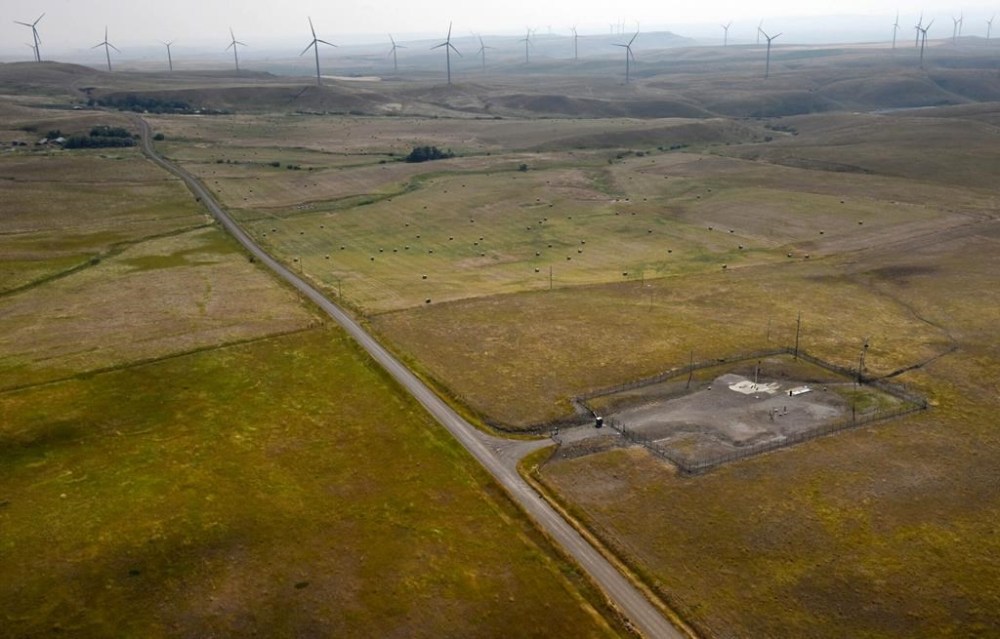
In this image provided by the U.S. Air Force, wind turbines spin near the Malmstrom Air Force Base missile launch site Alpha-03 in Geyser, Mont., in August 2023. As the nation's energy needs have increased, turbines have grown in size and number, and are being placed closer to the underground silos where Minuteman III intercontinental ballistic missiles are kept ready to fire. The Air Force is concerned that the turbines are making it dangerous for their helicopter crews to fly out to the sites, often flying low and fast, when responding to an alarm at one of the silos. The service is seeking a two nautical mile buffer zone around the sites. (John Turner/U.S. Air Force via AP)

As nearby populations have grown, so have energy needs, and so have the number and size of the turbines. It’s a boon for farmers and landowners, who can lease space on their lands to support both the military needs and wind power companies.

But the growth is making it dangerous for military helicopter crews. When an alarm triggers at a site, the UH-1 Huey crews fly in low and fast, often with security teams on board.

“When you think about a wind turbine, and even fields of wind turbines, they’ll stretch for miles,” said Staff Sgt. Chase Rose, a UH-1 Huey flight engineer at Malmstrom Air Force Base in Montana. “They’re monstrous, and then you have gigantic blades spinning on them as well. Not only is that a physical obstacle, but those turbines, they create the hazards like turbulence as well. That can be really dangerous for us to fly into. So it’s a very complex situation, when you have to deal with those.”

So the Air Force is asking Congress to pass legislation to create a 2-nautical-mile buffer zone around each site. The legislation has the support of wind energy advocates, but they caution against a one-size-fits-all approach. There are hundreds of underground silos spread across the U.S., in Nebraska, Colorado, North Dakota, Montana and Wyoming.

“The wind industry recognizes the nuclear missile silo mission is unique,” said Jason Ryan, a spokesman for the American Clean Power Association, which worked with the Air Force and lawmakers on drafting language for a buffer zone. “However, one-size-fits-all setbacks do not make sense for other (Department of Defense) missions or assets as site-specific and mission-specific evaluations are necessary to ensure military readiness.”

Jo Dee Black, a spokeswoman for NorthWestern Energy, which operates some of the towers near Malmstrom’s launch sites, did not say whether the firm is in support of the buffer zone but said “we have always and continue to support the critical role Malmstrom Air Force Base has in our nation’s security.”

“NorthWestern Energy and the U.S. Air Force have a long, successful history of collaboration that supports our missions of national security and providing safe, reliable energy service,” Black said.

Language to create a setback was included in the Senate version of the 2024 National Defense Authorization Act. The language is not in the House version of the bill and would need to be negotiated in conference.

Under the legislation, current towers would be unaffected, unless a company decided to refurbish an existing tower to make it taller.

FILE - Wind turbines work on June 25, 2023, in Kodiak, Alaska. The IEA’s annual world energy outlook, which analyzes the global picture of energy supply and demand, was released Tuesday, Oct. 24. (AP Photo/Joshua A. Bickel File)

That could still be a problem for the air crews. Some of the modern turbines have towers as tall as 650 feet, or nearly 200 meters, “which is twice the height of the Statue of Liberty,” Air Force Maj. Gen. Michael Lutton, who oversees all 450 missile silo sites, said earlier this year. Some rotor diameters, the width of the circle swept by the rotating blades, can be as much as 367 feet (112 meters), the distance from home plate to the left field pole at the Colorado Rockies’ baseball stadium.

Of the 450 sites, 46 are “severely” encroached upon, which the Air Force defines as having more than half of the routes to the launch site closed due to obstructions.

But the service acknowledges the difficult position it is in. The farmers who have allowed it to use their lands for decades benefit from the income from the turbine leases, and the service does not want to appear to push back on environmental energy alternatives.

The Air Force continues to “support renewable energy efforts to include wind turbines, and we continue to work with energy industry partners to ensure the country’s green energy needs are met,” said Air Force Maj. Victoria Hight, a spokeswoman for F.E. Warren Air Force Base in Wyoming. However, she said, “the encroaching turbines limit safe helicopter transit and nuclear security operations.”

___

This story has been corrected to show Lutton’s rank and first name are Maj. Gen. Michael, not Lt. Gen. John.

Report Error Submit a Tip

More Stories

Kinew delivered what most of us wanted; now we’ll have to deal with the consequences

Dan Lett 5 minute read Preview

Kinew delivered what most of us wanted; now we’ll have to deal with the consequences

Dan Lett 5 minute read Updated: Yesterday at 8:43 AM CDT

Premier Wab Kinew has decided to adopt permanent daylight savings time, which means a permanent end to the spring forward, fall back tradition of adjusting our clocks. And absolutely no one is surprised.

Read
Updated: Yesterday at 8:43 AM CDT

Jets vets weigh in on franchise goalie Hellebuyck not reporting to training camp

Mike McIntyre 7 minute read Preview

Jets vets weigh in on franchise goalie Hellebuyck not reporting to training camp

Mike McIntyre 7 minute read Thursday, Sep. 17, 2026

Hockey is the ultimate team sport, where it’s supposed to be about the crest on your chest rather than the name on your back.

So how is Connor Hellebuyck’s trade request and subsequent training camp strike playing out inside the Winnipeg Jets locker room — particularly among other core players he’s gone to battle with over the years?

“Obviously the news is heartbreaking,” Jets forward Kyle Connor said Thursday.

“It feels like we had such a special group here and for whatever reason — I can’t speak to the reason until we hear from the man, I’m not going to speculate on what it is but I know that a lot of guys in that room that are heartbroken.”

Read
Thursday, Sep. 17, 2026

Siloam Mission, WFPS discussing on-site paramedic to reduce staggering number of emergency calls

Scott Billeck 4 minute read Preview

Siloam Mission, WFPS discussing on-site paramedic to reduce staggering number of emergency calls

Scott Billeck 4 minute read Yesterday at 2:00 AM CDT

Winnipeg’s fire-paramedic service and its largest homeless-serving organization are discussing what it would look like to station at least one paramedic at Siloam Mission, as emergency calls to the downtown facility surge.

The ongoing discussions come as Winnipeg Fire Paramedic Service crews were dispatched 1,771 times during the first eight months of the year to the two adjacent Siloam properties at 303 Stanley St. and 300 Princess St.

WFPS said most of the calls were related to overdoses or other consequences of substance use, with the total nearly double the 854 calls recorded over the same period last year. By comparison, there were 831 calls during the same span in 2024, and 591 in 2023.

“The number of emergency calls isn’t sustainable for us as a service, but it’s certainly not sustainable for them as an agency trying to provide services,” WFPS chief Ryan Sneath told the Free Press. “And they recognize that they’re impacting emergency services, not them specifically, but the site in a significant way.”

Read
Yesterday at 2:00 AM CDT

Grieving child builds backyard rocket ship

Harriet Zaidman 4 minute read 2:01 AM CDT

I Built a Rocket Ship (Kids Can Press, 32 pages, hardcover, $22) by Winnipegger Anna Lazowski is a tender story for children ages 4-8 about a little girl trying to make sense of her mother’s death. The child engages in conversation with her late mom, agreeing and disagreeing about things said as she carries objects (and of course, the cat) to the backyard. There, she is building a rocket ship she will pilot into the skies to find her mom again.

Jennica Lounsbury’s varied perspectives show the range of emotions the little girl experiences.

● ● ●

Northwoods Lullaby by Mary Casanova (University of Minnesota Press, 32 pages, hardover, $25) is a bedtime book for readers up to age eight, perfect to bring a busy, happy day to a close. Just like children who are listening to adults reading the book, all the animal babies are being tucked into their nests and burrows by loving parents: “Thump and scamper,/nimble clover./ Soon it’s time to rest. Baby loon/ nestles in/as Papa floats along.”

United Way, other charities fight for dollars as donor base shrinks

Scott Billeck 7 minute read Preview

United Way, other charities fight for dollars as donor base shrinks

Scott Billeck 7 minute read Yesterday at 2:00 AM CDT

Winnipeg’s charitable sector is being squeezed from both sides: demand for help is growing while the pool of donors to meet that need is shrinking.

The imbalance is increasingly being carried by a relatively small group of deep-pocketed donors. Last year, 600 people — about three per cent of United Way Winnipeg’s individual donors — accounted for roughly $8 million, or 55 per cent of individual donations.

The fundraising pitch isn’t getting any easier.

Homelessness and public drug use have become increasingly visible, household budgets remain strained and the problems charities are trying to address can seem so entrenched that donors may reasonably wonder what difference another contribution can make.

Read
Yesterday at 2:00 AM CDT

Klein has burned bridges with PM, Gillingham says

Joyanne Pursaga 3 minute read Preview

Klein has burned bridges with PM, Gillingham says

Joyanne Pursaga 3 minute read Yesterday at 5:51 PM CDT

One mayoral candidate accused another of writing a column so critical it could compromise his ability to work with the federal government.

Read
Yesterday at 5:51 PM CDT