Exploding wild pig population on western Canadian prairie threatens to invade northern US states

Advertisement

Advertise with us

MINNEAPOLIS (AP) — An exploding population of hard-to-eradicate “super pigs” in Canada is threatening to spill south of the border, and northern states like Minnesota, North Dakota and Montana are taking steps to stop the invasion.

Read this article for free:


or

Already have an account? Log in here »

To continue reading, please subscribe:

Subscribe and receive a limited-edition Free Press branded hat or tote.

Digital Subscription

One year of digital access for only $205*

  • Enjoy unlimited reading on winnipegfreepress.com
  • Read the E-Edition, our digital replica newspaper
  • Access News Break, our award-winning app
  • Play interactive puzzles

*First annual payment billed as $205.00 + GST for one year. This annual subscription will automatically renew at $233.00 + GST every 52 weeks (10% off the regular annual price of $259.35). Offer available to new and qualified returning subscribers only. Cancel any time.

To continue reading, please subscribe:

Add Free Press access to your Brandon Sun subscription for only an additional

$1 for the first 4 weeks*

  • Enjoy unlimited reading on winnipegfreepress.com
  • Read the E-Edition, our digital replica newspaper
  • Access News Break, our award-winning app
  • Play interactive puzzles
Start now

*Your next Brandon Sun subscription payment will increase by $1.00 and you will be charged $17.95 plus GST for four weeks. After four weeks, your payment will increase to $24.95 plus GST every four weeks.

Hey there, time traveller!
This article was published 21/11/2023 (1046 days ago), so information in it may no longer be current.

MINNEAPOLIS (AP) — An exploding population of hard-to-eradicate “super pigs” in Canada is threatening to spill south of the border, and northern states like Minnesota, North Dakota and Montana are taking steps to stop the invasion.

In Canada, the wild pigs roaming Alberta, Saskatchewan and Manitoba pose a new threat. They are often crossbreeds that combine the survival skills of wild Eurasian boar with the size and high fertility of domestic swine to create a “super pig” that’s spreading out of control.

Ryan Brook, a professor at the University of Saskatchewan and one of Canada’s leading authorities on the problem, calls feral swine, “the most invasive animal on the planet” and “an ecological train wreck.”
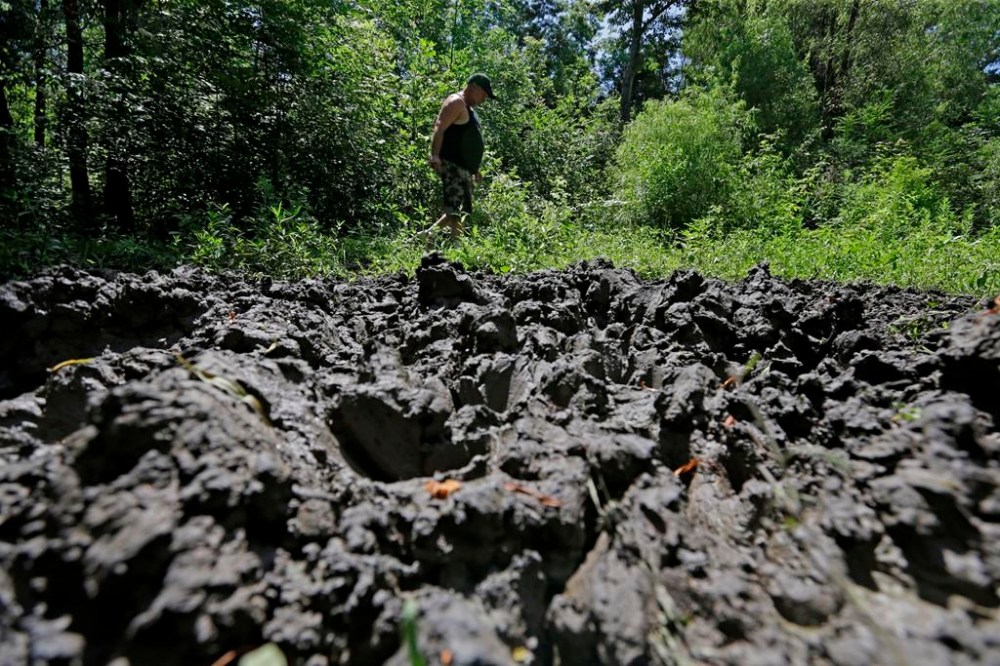
FILE - In this June 17, 2014, file photo, a wildlife trapper, walks past damage from feral hogs that happened overnight while foraging near one of his traps in New Orleans. An exploding population of hard-to-eradicate “super pigs” in Canada is threatening to spill south of the border, and northern states like Minnesota, North Dakota, Montana are taking steps to stop the invasion. (AP Photo/Gerald Herbert, File)

Pigs are not native to North America. While they’ve roamed parts of the continent for centuries, Canada’s problem dates back only to the 1980s when it encouraged farmers to raise wild boar, Brook said. The market collapsed after peaking in 2001 and some frustrated farmers simply cut their fences, setting the animals free.

It turned out that the pigs were very good at surviving Canadian winters. Smart, adaptable and furry, they eat anything, including crops and wildlife. They tear up land when they root for bugs and crops. They can spread devastating diseases to hog farms like African swine fever. And they reproduce quickly. A sow can have six piglets in a litter and raise two litters in a year.

That means 65% or more of a wild pig population could be killed every year and it will still increase, Brook said. Hunting just makes the problem worse, he said. The success rate for hunters is only about 2% to 3% and several states have banned hunting because it makes the pigs more wary and nocturnal — tougher to track down and eradicate.

Wild pigs already cause around $2.5 billion in damage to U.S. crops every year, mostly in southern states like Texas. And they can be aggressive toward humans. A woman in Texas was killed by wild pigs in 2019.

Eradication of wild pigs is no longer possible in Manitoba and Saskatchewan, Brook said. But the situation isn’t hopeless everywhere and a few U.S. states have eliminated them. The key, he said, is having a detection system that finds them early and fast, and then responding quickly.

Brook and his colleagues have documented 62,000 wild pig sightings in Canada. Their aerial surveys have spotted them on both sides of the Canada-North Dakota border. They’ve also recorded a sighting in Manitoba within 18 miles (28 kilometers) of Minnesota.

“Nobody should be surprised when pigs start walking across that border if they haven’t already,” Brook said. “The question is: What will be done about it?”

Brook said Montana has been the most serious about keeping wild pigs out. It banned raising and transporting wild pigs within the state.

“The only path forward is you have to be really aggressive and you have to use all the tools in the toolbox,” Brook said.

That could include big ground traps with names like “BoarBuster” or net guns fired from helicopters. Some states and provinces embrace crowdsourced “Squeal on Pigs” tracking programs. Scientists have also studied poisons such as sodium nitrite, but they risk harming other species.

Minnesota is among states trying to prevent the swine from taking hold. The state’s Department of Natural Resources is expected to release a report in February identifying gaps in its management plan and recommend new prevention steps. Meanwhile, the U.S. Department of Agriculture is using aircraft and drones to beef up surveillance along the northern border.

Minnesota was declared an eradicated state after USDA Wildlife Services shot and killed a group of pigs in 2016 that wandered off a farm and turned feral in the far northwest corner of the state — but not before they began to reproduce and root up a wildlife preserve. Gary Nohrenberg, the Minnesota director of Wildlife Services, said as far has he knows, no truly wild pigs have made their way to his state — yet.

Feral swine have been reported in at least 35 states, according to the USDA. The agency estimates the the swine population in those states totals around 6 million.

Since launching the National Feral Swine Management Program in 2014, the USDA has provided funding to 33 states, said Mike Marlow, an assistant program director. He said their goal is to eradicate wild pigs where populations are low or emerging, and to limit the damage where they’re already established such as Texas and southeastern states.

The program has had success in some states that had small populations like Vermont, New York, Pennsylvania, New Hampshire, Wisconsin and Washington, he said. The animals are spotted occasionally and quickly killed off in North Dakota.

“I think we’re making great strides toward success,” Marlow said. “But eradication is not in the near future.”

___

Follow AP news about invasive species at: https://apnews.com/hub/invasive-species.
Report Error Submit a Tip

More Stories

Jets new backup Stevenson ‘stoked’ to be in tandem with Skinner

Mike McIntyre 6 minute read Preview

Jets new backup Stevenson ‘stoked’ to be in tandem with Skinner

Mike McIntyre 6 minute read Wednesday, Sep. 30, 2026

It didn’t take long to get the dirt on the newest member of the Winnipeg Jets.

Meet Clay Stevenson, who has no problem if you prefer to refer to him by his long-standing nickname of “Mud.”

“You know, Clay is in the mud, and there you go. That’s it, right there,” Stevenson said Wednesday with a laugh. “I got it in juniors when I was playing in Coquitlam, and kind of stuck ever since.”

Stevenson is now hoping to make a name for himself in a city that, quite fittingly, translates to “muddy water” in Cree. The 27-year-old from Alberta was placed on waivers by the Washington Capitals and claimed by the Jets, who were looking to clarify a goaltending situation which was as murky as the Red River.

Read
Wednesday, Sep. 30, 2026

Exploding wild pig population on western Canadian prairie threatens to invade northern US states

Steve Karnowski, The Associated Press 5 minute read Preview

Exploding wild pig population on western Canadian prairie threatens to invade northern US states

Steve Karnowski, The Associated Press 5 minute read Tuesday, Nov. 21, 2023

MINNEAPOLIS (AP) — An exploding population of hard-to-eradicate “super pigs” in Canada is threatening to spill south of the border, and northern states like Minnesota, North Dakota and Montana are taking steps to stop the invasion.

In Canada, the wild pigs roaming Alberta, Saskatchewan and Manitoba pose a new threat. They are often crossbreeds that combine the survival skills of wild Eurasian boar with the size and high fertility of domestic swine to create a “super pig” that's spreading out of control.

Ryan Brook, a professor at the University of Saskatchewan and one of Canada's leading authorities on the problem, calls feral swine, “the most invasive animal on the planet" and “an ecological train wreck.”

Pigs are not native to North America. While they've roamed parts of the continent for centuries, Canada's problem dates back only to the 1980s when it encouraged farmers to raise wild boar, Brook said. The market collapsed after peaking in 2001 and some frustrated farmers simply cut their fences, setting the animals free.

Read
Tuesday, Nov. 21, 2023

Sisters relieved hospital takes accountability after mother’s death

Scott Billeck 6 minute read Preview

Sisters relieved hospital takes accountability after mother’s death

Scott Billeck 6 minute read Yesterday at 6:39 PM CDT

Eight months after losing their mother, two Winnipeg sisters say an internal hospital review has finally given them something they had been seeking since her death: accountability.

Chelsea Mann and Samantha Burns said St. Boniface Hospital officials acknowledged mistakes were made in the care of their mother, Judy Burns, during a recent meeting to discuss the findings of a critical incident review into her death.

The acknowledgement marked a significant departure from an earlier meeting with hospital officials, when they felt their concerns were largely dismissed.

Burns, 68, died on Jan. 21, three days after being admitted, after experiencing rectal bleeding.

Read
Yesterday at 6:39 PM CDT

Minimum wage hikes set to begin across five provinces

The Canadian Press 2 minute read Preview

Minimum wage hikes set to begin across five provinces

The Canadian Press 2 minute read Updated: Yesterday at 3:12 PM CDT

The minimum wage is going up in five provinces.

The bumps of between 25 and 40 cents come in Ontario, Prince Edward Island, Nova Scotia, Manitoba and Saskatchewan.

Like other government announcements, Ontario has tied the increase to the rising cost of living.

It's moving its minimum wage up to $17.95 an hour, while P.E.I. is boosting it to $17.30 and Nova Scotia moves it to $17.

Read
Updated: Yesterday at 3:12 PM CDT

Time for AI guardrails is right now

Editorial 4 minute read Preview

Time for AI guardrails is right now

Editorial 4 minute read 2:00 AM CDT

The genie is most definitely out of the bottle.

And while there’s little chance of putting it back in, we should be very concerned that the people who released it from the bottle are now frantically warning us that it has become disinclined to do their — or our — bidding and seems instead to be increasingly intent on following its own whims and granting wishes to itself.

The figurative genie, in this case, is artificial intelligence, or AI, and in recent weeks many of the tech geniuses responsible for its development and introduction into the digital-information realm have begun asking the U.S. government and even the United Nations to impose limits on the pace and breadth of its growth.

Their fear is that, as AI very quickly continues to advance and develops the ability to make independent decisions and essentially think for itself, it will cease to be a tool controlled by its creators and instead will become a species unto itself that might eventually decide it’s better off without humans continually messing things up.

Read
2:00 AM CDT

Today’s horoscope

Georgia Nicols 4 minute read Preview

Today’s horoscope

Georgia Nicols 4 minute read 2:00 AM CDT

MOON ALERT: Caution! Avoid shopping (except food and gas) and important decisions until after 3:30 p.m. today. After that, the moon moves from Gemini into Cancer.

ARIES (March 21-April 19)

This is a creative day for you. Because you’re the artisan of the zodiac, tap into your talents and make some art or explore one of your many hobbies. However, avoid intense discussions with partners, spouses and friends. Keep things light.

TAURUS (April 20-May 20)

Read
2:00 AM CDT