UN agency cites worrying warming trend as COP28 summit grapples with curbing climate change

Advertisement

Advertise with us

DUBAI, United Arab Emirates (AP) — The United Nations weather agency is reporting that glaciers shrank more than ever from 2011 and 2020 and the Antarctic ice sheet lost 75 percent more compared to the previous ten years, as it released its latest stark report about the fallout on the planet from climate change.

Read this article for free:


or

Already have an account? Log in here »

To continue reading, please subscribe:

Subscribe and receive a limited-edition Free Press branded hat or tote.

Digital Subscription

One year of digital access for only $205*

  • Enjoy unlimited reading on winnipegfreepress.com
  • Read the E-Edition, our digital replica newspaper
  • Access News Break, our award-winning app
  • Play interactive puzzles

*First annual payment billed as $205.00 + GST for one year. This annual subscription will automatically renew at $233.00 + GST every 52 weeks (10% off the regular annual price of $259.35). Offer available to new and qualified returning subscribers only. Cancel any time.

To continue reading, please subscribe:

Add Free Press access to your Brandon Sun subscription for only an additional

$1 for the first 4 weeks*

  • Enjoy unlimited reading on winnipegfreepress.com
  • Read the E-Edition, our digital replica newspaper
  • Access News Break, our award-winning app
  • Play interactive puzzles
Start now

*Your next Brandon Sun subscription payment will increase by $1.00 and you will be charged $17.95 plus GST for four weeks. After four weeks, your payment will increase to $24.95 plus GST every four weeks.

Hey there, time traveller!
This article was published 05/12/2023 (1020 days ago), so information in it may no longer be current.

DUBAI, United Arab Emirates (AP) — The United Nations weather agency is reporting that glaciers shrank more than ever from 2011 and 2020 and the Antarctic ice sheet lost 75 percent more compared to the previous ten years, as it released its latest stark report about the fallout on the planet from climate change.

The World Meteorological Organization served up more evidence of what scientists already know – the Earth is heating – on Tuesday, but this time looking at the trend over a longer period with its latest Decadal State of the Climate report.

“Each decade since the 1990s has been warmer than the previous one and we see no immediate sign of this trend reversing,” its secretary-general, Petteri Taalas, said. “We are losing the race to save our melting glaciers and ice sheets.”
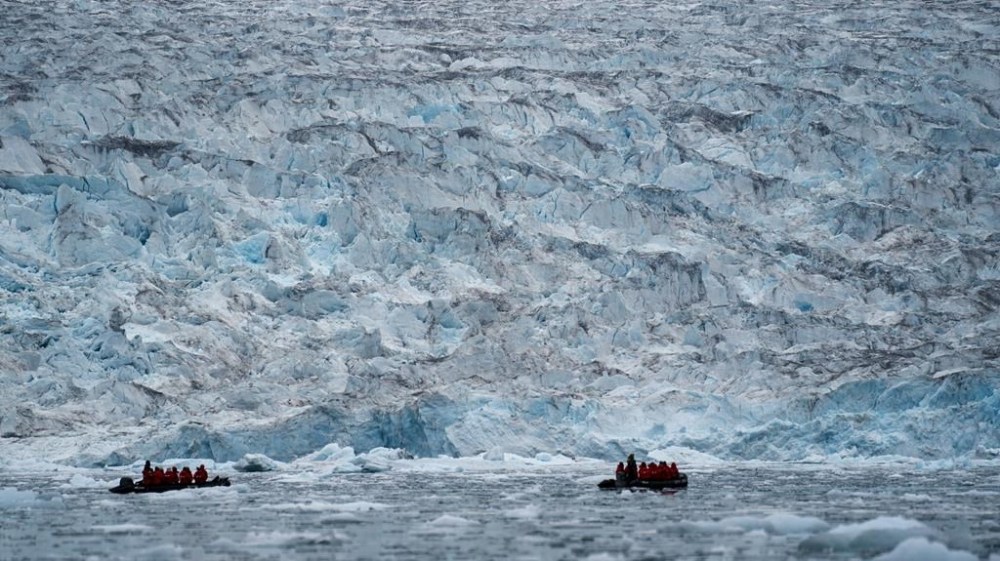
FILE - Two groups from the Poseidon Expeditions look at a glacier as it sits on the water line in the Scoresby Sund, Thursday, Sept. 7, 2023, in Greenland. The U.N. weather agency is reporting that glaciers shrank more than ever from 2011 and 2020, as it released its latest stark report about the fallout on the planet from climate change. (AP Photo/Chris Szagola, File)

Warming oceans and melting of ice sheets caused the rate of sea-level rise to nearly double in less than a generation, he said, and WMO says that bodes ill for low-lying coastal regions and countries.

Experts are divided about one of the most important metrics: The rate of warming.

Former NASA top scientist James Hansen, nicknamed the Godfather of Global Warming for his early warnings, has reported that the rate is accelerating. University of Pennsylvania climate scientist Michael Mann has argued warming has been steadily increasing since 1990, but isn’t speeding up.

“The surface of the planet and the oceans both continue to warm at a steady rate, not an accelerating rate, and that’s bad enough,” Mann said in an email. He warned that such warming is fueling increasingly dangerous extreme weather events, coastal flooding and many other “disastrous” impacts.

“And the warming and its consequences will continue as long as we continue to generate carbon pollution through fossil fuel burning and other activities, highlighting the critical need for progress at the COP28 climate summit in Dubai taking place right now,” he wrote.

The WMO report said that glaciers measured around the world thinned by roughly one meter (about 3 feet) per year on average from 2011 to 2020, and a look at over 40 “reference glaciers” showed the lowest mass balances of any decade.

“The remaining glaciers near the Equator are generally in rapid decline. Glaciers in Papua, Indonesia are likely to disappear altogether within the next decade,” WMO said. “In Africa, glaciers on the Rwenzori Mountains and Mount Kenya are projected to disappear by 2030, and those on Kilimanjaro by 2040.”

As for the ice-sheet thaw, Greenland and Antarctica lost 38% more ice from 2011 to 2020 than in the previous decade. It also said that sea level rise has accelerated during the decade because of the melting.

WMO deputy secretary general Elena Manaenkova said the report is different from other warnings in the past because it provides a long-term perspective and sustained trends from the 2010s which can help discern where the warming is headed.

This report is also crucial to eliminate variations due to factors like natural weather phenomenon such as El Nino or La Nina, which are periods of unusual warming and cooling of the waters of the Pacific Ocean that have ripple effects on weather around the world.

“Often people react to the news of the day. With this, we can safely say where we are going,” Manaenkova said.

With the world emitting 36.8 billion metric tons of carbon dioxide in 2023 —twice the yearly volume of four decades ago — Manaenkova, attending her 17th international climate conference, said: “Let’s finally get serious.”

___

Gaurav Saini from The Press Trust of India contributed to this report.

___

Associated Press climate and environmental coverage receives support from several private foundations. See more about AP’s climate initiative here. The AP is solely responsible for all content.

Report Error Submit a Tip

More Stories

A quick look at where provinces and territories stand on time changes

The Canadian Press 2 minute read Preview

A quick look at where provinces and territories stand on time changes

The Canadian Press 2 minute read Updated: Yesterday at 6:28 AM CDT

WINNIPEG - Manitoba's government said Thursday the province will be sticking with daylight time year-round, making it the latest jurisdiction to move away from twice-annual time changes. Here's a look at where things stand across Canada:

British Columbia said in March that it was moving to permanent Pacific daylight time. The change also means that parts of northeastern B.C., which have been on mountain standard time year round, are now in alignment with the rest of the province.

Alberta also switched to permanent daylight time this year in what it calls Alberta time. The change means it now has the same time as Saskatchewan year round.

Saskatchewan has been on permanent central standard time since 1966.

Read
Updated: Yesterday at 6:28 AM CDT

A life’s story: activist, educator, organizer knew the true meaning of community

Janine LeGal 7 minute read Preview

A life’s story: activist, educator, organizer knew the true meaning of community

Janine LeGal 7 minute read 3:00 AM CDT

Somewhere between a love for sharing stories and a love of community connections, Michael (Mike) Maunder lived his life. Giving voice to people and neighbourhoods was a passion for the natural-born community organizer.

An author, teacher and principal, Maunder lived in a one-bedroom apartment in West Broadway and devoted himself to community development, education and neighbourhood renewal.

He maintained a connection with Augustine United Church, whose commitment to social justice he appreciated, volunteered at the Sandy-Saulteaux Spiritual Centre, and found comfort in a Buddhist prayer community.

Maunder died on July 15 at the age of 80.

Read
3:00 AM CDT

Former Bombers linebacker Gauthier enjoying career as electrician

Taylor Allen 6 minute read Preview

Former Bombers linebacker Gauthier enjoying career as electrician

Taylor Allen 6 minute read Yesterday at 12:44 PM CDT

Most professional football players don’t ride off into the sunset on their own terms.

Shayne Gauthier was well aware of that, but it didn’t make it sting any less when the Winnipeg Blue Bombers informed the veteran linebacker that they weren’t bringing him back for 2026.

“I was really hoping to play one more (season) because it would have been my 10th season, so, I’d say it didn’t really end the way I wanted,” Gauthier recently told the Free Press.

“It left a little sour taste in my mouth, but that’s part of pro sports. If everybody got the ending that they wanted, then it wouldn’t really work.”

Read
Yesterday at 12:44 PM CDT

Gillingham in lead with decided voters

Nicole Buffie 6 minute read Preview

Gillingham in lead with decided voters

Nicole Buffie 6 minute read Yesterday at 6:55 PM CDT

A cloud of uncertainty is hanging over Winnipeg as October’s municipal election nears.

Three months after a poll showed more than 40 per cent of Winnipeggers wanted to see someone other than current mayor Scott Gillingham elected, a new Abacus Data poll indicates more than half of Winnipeg voters are undecided heading into next month’s civic election.

Of decided voters, 55 per cent favour Gillingham compared to 23 per cent for former councillor and provincial cabinet minister Kevin Klein and 11 per cent for funeral director Mike Vogiatzakis.

Of all respondents, just over 50 per cent said they were unsure while 13 per cent said they will not vote.

Read
Yesterday at 6:55 PM CDT

American Hostage stars recall warmth of Winnipeggers during brutal winter

Randall King 7 minute read Preview

American Hostage stars recall warmth of Winnipeggers during brutal winter

Randall King 7 minute read Yesterday at 6:13 PM CDT

TORONTO — When you stream the eight-part series American Hostage, a sense of familiarity may strike.

That’s because the show was shot in Winnipeg — especially in the Exchange District — from November of last year to the beginning of February, with Winnipeg portraying Indianapolis circa 1977.

The whole world seemed to be watching that midwest American city that year as a hostage crisis unfolded involving one Tony Kiritsis, an angry man who goes ballistic when a mortgage brokerage was poised to foreclose on property he had dreamed of developing into a shopping centre.

Kiritsis kidnapped his mortgage broker, Richard Hall, wiring a shotgun to the back of his head, and demanded a public airing of his grievances, with the reluctant help of popular radio broadcaster Fred Heckman.

Read
Yesterday at 6:13 PM CDT

Not good bet to shoulder gambling issue alone

Maureen Scurfield 5 minute read 2:01 AM CDT

DEAR MISS LONELYHEARTS: We’re living a lie over at our house, but it’s holding the family together.

I know my husband is deeply into gambling. If it weren’t for my steady job I don’t know where the family would be! I insist on paying all of our bills. I also funnel some major cash off to my sister, in case my husband tries to tap into my accounts somehow when I’m out of the house.

He doesn’t know my passwords, since I keep changing them, but he sometimes shows up behind me when I’m online, like he’s dying to ask something.

I say, “What are you looking at? Stop looking over my shoulder!” Then he makes a lame joke and goes away.