Site for Canada’s underground nuclear waste repository to be selected next year
Advertisement
Read this article for free:
or
Already have an account? Log in here »
To continue reading, please subscribe:

Digital Subscription
One year of digital access for only $205*
- Enjoy unlimited reading on winnipegfreepress.com
- Read the E-Edition, our digital replica newspaper
- Access News Break, our award-winning app
- Play interactive puzzles
*First annual payment billed as $205.00 + GST for one year. This annual subscription will automatically renew at $233.00 + GST every 52 weeks (10% off the regular annual price of $259.35). Offer available to new and qualified returning subscribers only. Cancel any time.
To continue reading, please subscribe:
Add Free Press access to your Brandon Sun subscription for only an additional
$1 for the first 4 weeks*
- Enjoy unlimited reading on winnipegfreepress.com
- Read the E-Edition, our digital replica newspaper
- Access News Break, our award-winning app
- Play interactive puzzles
*Your next Brandon Sun subscription payment will increase by $1.00 and you will be charged $17.95 plus GST for four weeks. After four weeks, your payment will increase to $24.95 plus GST every four weeks.
Read unlimited articles for free today:
or
Already have an account? Log in here »
Hey there, time traveller!
This article was published 27/12/2023 (996 days ago), so information in it may no longer be current.
A critical milestone is on the horizon for Canada’s 175-year-long plan to bury its nuclear waste underground, with two pairs of Ontario communities set to decide if they would be willing hosts.
Late next year, the Nuclear Waste Management Organization plans to select the site for Canada’s deep geological repository, where millions of bundles of used nuclear fuel will be placed in a network of rooms connected by cavernous tunnels, as deep below the Earth’s surface as the CN Tower is tall — if the process goes according to plan.
The sites are down to the Wabigoon Lake Ojibway Nation-Ignace area in northwestern Ontario and the Saugeen Ojibway Nation-South Bruce area in southern Ontario. The municipalities and First Nations are planning votes for next year, the culmination of a years-long information gathering process that some say has left deep divisions within their communities.
The process to move ahead with a deep geological repository is already more than 20 years along. The NWMO was established under legislation in 2002 and is funded by the corporations that generate nuclear power and waste, such as Ontario Power Generation and Hydro-Quebec.
While officials say they are confident at least one area will say yes, two rejections would be a major setback for the $26-billion project.
“Ultimately, if both areas say no, then we have to start over — and by we I mean Canada,” said Lise Morton, the vice-president of site selection.
“We as a country would then be really pushing the resolution of this issue to the next generation.”
Both the municipality and First Nation in the area of either proposed site must confirm willingness to host the repository before the NWMO will proceed.
In South Bruce, they are planning to hold a referendum late next year. The mayor sees great potential for direct and indirect job creation if the repository is located there.
“In this location we’ve kind of been left out of the major boom that Ontario has been seeing so far,” Mark Goetz said. “We’ve seen it to the west of us, to the Great Lakes, and we’ve seen it sprawling from Toronto to the east of us … but we haven’t really benefitted here a whole lot yet.”
South Bruce already has deep nuclear roots, with the Bruce Power plant close by. A refurbishment project there is set to wind down around when the repository project would start up, providing opportunities for tradespeople, Goetz said.
But there are a good number of people in the community who are not convinced — about 20 per cent are with Protect Our Waterways, the main opposition group, Goetz estimates — and it has caused “quite a friction.”
South Bruce is also in the shadow of Walkerton, Ont., where seven people died and thousands fell ill after drinking contaminated water in 2000. Fears about drinking water have lingered there long after the tragedy, said Bill Noll, vice chair of Protect Our Waterways.
“There is a big concern relative to water,” Noll said. “Once you pollute the water, there’s not much you can do about it.”
Water also weighs heavily on the minds of members of the Wabigoon Lake Ojibway Nation, who have seen members of another northwestern Ontario First Nation on the English-Wabigoon river system grapple with generations of mercury poisoning after a mill in Dryden dumped 9,000 kilograms of the substance in the 1960s.
“That’s the evidence right now of how an industry went astray or how government oversight wasn’t there,” said Wabigoon Lake Ojibway Nation Chief Clayton Wetelainen.
Within the planned repository, the radioactive materials would be under multiple layers of protection, and for contamination to happen, “everything has to fail,” said NWMO senior transportation engineer Ulf Stahmer. It’s a scenario he does not see happening.
The outermost layer of protection is the rock itself, with the repository about 500 metres down in a rock formation selected for its low permeability. Then come blocks of bentonite clay that encase further layers within. The clay forms a good seal and naturally attracts radioactive materials, so if any were to migrate through the other layers underneath, they would find it hard to make it past the clay, Stahmer said.
Bentonite clay also swells, creating a pressure that inhibits microbial corrosion, he said.
Packed within the bentonite clay will be containers made of carbon steel and coated with copper to prevent corrosion. Those containers have been subjected to crush tests with the weight of 500 to 700 metres of rock plus two kilometres of ice — designed to mimic a future ice age, Stahmer said.
“This container can then survive the repository for a long, long time … essentially forever,” he said.
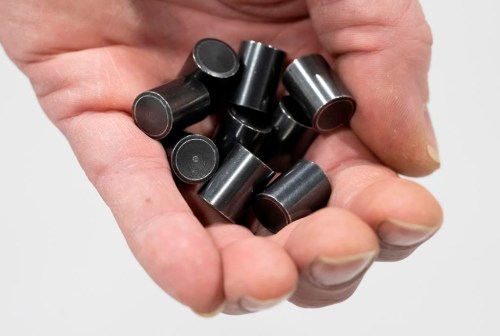
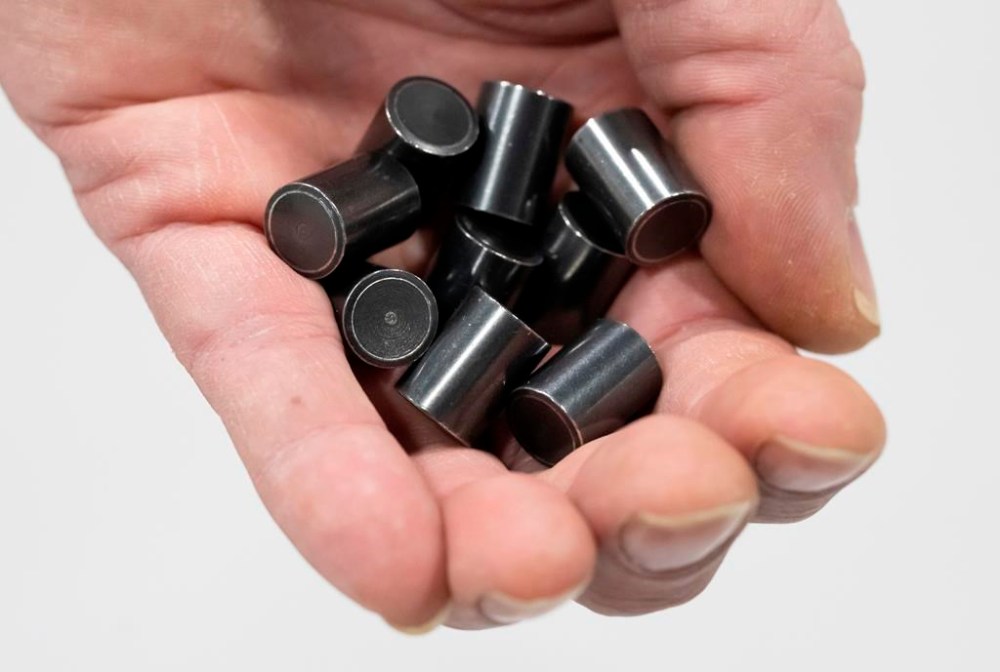
Within the used nuclear fuel containers will be the fuel bundles, or rods, made of corrosion-resistant Zircaloy. Those bundles contain the actual fuel pellets, which look a bit like a thick watch battery. They are made from uranium dioxide powder and baked into ceramic, which doesn’t dissolve easily in water.
But all the tests and planning and modelling are not easing the fears of the project’s critics, either with the southern Ontario-based Protect Our Waterways or We the Nuclear Free North.
“The whole thing is a grand experiment,” said Brennain Lloyd, with the northern group.
“There’s not a deep geological repository … operating anywhere in the world. The NWMO likes to say, ‘Well, this is best international practice,’ but practice implies that it’s been done before. And there is no practice. Nobody has done this before.”
There are others in the works internationally, with Finland’s being one of the furthest along. The NWMO recently sent officials and community members from both possible Ontario sites on a trip to Finland to see that repository for themselves.
Jodie Defeo, an Ignace councillor, was on the trip and was awed at the scale of the project.
“It was physically daunting,” she said. “You could fit a car driving through the tunnels. It was very amazing to see.”
Defeo said she is conveying to her community what she learned and saw on the trip in order to help inform residents’ opinions, which will ultimately shape her vote when the issue comes to Ignace council next year.
“I can definitely talk to the footprint that they carved out of the land, (which) was only exactly what they needed,” she said.
“I can speak to the fact that there was economic stability in their community and in surrounding communities. And I can speak to the fact … we wouldn’t be the first, that it will have been done before us.”
The NWMO is currently working on hosting agreements with the affected communities, so people can see the terms before making their decisions. Those agreements will include a mechanism to change the scope of the project, Morton said, as governments such as Ontario’s forge ahead with plans for a new, large-scale nuclear plant as well as small modular reactors.
The current fleet of reactors in Canada will produce about 5.5 million used fuel bundles, with around 3.2 million already in either wet or dry storage on site at nuclear plants. After the spent fuel rods come out of a reactor they spend about 10 years cooling in pools of water before being stored in containers with thick concrete walls lined on the outside with a steel plate.
Those containers are designed to last 50 years, so they are not seen as a long-term solution, Morton said.
“The length of time that you have to manage this fuel goes over millennia,” she said. “So you just don’t want to be burdening future generations with having to monitor that fuel and keep moving it into new packaging every century or whatever that would be for many, many centuries to come.”
Community members have been very engaged over the years of information sessions, reports and studies, asking smart questions, Morton said. The affected municipalities have community liaison committees, consisting of both officials and regular citizens.
Douglas Culbert joined the South Bruce committee 13 years ago as a community member and said he has seen a slow shift toward supporting the repository.
“There’s people asking more detailed questions,” he said.
“Some are looking at just the safety aspect. So right now the waste is stored right adjacent to Lake Huron (at the Bruce Power station), so if you put it in a DGR it gets it away from the lake. Others are looking at future job opportunities for children, others are looking at the (economic) spinoff.”
Once a site is selected in late 2024, it’s really just the beginning, Morton said.
The NWMO is estimating regulatory approvals will take about 10 years, and construction will take about 10 years. The used fuel will be loaded in over a period of about 50 to 60 years, then it will enter an “extended monitoring” phase that will last about 70 years.
“It will be up to future generations to decide: do we think we have all the data we need? And do we need to keep monitoring,” she said. “Or can we now close the facility up and seal the shaft.”
This report by The Canadian Press was first published Dec. 27, 2023.
Related Articles
Nuclear site oversight needed Canadian Nuclear Laboratories fined for failing to comply with terms of act
Advertisement Advertise With Us
Advertisement Advertise With Us