States with big climate goals strip local power to block green projects
Advertisement
Read this article for free:
or
Already have an account? Log in here »
To continue reading, please subscribe:

Digital Subscription
One year of digital access for only $205*
- Enjoy unlimited reading on winnipegfreepress.com
- Read the E-Edition, our digital replica newspaper
- Access News Break, our award-winning app
- Play interactive puzzles
*First annual payment billed as $205.00 + GST for one year. This annual subscription will automatically renew at $233.00 + GST every 52 weeks (10% off the regular annual price of $259.35). Offer available to new and qualified returning subscribers only. Cancel any time.
To continue reading, please subscribe:
Add Free Press access to your Brandon Sun subscription for only an additional
$1 for the first 4 weeks*
- Enjoy unlimited reading on winnipegfreepress.com
- Read the E-Edition, our digital replica newspaper
- Access News Break, our award-winning app
- Play interactive puzzles
*Your next Brandon Sun subscription payment will increase by $1.00 and you will be charged $17.95 plus GST for four weeks. After four weeks, your payment will increase to $24.95 plus GST every four weeks.
Read unlimited articles for free today:
or
Already have an account? Log in here »
Hey there, time traveller!
This article was published 13/01/2024 (994 days ago), so information in it may no longer be current.
LANSING, Mich. (AP) — Clean energy developers had planned a 75-turbine wind farm in mid-Michigan’s Montcalm County before local voters shot down the idea in 2022 and recalled seven local officials who had supported it.
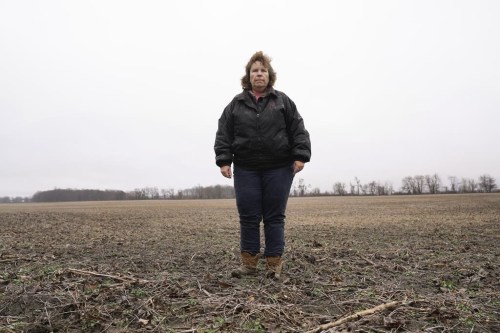
About 150 miles (240 kilometers) southeast, Clara Ostrander in Monroe County found herself at the center of a similar conflict as rising medical costs forced her and her husband to consider selling land her family has owned for 150 years.
Leasing a parcel to an incoming solar farm could save the property, but neighboring residents complained so vehemently that Ostrander said the township changed its zoning to block the project.
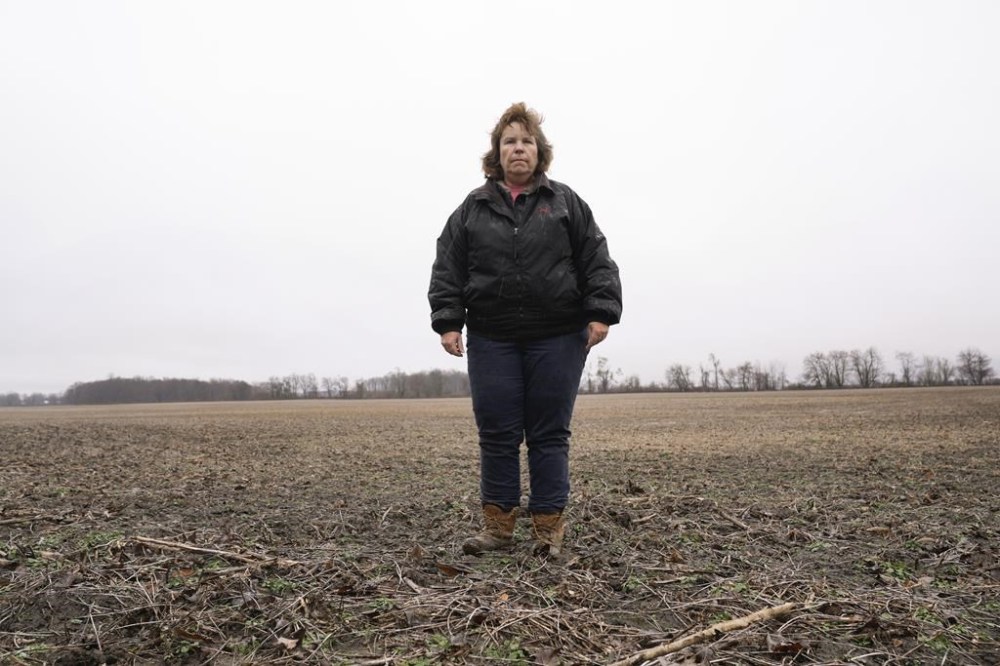
“There are people in this township I will never, ever speak to again,” she said.
Local restrictions in Michigan derailed more than two dozen utility-scale renewable energy projects as of last May, according to a study by the Sabin Center for Climate Change Law at Columbia University. Nationwide, and at least 228 restrictions in 35 states have been imposed to stop green energy projects.
The conflicts have hindered many states’ aggressive timelines for transitioning to cleaner energy production, with the ultimate goal of eliminating carbon pollution within the next two decades.
Michigan and more than a dozen other states are seeking to upend the decision-making process by grabbing the power to supersede local restrictions and allow state authorities to approve or disapprove locations for utility-scale projects.
The shift has sparked a political backlash that may escalate as more states seek to simplify getting green energy projects approved and built.
“We can’t allow projects of statewide importance that are critical to our state energy security to be vetoed on purely local concerns,” said Dan Scripps, chair of Michigan’s Public Service Commission.
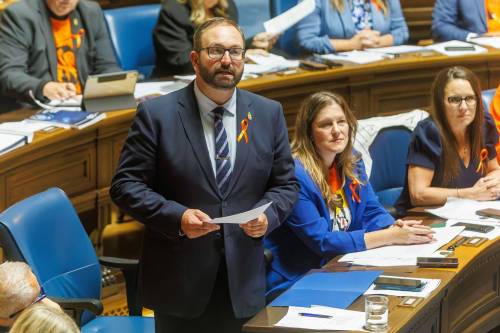
Scripps and two other commission members now have the power to site large-scale renewable energy projects in the state under legislation passed by Michigan lawmakers and signed by Democratic Gov. Gretchen Whitmer in November.
Michigan joined Connecticut, New York, Oregon and Minnesota in requiring utility providers to transition to 100% carbon-free electricity generation by 2040. A sixth state, Rhode Island, is shooting for 100% renewable energy by 2033. The goals are consistent with the Biden administration’s target of carbon pollution-free electricity by 2035 and a net-zero emissions economy by 2050. Other states have long-standing goals lower than 100%.
But many local officials say giving states the power to site large-scale energy projects clashes with cherished U.S. political principles. Local officials, they say, are the public servants closest to and most directly accountable to voters. They argue that’s especially important when it comes to land use and what gets built near homes.
In Kansas, Osage County’s moratorium on commercial solar and wind projects came in 2022 after multiple hearings. County Commissioner Jay Bailey said the decision reflected most residents’ concerns. Even after all the hearings and discussions, he said he just didn’t feel he had enough information about the effects of large turbines or solar farms.
“Here’s the difference,” he said. “If you allow them, you can’t go back and change it, but if you don’t allow them, you can always change it.”
In other places, such as the Flint Hills of Kansas — home to most of the nation’s remaining tall grass prairie — moratoriums on energy projects stem from environmental concerns.
But even with the restrictions in place in parts of Kansas, renewable energy has boomed there. Wind farms now provide 47% of the state’s electricity, up from 7% in 2010. The gains came as the clean energy lobby worked steadily to counter opposition from the state’s Republican-controlled Legislature.
Elise Caplan, vice president for regulatory affairs at the nonprofit American Council on Renewable Energy, said local rules restricting green energy facilities are “not really based on science.” Projects can benefit local environments by retiring generating plants powered by fossil fuels, she said.
Michigan has pursued its clean-energy goals by rapidly developing facilities where there’s ample farmland. It’s a choice that can divide rural communities, as it did in the Monroe County case in which Ostrander sought to lease property for a solar farm.
Michigan’s new siting law could revive the project.
“No one’s forcing this on us,” Ostrander said. “This was something we decided and felt it would be good for us to build to keep our property in the family.”
Michigan is unusual in that its more than 1,200 townships have the power to enact and enforce zoning ordinances. Twenty of the state’s 83 counties have passed ordinances blocking or delaying wind or solar developments.
Scripps, the chair of Michigan’s Public Service Commission that can now override those restrictions, has said an additional 209,000 acres (84,579 hectares) will be needed for projects to hit the state’s 60% renewable energy goal by 2035. It’s a massive increase from the 17,000 acres (6,880 hectares) currently being used.
Developers will still need to go through local communities to approve projects, Scripps said. But if the project is denied, and meets the state’s criteria to proceed, the three-person commission can overrule the local decision and approve solar projects with a capacity of 50 megawatts or greater and wind projects with a capacity of 100 megawatts.
A 2023 law in Illinois limits local authorities’ power and bans moratoriums on clean-energy projects. In addition to Michigan, the Columbia University study reported that state boards or agencies in California, Connecticut, New York and Rhode Island control decisions about siting projects. Local rules also can be bypassed by the state in Maryland, Massachusetts, Minnesota, New Jersey, New Mexico, Florida and South Dakota.
Local government groups in Michigan have overwhelmingly opposed the new law giving the state power to site projects, saying it creates a “one-size-fits-all” process. Citizens for Local Choice, a group with four state lawmakers, announced in early January that it will try put the issue before Michigan voters in November, which would require collecting nearly 357,000 signatures by May 29.

Green energy advocates are frustrated by what they often see driving local opposition to projects: A fear of change, widely circulating misinformation about wind turbines and solar panels and a desire by suburbanites who move to rural areas to preserve views.
Josh Svaty, who assists renewable energy companies seeking county-level approval and lobbies for them at the Kansas Statehouse, decries how opponents can make local officials’ lives “absolutely miserable.” Yet, he said, he still believes in local decision making.
“County governments — city governments, the same way — they are designed to be accessible to their citizens,” Svaty said. “So you can go to that planning and zoning meeting and if you want to say your view, you can do that.”
___
Hanna reported from Topeka, Kansas.