New Mexico governor proposes $500M to treat fracking wastewater
Advertisement
Read this article for free:
or
Already have an account? Log in here »
To continue reading, please subscribe:

Digital Subscription
One year of digital access for only $205*
- Enjoy unlimited reading on winnipegfreepress.com
- Read the E-Edition, our digital replica newspaper
- Access News Break, our award-winning app
- Play interactive puzzles
*First annual payment billed as $205.00 + GST for one year. This annual subscription will automatically renew at $233.00 + GST every 52 weeks (10% off the regular annual price of $259.35). Offer available to new and qualified returning subscribers only. Cancel any time.
To continue reading, please subscribe:
Add Free Press access to your Brandon Sun subscription for only an additional
$1 for the first 4 weeks*
- Enjoy unlimited reading on winnipegfreepress.com
- Read the E-Edition, our digital replica newspaper
- Access News Break, our award-winning app
- Play interactive puzzles
*Your next Brandon Sun subscription payment will increase by $1.00 and you will be charged $17.95 plus GST for four weeks. After four weeks, your payment will increase to $24.95 plus GST every four weeks.
Read unlimited articles for free today:
or
Already have an account? Log in here »
Hey there, time traveller!
This article was published 22/01/2024 (986 days ago), so information in it may no longer be current.
SANTA FE, N.M. (AP) — Environmental activists pushed back Monday against an initiative from the governor of New Mexico that would finance the treatment and recycling of oil-industry wastewater, warning that the plan relies on unproven technologies and might propel more water-intensive fracking for oil and natural gas.
Democratic Gov. Michelle Lujan Grisham is seeking legislation and regulatory changes that would allow the state to finance development of a strategic new source of water by buying and selling treated water that originates from the used, salty byproducts of oil and natural gas drilling or from underground saltwater aquifers.
The aim is to help preserve freshwater sources by providing a new source of recycled water for industrial uses, at the same time helping an arid state attract businesses ranging from microchip manufacturers to hydrogen fuel producers.
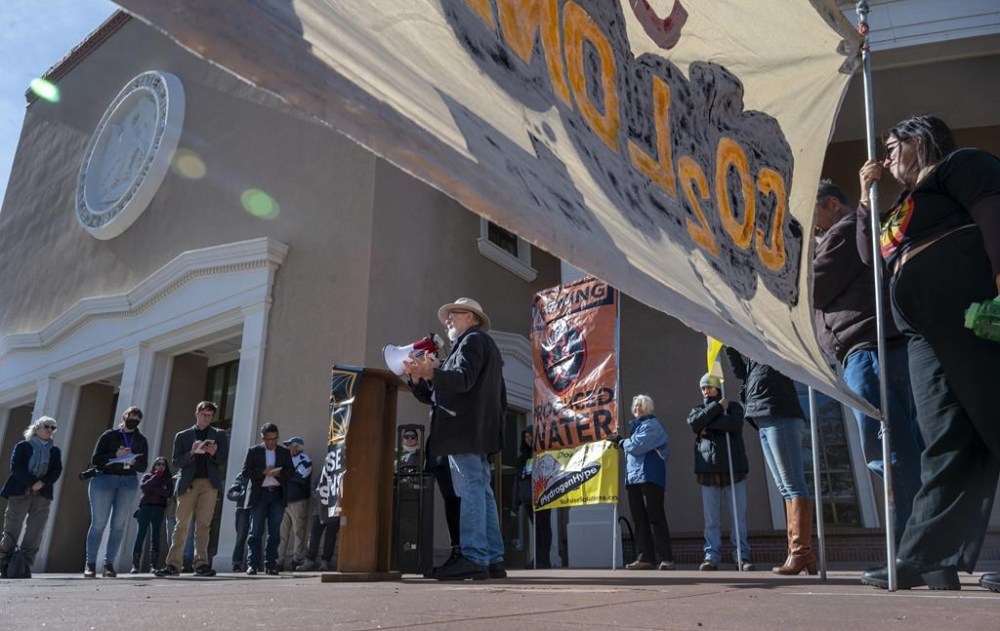
An array of environmental and social-justice groups gathered outside the Statehouse to denounce the governor’s plan as a handout to the oil and natural gas industry that won’t necessarily decrease pressure on the state’s ancient underground aquifers.
“It’s intended to help oil and gas producers, particularly in the Permian Basin, to resolve their enormous problem with wastewater disposal and allow for continued extraction” of petroleum, said Mariel Nanasi, executive director of the environmental and consumer protection group New Energy Economy.
Julia Bernal, executive director of the environmental justice group Pueblo Action Alliance, sees the initiative as an attempt to secure more water supplies for the production of hydrogen.
Hydrogen can be made by splitting water with solar, wind, nuclear or geothermal electricity yielding little if any planet-warming greenhouse gases. But most hydrogen today is not made this way and does contribute to climate change because it is made from natural gas.

“We would like to see more investment in wind and solar, more community based projects,” said Bernal, a tribal member of Sandia Pueblo.
Inside the Capitol, state Environment Department Secretary James Kenney briefed a state Senate budget-writing on the administration’s plan to underwrite the project with up to $500 million in bonds over a two-year period, to spur private investment in water-treatment and desalination infrastructure.
Approval from the Legislature is necessary under a construction-spending bill that has not yet been introduced. The state’s annual legislative session ends on Feb. 15.
The Environment Department is proposing a new regulatory framework for reusing oil-industry wastewater and desalination of naturally occurring brine. On Monday, it also announced a related request for technical and economic briefings by people in business, academia, government agencies — or other interested individuals.
New Mexico has extensive underground reservoirs of salty water that have been of limited use. That brackish water is a crucial component in hydraulic fracturing, or fracking, and advanced drilling techniques that have helped turn New Mexico into the No. 2 oil production state in the U.S.