Alberta First Nations seek answers on carbon capture and storage plans

Advertisement

Advertise with us

Seven Alberta First Nations have banded together to seek answers as industry and government move on billion-dollar plans to inject and store millions of tonnes of greenhouse gases underneath or adjacent to their traditional lands.

Read this article for free:


or

Already have an account? Log in here »

To continue reading, please subscribe:

Subscribe and receive a limited-edition Free Press branded hat or tote.

Digital Subscription

One year of digital access for only $205*

  • Enjoy unlimited reading on winnipegfreepress.com
  • Read the E-Edition, our digital replica newspaper
  • Access News Break, our award-winning app
  • Play interactive puzzles

*First annual payment billed as $205.00 + GST for one year. This annual subscription will automatically renew at $233.00 + GST every 52 weeks (10% off the regular annual price of $259.35). Offer available to new and qualified returning subscribers only. Cancel any time.

To continue reading, please subscribe:

Add Free Press access to your Brandon Sun subscription for only an additional

$1 for the first 4 weeks*

  • Enjoy unlimited reading on winnipegfreepress.com
  • Read the E-Edition, our digital replica newspaper
  • Access News Break, our award-winning app
  • Play interactive puzzles
Start now

*Your next Brandon Sun subscription payment will increase by $1.00 and you will be charged $17.95 plus GST for four weeks. After four weeks, your payment will increase to $24.95 plus GST every four weeks.

Hey there, time traveller!
This article was published 18/02/2024 (938 days ago), so information in it may no longer be current.

Seven Alberta First Nations have banded together to seek answers as industry and government move on billion-dollar plans to inject and store millions of tonnes of greenhouse gases underneath or adjacent to their traditional lands.

“We don’t know how pumping carbon underground will affect our lakes, our rivers — even our underground reservoirs,” said councillor Michael Lameman of Beaver Lake Cree Nation, one of the members of the Treaty 6 working group.

“(Industry’s) been vague, not very forthcoming.”
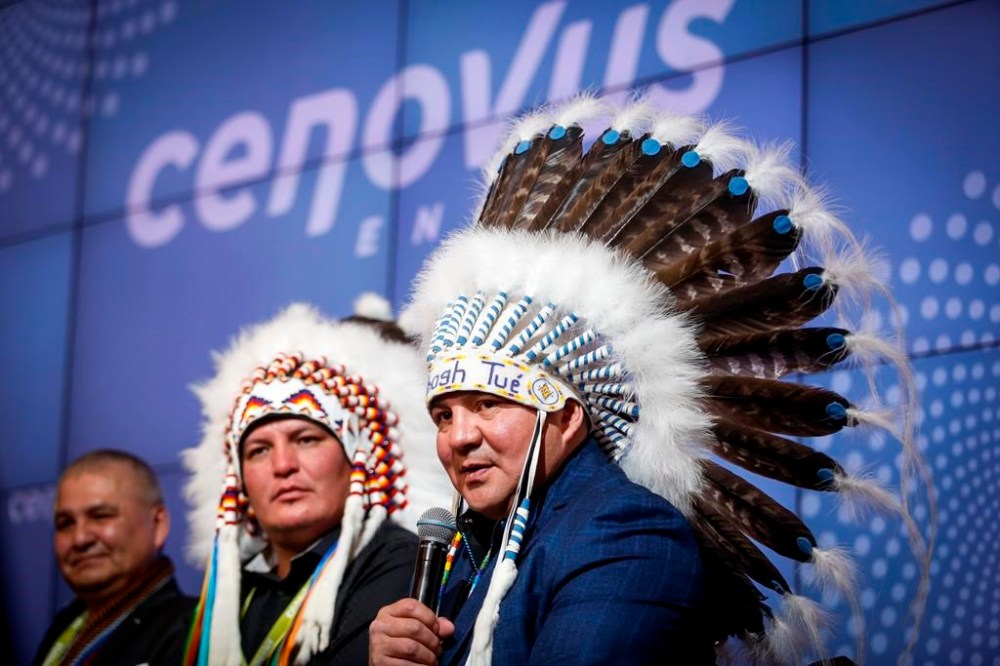
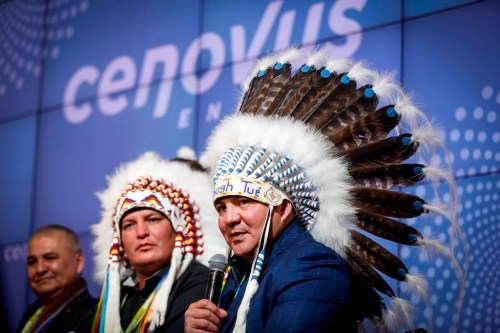
Seven Alberta First Nations have banded together to seek answers as industry and government move on billion-dollar plans to inject and store millions of tonnes of greenhouse gases underneath or adjacent to their traditional lands. Roger Marten, right, Chief of Cold Lake First Nations, and Curtis Monias, centre, Chief of Heart Lake First Nation, speak after Cenovus CEO Alex Pourbaix made an annoucement at a news conference in Calgary, Alta., Thursday, Jan. 30, 2020. THE CANADIAN PRESS/Jeff McIntosh

The working group includes Heart Lake First Nation, Beaver Lake Cree Nation, Whitefish Lake First Nation, Kehewin Cree Nation, Frog Lake First Nation, Cold Lake First Nations and Onion Lake Cree Nation. Saddle Lake Cree Nation is observing the group.

“There’s lots to be checked as far as the project relates to both the safety of the environment and the communities,” said Darryl Steinhauer, consultation co-ordinator for Whitefish Lake.

“The (carbon capture) project is inclusive of eight Nations where people are not only practising their treaty rights but living there day to day. Safety is a big concern.”

Industry says it’s doing its best.

“We are in the early stages of consultation with communities,” said a statement from Kendall Dilling, head of Pathways Alliance, which represents 95 per cent of Alberta’s oilsands production. “We are dedicated to working together with Treaty 6 First Nations and ongoing discussions will take place in a confidential manner.”

A Pathways spokeswoman said the first project-related applications are expected by the end of next month.

“Focusing initially on the proposed right-of-way for the CO2 transportation network, Pathways now intends to target filing applications under the Public Lands Act in (the first quarter),” Jerrica Goodwin said in an email.

Indigenous communities, who watch the promotional TV ads and hear the support from politicians, say they feel the momentum building.

“We’re hearing a lot of concerns,” said Steinhauer. “(Councillors) are getting called in the evening about it, saying ‘Hey, what’s going on?’ ”

The bands would like to know.

“The Pathways Alliance has not provided our First Nations with any reports or data assessing the potential risks associated with the storage of carbon adjacent to and beneath our reserve lands,” says an Oct. 13 letter from the First Nations to Pathways.

Pathways Alliance is proposing a gargantuan scheme to capture carbon dioxide from 13 oilsands facilities, pipe it hundreds of kilometres south and pump it from at least 16 injection wells to more than a kilometre underground. There, porous limestone underneath a layer of solid rock salt is to hold it fast.

The first phase is budgeted at $16.5 billion and will stash up to 12 million tonnes of carbon a year by 2030. Depending on who’s measuring, that’s between 12 and 17 per cent of the oilsands’ annual emissions.

Advocates say projects such as the Boundary Dam power plant in Saskatchewan and Shell’s Quest project outside Edmonton prove carbon capture and storage can work. Quest injects about a million tonnes of carbon dioxide underground annually.

Others say leakage — especially through poorly sealed oil and gas wells or into groundwater — remains a concern.

Alberta’s underground carbon tank is vast. A Pathways map suggests its proposed storage hub covers thousands of square kilometres of northeastern Alberta.

That map does not show any reserve lands or First Nations communities, although there are 11 such areas within or adjacent to it.

“The map of the proposed sequestration hub … is premised on the notion that our First Nations and our reserve lands either do not exist or we simply don’t matter,” says the letter from the First Nations.

The approval process for the project also raises concerns.

Renato Gandia, spokesman for the Alberta Energy Regulator, said the agency reviews facilities that capture carbon, pipelines that transport it and wells that inject it. It has also been delegated responsibility for reviewing risk assessment, monitoring and cleanup plans for carbon storage.

“A carbon sequestration tenure or agreement from the government of Alberta is required if a company wants to apply for a CCS project,” Gandia wrote in an email.

Applications under the Carbon Sequestration Tenure Regulations require risk assessment, monitoring and cleanup plans. Those regulations do not mention avenues for public input, although such projects will come under the regulator’s established review processes.

“It appears that the regulatory regime is going to consist of a series of isolated, low-level regulatory applications,” said Clayton Leonard, lawyer for several of the First Nations in the working group.

Pore space under reserve lands is owned by First Nations. Leonard said it’s unlikely that carbon dioxide injected into Crown land can be kept from seeping under reserves.

“I don’t think you can talk about pore space with that neat boundary to it.”

Leonard said information gleaned from public meetings held in non-reserve communities suggests injection wells will be located close to reserves.

“That really raises our level of concern.”

Meanwhile, Steinhauer said he continues to face questions from band members every day.

“Grocery shopping isn’t as quick any more as it used to be.”

This report by The Canadian Press was first published Feb. 18, 2024.

Note to readers: This is a corrected story. A previous version said Alberta’s Energy minister is responsible for issuing carbon storage permits and in charge of reviewing such plans. In fact, that authority has been delegated to the Alberta Energy Regulator.
Report Error Submit a Tip

More Stories

A life's story: ‘Ivor the Driver’ found his calling in the ranching life

Aaron Epp 7 minute read Preview

A life's story: ‘Ivor the Driver’ found his calling in the ranching life

Aaron Epp 7 minute read Updated: Yesterday at 9:59 AM CDT

Ivor Asham’s family couldn’t have picked a better image to accompany his obituary. There he is, riding Flash, his beloved brown and white quarter horse, a black cowboy hat on his head and a drink in his hand.

Asham owned and operated Birds Hill Park Ranch for nearly 35 years, where he shared his lifelong passion for horses with thousands of visitors. He moved hay, harnessed horses and drove the wagons, introducing himself as “Ivor the Driver.”

Over the years, Asham built a reputation as the quintessential cowboy.

There’s a restaurant at the ranch filled with memorabilia that he collected over the years. Calgary Stampede posters, cowboy boot-shaped shot glasses, a child’s rocking horse, a wagon wheel and numerous photos of legendary actor John Wayne are just some of the items that line the walls.

Read
Updated: Yesterday at 9:59 AM CDT

City to hire consultant to analyze 911 staffing levels amid skyrocketing calls

Joyanne Pursaga 4 minute read Preview

City to hire consultant to analyze 911 staffing levels amid skyrocketing calls

Joyanne Pursaga 4 minute read Friday, Sep. 11, 2026

The Winnipeg Fire Paramedic Service is ordering a detailed analysis of its 911 communications staffing level to cope with a surge in emergency calls and the demands of new technology.

WFPS emergency communications staff handled calls for 136,198 separate incidents in 2025. That number has risen every year since at least 2020, when 104,250 incidents were reported, the service’s annual report notes.

The total number of calls to the centre reached almost 275,000 last year. That broader figure also includes multiple calls per event and administrative calls.

“Things have changed in the last decade and call volumes have increased dramatically. That puts pressure on our systems,” said Coun. Vivian Santos (Point Douglas).

Read
Friday, Sep. 11, 2026

Alberta First Nations seek answers on carbon capture and storage plans

Bob Weber, The Canadian Press 6 minute read Preview

Alberta First Nations seek answers on carbon capture and storage plans

Bob Weber, The Canadian Press 6 minute read Friday, Feb. 23, 2024

Seven Alberta First Nations have banded together to seek answers as industry and government move on billion-dollar plans to inject and store millions of tonnes of greenhouse gases underneath or adjacent to their traditional lands.

"We don't know how pumping carbon underground will affect our lakes, our rivers — even our underground reservoirs," said councillor Michael Lameman of Beaver Lake Cree Nation, one of the members of the Treaty 6 working group.

"(Industry's) been vague, not very forthcoming."

The working group includes Heart Lake First Nation, Beaver Lake Cree Nation, Whitefish Lake First Nation, Kehewin Cree Nation, Frog Lake First Nation, Cold Lake First Nations and Onion Lake Cree Nation. Saddle Lake Cree Nation is observing the group.

Read
Friday, Feb. 23, 2024

The port of Churchill — but done right

Editorial 4 minute read Preview

The port of Churchill — but done right

Editorial 4 minute read Yesterday at 2:00 AM CDT

The seagoing grain carrier wasn’t christened with a champagne bottle. There was no confetti or streamers. Nevertheless, the Aug. 31 event marking the first shipment of grain to be loaded at the Port of Churchill since 2020 was celebrated like the launch of a brand new vessel.

The presence of the federal minister of northern and arctic affairs, provincial cabinet ministers and leaders and elders from several northern First Nations signalled that the fast-tracked process of refurbishing and buffing up Manitoba’s deep-water seaport gem is gaining momentum.

For OneNorth, the partnership of 29 First Nations and 12 northern communities which owns the Port of Churchill and the Hudson Bay Railway (both operated by the Arctic Gateway Group) the event heralded a new beginning. It’s been eight years since OneNorth purchased the port and railroad, and six years since grain was moved by rail through Manitoba and then by ship to European markets. Two more grain shipments, plus shipments of potash and critical minerals, will continue through the fall.

When Prime Minister Mark Carney solicited the premiers to suggest “nation-building” projects following his election in 2025, Premier Wab Kinew pitched a Manitoba trade corridor that would move wheat, critical minerals, potash and energy (oil or liquid natural gas) through the Port of Churchill.

Read
Yesterday at 2:00 AM CDT

Drug recovery centre opens office in ‘heart of the city’

Morgan Modjeski 4 minute read Preview

Drug recovery centre opens office in ‘heart of the city’

Morgan Modjeski 4 minute read Yesterday at 3:38 PM CDT

Richard Halverson found his freedom from addiction through Adult & Teen Challenge and, six years later, he hopes a new Winnipeg location will bring hope to the city.

Dozens gathered Saturday morning to mark the grand opening of the recovery centre’s community services office on Main Street.

Located inside the former Wojcik funeral home, the bright-white building — which was also formerly a liquor store — will serve as an access point for people fighting drug addiction. That includes connecting them to addictions support, housing and training.

“For me, I always start with: ‘What’s your story?’” said Halverson, who now works for the faith-based organization.

Read
Yesterday at 3:38 PM CDT

Puzzles Palace

1 minute read Monday, Jul. 27, 2026

To solve our puzzles, please subscribe with this special offer: |