Tiny, endangered fish hinders California River water conservation plan
Advertisement
Read this article for free:
or
Already have an account? Log in here »
To continue reading, please subscribe:

Digital Subscription
One year of digital access for only $205*
- Enjoy unlimited reading on winnipegfreepress.com
- Read the E-Edition, our digital replica newspaper
- Access News Break, our award-winning app
- Play interactive puzzles
*First annual payment billed as $205.00 + GST for one year. This annual subscription will automatically renew at $233.00 + GST every 52 weeks (10% off the regular annual price of $259.35). Offer available to new and qualified returning subscribers only. Cancel any time.
To continue reading, please subscribe:
Add Free Press access to your Brandon Sun subscription for only an additional
$1 for the first 4 weeks*
- Enjoy unlimited reading on winnipegfreepress.com
- Read the E-Edition, our digital replica newspaper
- Access News Break, our award-winning app
- Play interactive puzzles
*Your next Brandon Sun subscription payment will increase by $1.00 and you will be charged $17.95 plus GST for four weeks. After four weeks, your payment will increase to $24.95 plus GST every four weeks.
Read unlimited articles for free today:
or
Already have an account? Log in here »
Hey there, time traveller!
This article was published 26/03/2024 (920 days ago), so information in it may no longer be current.
Southern California’s Imperial Irrigation District, which supplies water to farmers who grow most of the nation’s winter vegetables, planned to start a conservation program in April to scale back what it draws from the critical Colorado River.
But a tiny, tough fish got in the way.
Now, those plans won’t start until at least June so water and wildlife officials can devise a way to ensure the endangered desert pupfish and other species are protected, said Jamie Asbury, the irrigation district’s general manager. The proposal to pay farmers to temporarily stop watering feed crops such as alfalfa this summer has environmentalists concerned that irrigation drains could dry up, threatening the fish that measures the length of an ATM card.
“Drains are created for farmers to be able to convey irrigation runoff, and the pupfish decided it was a good place to live,” Asbury said.
Protecting the desert pupfish, listed as endangered since 1986, has been one of many vexing problems facing the Colorado River and the people and species that rely on it.
The 1,450-mile (2,334-kilometer) river provides water to 40 million people in seven U.S. states, parts of Mexico and more than two dozen Native American tribes. It’s long been over-tapped, a problem aggravated by recent years of prolonged drought. The Western states are negotiating a new long-term use plan meant to stabilize the river.
Last year, Arizona, Nevada and California offered to cut back on their use of Colorado River water in exchange for money from the federal government to avoid forced cuts. California, which gets the most water of all the states based on a century-old water rights priority system, agreed to give up 1.6 million acre-feet of water through 2026, with more than half coming from the Imperial Irrigation District. An acre-foot serves about two to three U.S. households per year.
The Imperial district envisioned a summer idling program in which farmers could turn off water for 60 days for feed crops since yields already are down at that time of year and growing requires much more water. But environmental officials worried that limiting the flow of water through irrigation drains could harm the desert pupfish. They also raised concerns about the impact on migratory birds that frequent the Salton Sea, Asbury said.
Now the district, the biggest user of Colorado River water with more than 3,000 miles (4,828 kilometers) of canals and drains, is in talks with state and federal officials on how it can proceed while setting up a monitoring program to ensure the fish isn’t further threatened, Asbury said.
The curious fish — the males turn blue during breeding season while females are tan or olive — was once plentiful. But with the introduction of invasive species in the Colorado River, its numbers dwindled, according to California’s Department of Fish and Wildlife. The fish feeds on invertebrates and snails and can handle an extreme range of water temperatures and both fresh and saltwater.
Today, it lives in a few areas in California, Arizona and Mexico, including the Imperial Irrigation District’s drains, which funnel water runoff from farms in California’s Imperial Valley into the saline Salton Sea, a drying lake with no outlet that’s a stopover point for migratory birds.
Often, the district’s drains have more fresh water than the Salton Sea, so the fish seek out those spaces, said Ileene Anderson, senior scientist with the Center for Biological Diversity. The fish has proven remarkably resilient and can survive in water with low oxygen levels, high salinity and temperatures of more than 100 degrees Fahrenheit (37.7 degrees Celsius).
“A lot of them do live in these really bizarre drains, these agricultural drains,” she said. “These fish are incredibly tough — they basically just try to find a space where they can carry on their lives.”

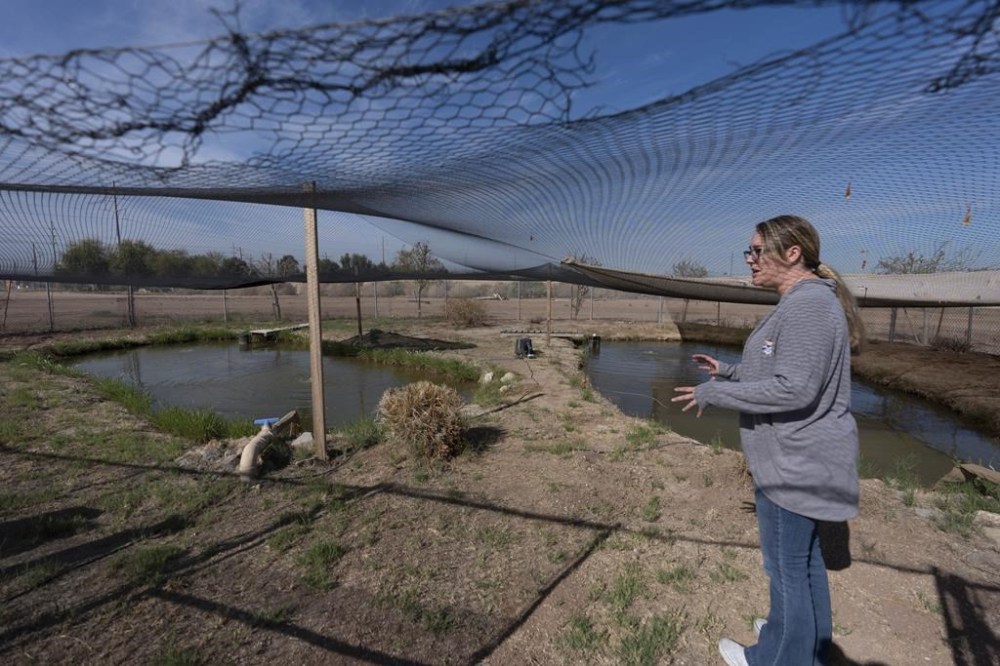
The desert pupfish is a key part of the ecosystem in the Salton Sea, feeding on biting flies and serving as a food source for birds, said James Danoff-Burg, vice president of conservation at the Palm Desert-based Living Desert Zoo and Gardens, which works on desert conservation. In the summer, creeks that flow into the Salton Sea can dry out so much the fish risk getting stranded, so they are moved to special ponds as an insurance population, he said.
California’s Department of Fish and Wildlife declined to discuss the water conservation plan. The department said in an emailed statement that officials support water use reductions on the Colorado River and will work with other agencies to “find solutions that proactively minimize and mitigate any potential impacts to the great work underway.”
The U.S. Bureau of Reclamation, which operates major dams in the Colorado River system, did not immediately comment.
Environmentalists have long said that while many species depend on the Colorado River, decisions about how to use its water typically focus on human needs, not wildlife.
“This is conservation,” Danoff-Burg said. “There are always wicked problems, as they say, all these conflicting things that are working against each other, and you try to muddle through as best you can.”