As fire season fast approaches, Greece’s planners look for an edge in response time
Advertisement
Read this article for free:
or
Already have an account? Log in here »
To continue reading, please subscribe:

Digital Subscription
One year of digital access for only $205*
- Enjoy unlimited reading on winnipegfreepress.com
- Read the E-Edition, our digital replica newspaper
- Access News Break, our award-winning app
- Play interactive puzzles
*First annual payment billed as $205.00 + GST for one year. This annual subscription will automatically renew at $233.00 + GST every 52 weeks (10% off the regular annual price of $259.35). Offer available to new and qualified returning subscribers only. Cancel any time.
To continue reading, please subscribe:
Add Free Press access to your Brandon Sun subscription for only an additional
$1 for the first 4 weeks*
- Enjoy unlimited reading on winnipegfreepress.com
- Read the E-Edition, our digital replica newspaper
- Access News Break, our award-winning app
- Play interactive puzzles
*Your next Brandon Sun subscription payment will increase by $1.00 and you will be charged $17.95 plus GST for four weeks. After four weeks, your payment will increase to $24.95 plus GST every four weeks.
Read unlimited articles for free today:
or
Already have an account? Log in here »
Hey there, time traveller!
This article was published 04/04/2024 (906 days ago), so information in it may no longer be current.
GLYKA NERA, Greece (AP) — In a drill at a 12th century monastery near Athens, a fast-approaching wildfire threatens to trap clergy and a group of people attending a baptism.
Volunteers and firefighters race to pull them to safety through clouds of red smoke, as a drone buzzing overhead sends live video of the rescue to a national coordination center.
Members of the baptism party are played by actors hired for the day by the Fire Service and the regional authority, and smoke flares are used to mimic fire conditions.
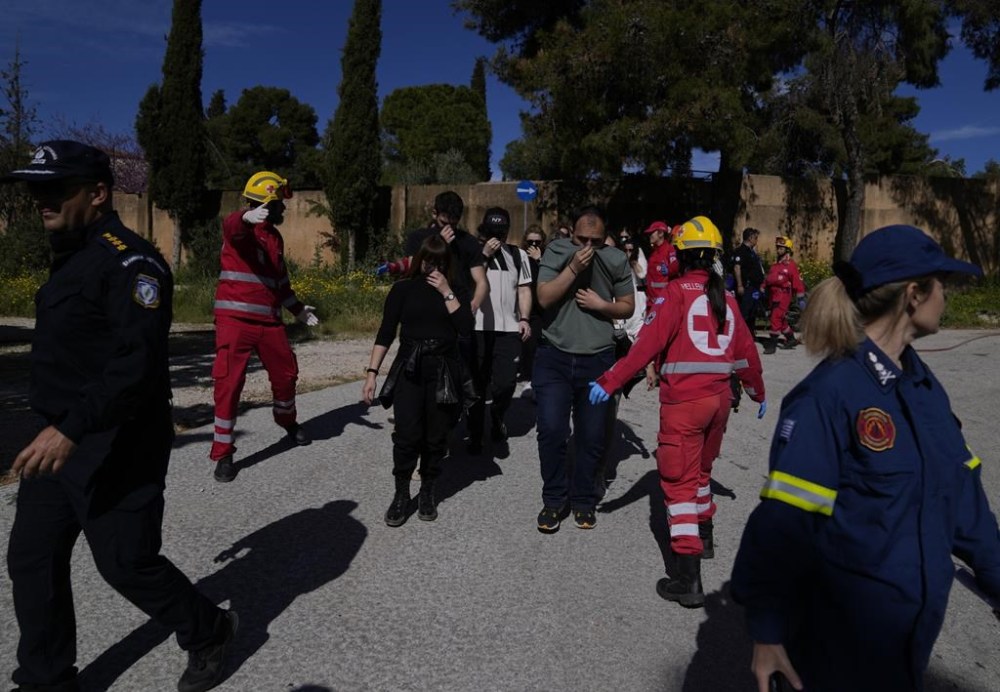
The exercise held Thursday and multiple drills planned this month have taken on added urgency ahead of the fire season that officially starts May 1.
Temperatures touched 30 degrees Celsius (86 Fahrenheit) in late March and large wildfires are already breaking out weeks earlier than expected.
“Due to climate, conditions have changed. Everything in nature is dry now and it’s very easy to catch fire. So we have to be ready to deal with it,” said Loukia Kefalogianni, the deputy regional government of the capital’s North Attica region.
To cope with the crisis, Greece is fast-tracking a 2.1 billion euro ($2.3 billion) program to upgrade its fleet of water tankers and create an artificial intelligence-driven sensor network to detect smoke in the early stages of a fire.

But delivery of the new equipment won’t start until next year, leaving planners to scramble to find alternatives to cut response times.
In the short term, authorities are betting on a host of preventive measures, a more flexible administration, better inter-agency cooperation including local governments and the military, and many more practice runs before scorching summer months arrive.
“Εxercises like this one today are very, very helpful because all the agencies communicate with each other and work together to get better results on a larger scale,” said Christos Symiakakis, a deputy fire chief for the region.
Greece was again at the center of Europe’s fire season last summer with the worst fire in European Union records. Fires burned an estimated 1,750 square kilometers (675 square miles) last year.
Deliveries to Greece of seven new Canadian-built DHC-515 firefighting aircraft, part of a larger European Union order by six member states, will begin in 2027.