Mercury exposure widespread among Yanomami tribe in Amazon, report finds
Advertisement
Read this article for free:
or
Already have an account? Log in here »
To continue reading, please subscribe:

Digital Subscription
One year of digital access for only $205*
- Enjoy unlimited reading on winnipegfreepress.com
- Read the E-Edition, our digital replica newspaper
- Access News Break, our award-winning app
- Play interactive puzzles
*First annual payment billed as $205.00 + GST for one year. This annual subscription will automatically renew at $233.00 + GST every 52 weeks (10% off the regular annual price of $259.35). Offer available to new and qualified returning subscribers only. Cancel any time.
To continue reading, please subscribe:
Add Free Press access to your Brandon Sun subscription for only an additional
$1 for the first 4 weeks*
- Enjoy unlimited reading on winnipegfreepress.com
- Read the E-Edition, our digital replica newspaper
- Access News Break, our award-winning app
- Play interactive puzzles
*Your next Brandon Sun subscription payment will increase by $1.00 and you will be charged $17.95 plus GST for four weeks. After four weeks, your payment will increase to $24.95 plus GST every four weeks.
Read unlimited articles for free today:
or
Already have an account? Log in here »
Hey there, time traveller!
This article was published 04/04/2024 (911 days ago), so information in it may no longer be current.
BRASILIA, Brazil (AP) — Many Yanomami, the Amazon’s largest Indigenous tribe in relative isolation, have been contaminated with mercury coming from widespread illegal gold mining, according to a report released on Thursday by Brazil’s top public health institute.
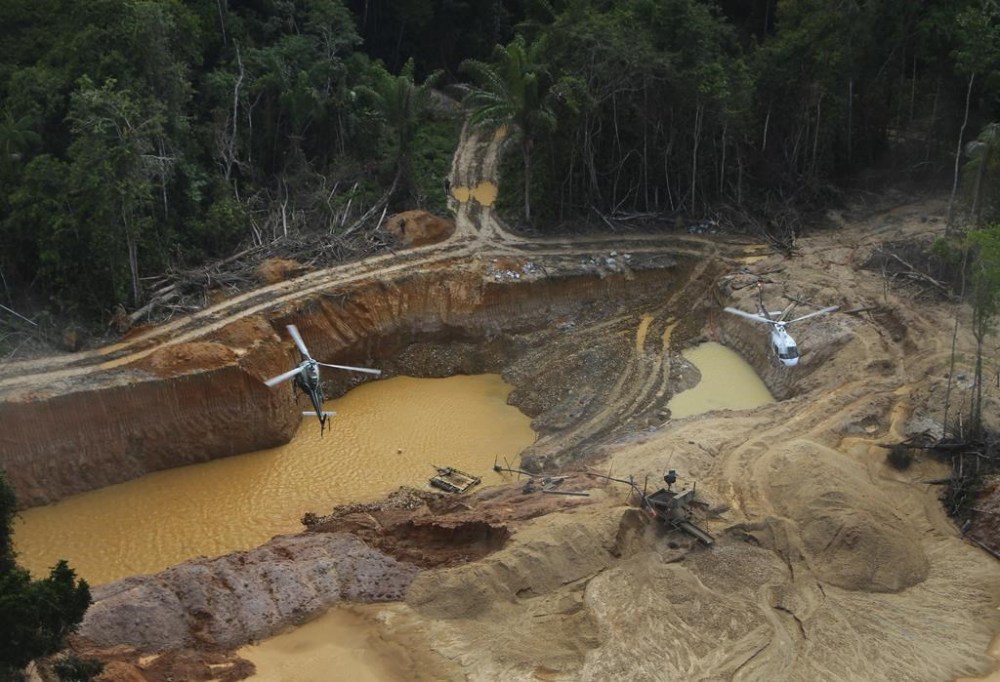
The research was conducted in nine villages along the Mucajai River, a remote region where illegal mining is widespread. Mercury, a poison, is commonly used in illegal mining to process gold.
The researchers collected hair samples from nearly 300 Yanomami of all ages. They were then examined by doctors, neurologists, psychologists and nurses.
The vast majority, 84% of Yanomami tested, had contamination equal to or above 2 micrograms per gram, a level of exposure that can lead to several health problems, according to standards by the U.S. Environmental Protection Agency and World Health Organization.
Even more worrying, a smaller part of this group, 10%, surpassed the 6 micrograms per gram threshold, a contamination level often associated with more severe medical conditions.
Research teams also tested fish in the area, finding high levels in them. Eating fish with high mercury levels is the most common path of exposure.
Exposure studies usually test for methylmercury, a powerful neurotoxin formed when bacteria, in this case in rivers, metabolize inorganic mercury. Ingestion of large amounts over weeks or months damages the nervous system. The substance also can pass through a placenta of a pregnant woman, exposing a fetus to developmental abnormalities and cerebral palsy, according to the U.S. Centers for Disease Control and Prevention.
Health effects can include decreased sensitivity in the legs, feet, and hands, overall weakness, dizziness, and ringing in the ears. In some cases, a compromise of the central nervous system can lead to mobility issues.
“Chronic exposure to mercury settles in slowly and progressively,” Paulo Basta, an epidemiologist with the Oswaldo Cruz Foundation, which led the testing, told The Associated Press. “There’s a wide spectrum of clinical actions that range from mild to severe symptoms.”
Concerted global efforts to address mercury pollution led to the 2013 Minamata Convention, a UN-backed agreement signed by 148 parties to curb emissions. The treaty is named after the Japanese city of Minamata, whose population was contaminated by decades-long emissions of mercury dumped along with wastewater. Brazil and the United States were among the signatories.
The Brazilian government report has not been peer reviewed but synthesizes three papers published recently in the journal Toxics, all based on the same field work. One of the studies noted that determining what long-term mercury exposure levels constitute a significant risk for health remains a challenge.
The study’s findings align with prior research in other areas of the Amazon, said Maria Elena Crespo López, a biochemist at the Federal University of Pará who was not involved in the report and has studied the subject for 20 years.
“The mercury problem is widespread throughout the Amazon,” she told the AP. “Since the 1970s, when the first major gold rush happened here, mercury has been released for decades and ends up being transported over long distances, entering the food chain.”
A global review of mercury exposure in the journal Environmental Health Perspectives in 2018 identified Amazon river tributary communities as one of four communities of most concern.
The World Health Organization ranks small-scale gold mining as the single largest source of human-led contamination. The Yanomami territory, which spans the size of Portugal and has a population of 27,000, has endured decades of this illegal activity.
The mining problem significantly expanded during the four-year term of far-right President Jair Bolsonaro, which ended in 2022. He defanged Brazil’s environment protection agencies amid rising gold prices. The combination caused a rush of thousands of miners onto Yanomami lands. Basta said that during the fieldwork, which took place near the end of Bolsonaro’s term, Mucajai was teeming with illegal miners.
Upon arrival by plane, the 22-strong team had to wait for about hours to proceed by boat due to heavy gold barge traffic in the Mucajai River. During ten days of testing, researchers were guarded by four military police carrying machine guns and grenades. Basta recalls counting 30 to 35 small planes flying to and from illegal mining sites each day.

“The tension was present throughout our entire stay in the village. I have been working in indigenous villages for 25 years, and it was the most tense work I have done,” he said.
Current President Luiz Inácio Lula da Silva has pledged to expel gold prospectors from Yanomami territory and improve health conditions, but the task is far from complete.
“Mining is the biggest threat we face in Yanomami land today,” Yanomami leader Dário Kopenawa said in a statement. “It’s mandatory and urgent to expel these intruders. If mining continues, so will contamination, devastation, malaria, and malnutrition. This research provides concrete evidence of it.”
___
The Associated Press’ climate and environmental coverage receives financial support from multiple private foundations. AP is solely responsible for all content. Find AP’s standards for working with philanthropies, a list of supporters and funded coverage areas at AP.org.