Cap on plastic production remains contentious as Ottawa set to host treaty talks
Advertisement
Read this article for free:
or
Already have an account? Log in here »
To continue reading, please subscribe:

Digital Subscription
One year of digital access for only $205*
- Enjoy unlimited reading on winnipegfreepress.com
- Read the E-Edition, our digital replica newspaper
- Access News Break, our award-winning app
- Play interactive puzzles
*First annual payment billed as $205.00 + GST for one year. This annual subscription will automatically renew at $233.00 + GST every 52 weeks (10% off the regular annual price of $259.35). Offer available to new and qualified returning subscribers only. Cancel any time.
To continue reading, please subscribe:
Add Free Press access to your Brandon Sun subscription for only an additional
$1 for the first 4 weeks*
- Enjoy unlimited reading on winnipegfreepress.com
- Read the E-Edition, our digital replica newspaper
- Access News Break, our award-winning app
- Play interactive puzzles
*Your next Brandon Sun subscription payment will increase by $1.00 and you will be charged $17.95 plus GST for four weeks. After four weeks, your payment will increase to $24.95 plus GST every four weeks.
Read unlimited articles for free today:
or
Already have an account? Log in here »
Hey there, time traveller!
This article was published 21/04/2024 (878 days ago), so information in it may no longer be current.
OTTAWA – Negotiators from 176 countries will gather in downtown Ottawa this week for the fourth round of talks to create a global treaty to eliminate plastic waste in less than 20 years.
Ottawa is hosting the fourth of five rounds of negotiations, with the aim of finalizing a deal by the end of the year.
The proliferation of plastics has been profound, as it is a preferred material largely for its affordability and longevity. But that also means it never goes away, and the impact on nature and growing concerns about human health are leading a push to get rid of plastic waste and eliminate the most problematic chemicals used to make it.
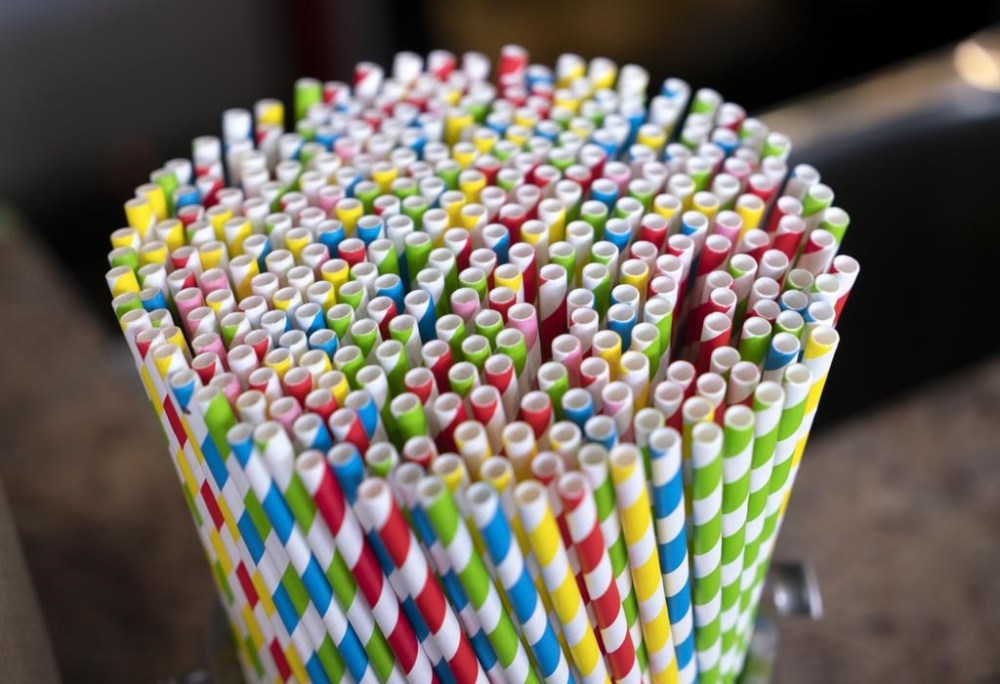
Paper straws are seen at a market in Montreal on Thursday, June 13, 2019. Negotiators from 176 countries will gather in downtown Ottawa this week for the fourth round of talks to create a global treaty to eliminate plastic waste in less than 20 years. THE CANADIAN PRESS/Paul Chiasson
Canada’s environment minister, Steven Guilbeault, played a crucial role in getting the plastic treaty talks underway in 2022 when he helped push a resolution at the United Nations Environment Assembly in Kenya. He remains firm that a strong treaty is needed.
“We want to move as rapidly as possible to eliminate plastic pollution,” he said in an interview with The Canadian Press. “I mean, the collective goal we’ve set for ourselves is to do it by 2040, but I think both from an environmental and a health perspective, the sooner the better.”
But Guilbeault is still reluctant to take a definitive position on the elephant in the negotiating room: a cap on plastic production.
“We want an ambitious treaty,” he said.
“I don’t think right now is the time to start … getting bogged down on certain things and say, ‘OK, well, this is it.’ Let’s have the conversation and see where we land.”
For many environmental and health organizations observing the talks, the only way to solve the plastic crisis is to cut back on the amount produced in the first place.
But that’s a no-go zone for the chemical and plastic production industries, whose members argue alternatives to plastic are often more expensive, more energy intensive and heavier.
Karen Wirsig, senior program manager for plastics at advocacy organization Environmental Defence, said plastic production will double by 2050 if left unchecked. Plastic waste could triple by 2060, she added.
“Plastic pollution is a global crisis that intensifies every day when we let plastic production and use go unchecked,” she said.
“The Earth and our health cannot afford business as usual.”
The Organization for Economic Co-operation says global plastic production grew from 234 million tonnes in 2000 to 460 million tonnes in 2019, while plastic waste grew from 156 million tonnes to 353 million tonnes.
Globally about half of that waste ends up in landfills, one-fifth is incinerated, sometimes to create electricity, and almost one-tenth is recycled. More than one-fifth is “mismanaged,” meaning it ends up in places it is not supposed to be.
The mismanagement issue is far worse in developing economies, where waste management programs are limited if they exist at all. In some parts of Africa, the OECD said almost two-thirds of plastic waste is mismanaged, and in much of Asia almost half. That compares with less than one-tenth across the world’s richest countries.
Adding to that problem is that rich countries continue to export their garbage overseas despite international rules in place to prevent the practice. Last fall a Canadian Press investigation in partnership with Lighthouse Reports and journalists in Myanmar, Thailand and Europe found evidence of Canadian plastic food wrappers and plumbing parts in trash heaps encircling homes and gardens in a Myanmar town.
In Canada, the OECD reported, more than 80 per cent of plastic waste is landfilled, and only six per cent recycled. Seven per cent is mismanaged.
The evolving treaty has several areas of focus, including discussions on a cap on production, reducing the types of products most commonly found in nature, and what are known as chemicals of concern.
A UN report prepared ahead of the second round of treaty talks in Paris last June said more than 13,000 chemicals are used to make plastics, and 10 groups of those chemicals are highly toxic and likely to leech out of their products. That includes flame retardants, ultraviolet stabilizers and additives used to make plastics harder, waterproof or stain resistant.
Dr. Lyndia Dernis, a Montreal anesthesiologist and member of the Canadian Association of Physicians for the Environment, said most plastic additives are endocrine disrupters, which cause everything from diabetes and obesity to high blood pressure, infertility, cancer and immunologic disorders.
Plastic is extremely common in medicine. When she starts an intravenous for a pregnant patient, for instance, she said that material contains phthalates, “a very well studied endocrine disruptor.”
“Early in pregnancy the baby girl’s reproductive system is in place, including all the eggs for the rest of her life. This means that when I start an intravenous, I’m exposing three generations at once: the pregnant mom, her future baby girl, and the babies of that baby to be,” she said.
Greenpeace and other environmental groups are calling for plastic production to be cut 75 per cent from 2019 levels by 2040. Recycling, they argue, is a myth that doesn’t really happen. Most of what Canadians toss in their blue boxes still ends up in the landfill.
Isabelle Des Chênes, vice-president of policy for the Chemistry Industry Association of Canada, said society can’t ban or cap its way out of plastic waste.
For Des Chênes, the key component to the treaty is to create a “circular economy” where companies design products to be reused and recycled, rather than thrown away.
That includes investments in equipment to break plastics back down into their original compounds to be used again, as well as standardizing designs to make recycling possible, she said.
Des Chênes said if you just look at potato chip bags, which are made of layers of different plastic polymers, those layers differ depending on the brand. It is easier to recycle those bags if there is consistency.
Guilbeault has promised regulations in Canada to require both minimum amounts of recycled content in plastics and consistency in design. Both will increase a market for recycling, which is very limited in Canada. Updates on those promises could be expected during the treaty talks, he implied.
Some of Canada’s domestic efforts are on pause after the Federal Court ruled last fall that a government decision to designate all plastics as “toxic” was too broad. That designation is what Canada is using to ban the production and use of some single-use plastics like straws, grocery bags and takeout containers.
Canada is appealing that decision and Guilbeault said the case won’t have any influence on federal positions during treaty talks.
November treaty talks in Kenya saw the deal’s draft text balloon from 35 pages to more than 70. It currently contains a lot of repetition, with multiple options on line items reflecting varying viewpoints.
Guilbeault said he’d like to get that text “70 per cent clean” by the end of the Ottawa round, leaving the most difficult issues to be handled in side talks over the summer and then in the final discussions in Korea in the fall.
The treaty talks in Ottawa begin Tuesday and run for seven days.
This report by The Canadian Press was first published April 21, 2024.
Related Articles
Canada to force plastic makers to report how much they make, reuse and recycle

Advertisement Advertise With Us
Advertisement Advertise With Us