Canada to force plastic makers to report how much they make, reuse and recycle

Advertisement

Advertise with us

OTTAWA - Canada is creating a national registry to track plastic production and pollution, Environment Minister Steven Guilbeault said Monday, with Ottawa set to host another round of negotiations toward a global treaty to end plastic waste.

Read this article for free:


or

Already have an account? Log in here »

To continue reading, please subscribe:

Subscribe and receive a limited-edition Free Press branded hat or tote.

Digital Subscription

One year of digital access for only $205*

  • Enjoy unlimited reading on winnipegfreepress.com
  • Read the E-Edition, our digital replica newspaper
  • Access News Break, our award-winning app
  • Play interactive puzzles

*First annual payment billed as $205.00 + GST for one year. This annual subscription will automatically renew at $233.00 + GST every 52 weeks (10% off the regular annual price of $259.35). Offer available to new and qualified returning subscribers only. Cancel any time.

To continue reading, please subscribe:

Add Free Press access to your Brandon Sun subscription for only an additional

$1 for the first 4 weeks*

  • Enjoy unlimited reading on winnipegfreepress.com
  • Read the E-Edition, our digital replica newspaper
  • Access News Break, our award-winning app
  • Play interactive puzzles
Start now

*Your next Brandon Sun subscription payment will increase by $1.00 and you will be charged $17.95 plus GST for four weeks. After four weeks, your payment will increase to $24.95 plus GST every four weeks.

Hey there, time traveller!
This article was published 22/04/2024 (873 days ago), so information in it may no longer be current.

OTTAWA – Canada is creating a national registry to track plastic production and pollution, Environment Minister Steven Guilbeault said Monday, with Ottawa set to host another round of negotiations toward a global treaty to end plastic waste.

The talks, set to kick off on Tuesday, seek to find international agreement on how to tackle the world’s plastics habit, in a similar vein to the 2015 Paris Agreement on climate change.

Guilbeault said one of the keys to making it work is for countries like Canada to have a better handle on what plastic we’re making and what happens to it.
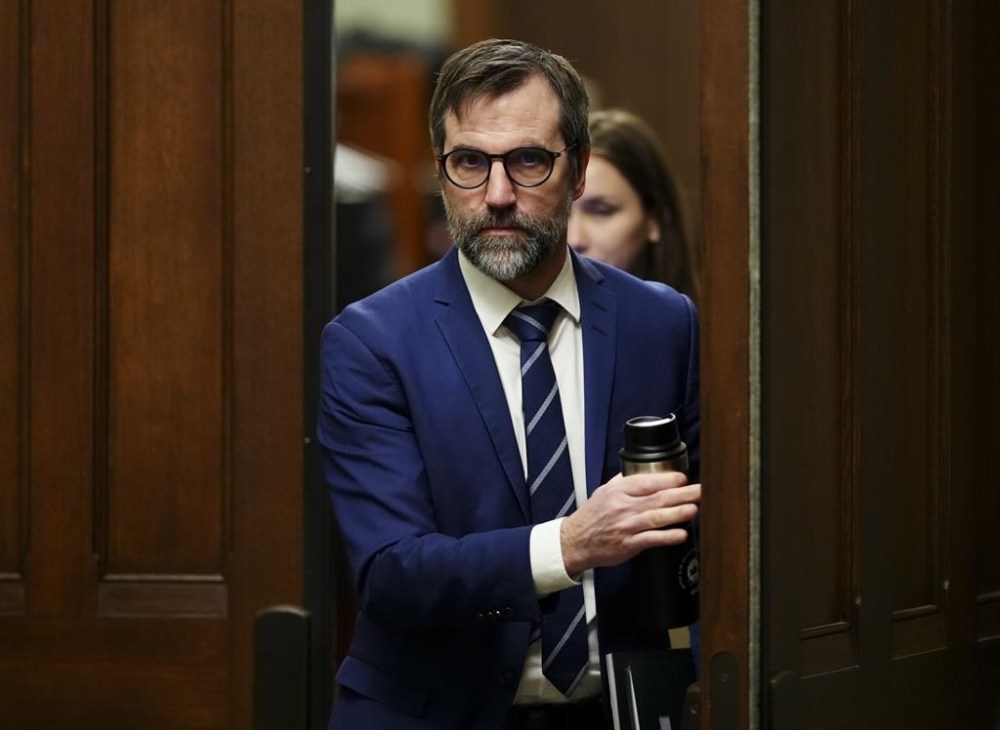
Minister of Environment and Climate Change Steven Guilbeault leaves caucus on Parliament Hill in Ottawa on Wednesday, March 20, 2024. Canada is seeking to get a better handle on how much plastic is being produced in this country by forcing the companies that make it to report annually on what they produce. THE CANADIAN PRESS/Sean Kilpatrick

Since 2022, Environment and Climate Change Canada has been consulting on the development of a plastics registry, similar to how it tracks greenhouse-gas emissions.

The registry is to be phased in over the next few years.

Guilbeault said it will make plastics producers more responsible for what they are putting on the market.

“What we’re aiming to do with this registry is to ensure that there’s more transparency in Canada on the production and use of plastics,” he said.

“It is hard to tackle a problem if you don’t know what it is, where it is, what’s being used.”

For years, Canada has asked industries to report on emissions they produce, and those data are a critical component of Canada’s annual reporting on total emissions.

Guilbeault said the plastics registry will be similar. Companies that produce or import plastic in Canada will have to report every year how much of it they are putting on the market, along with how much plastic waste they generate.

That includes reporting on how much they send for recycling or reuse, versus how much is simply tossed out.

The registry will start with plastic packaging, electronics and single-use items, and eventually expand to include plastic resins, tires and plastic products for agriculture.

Statistics Canada reported that in 2019, 6.2 million tonnes of plastic was produced in Canada, more than one-third of it for packaging alone.

Canada also estimates that more than four million tonnes of plastic ends up as waste each year, and less than one-tenth of that is recycled.

The registry announcement is the first of several domestic moves Guilbeault is expected to make on plastics this week, as delegates from more than 170 countries descend on a downtown Ottawa convention centre to make progress on a global plastics treaty.

Guilbeault, who was key to getting a UN motion passed in 2022 that set the process for the treaty talks in motion, said it is a “once-in-a-generation opportunity.”

There is growing evidence about the physical harm all the plastics we produce is causing, as production has nearly doubled in 20 years and plastic itself never really disappears.

Instead, it breaks down into microparticles of plastic that end up in our water, our food and our air.

Microplastics are linked to a string of health concerns including hormone disruptions, cancers and infertility.

The treaty is bent on attacking that problem.

“We’re leaving a legacy of environmental disaster for future generations if we fail to act,” Guilbeault said.

Inger Andersen, the executive director of the UN Environment Program, said Monday that a successful treaty must have clear and measurable targets, with specific timelines and agreement that unnecessary single-use and problematic plastics must be phased out.

She also said recycling must be improved and the treaty must address “chemicals of concern,” a list of toxic chemicals used to make plastics that are hazardous to human health.

“We are on the cusp of securing a just and ambitious treaty that addresses that full life cycle,” she said.

The Ottawa talks are the fourth of five scheduled rounds. Earlier talks were held in Uruguay in 2022, and in Paris and Kenya in 2023. The goal is that by the end of this year, at the fifth round in South Korea, a treaty can be finalized.

Dr. Adil Najam, president of the Worldwide Fund for Nature, said if a full treaty is to be possible by the end of the year, the Ottawa talks must reach agreement on the need to ban the most problematic plastics and chemicals.

Delegates must also agree to hold formal talks between the Ottawa negotiations and those scheduled at the end of November, Najam said.

Guilbeault said there are some areas where there is widespread agreement, including banning some single-use plastics and “chemicals of concern,” the need for plastics to contain more recycled content and the need for more transparency in labelling so consumers know what is in the plastics they are buying.

What he said is still not clear is whether the treaty will include very specific elements, such as which chemicals to ban, or whether it’s more of a framework with “details to come later.”

“I think this is still an area where countries need more time to discuss and exchange,” he said.

This report by The Canadian Press was first published April 22, 2024.

Report Error Submit a Tip

More Stories

Lone Manitoba 9/11 victim's legacy lives on helping Inuit students become nurses

Melissa Martin 13 minute read Preview

Lone Manitoba 9/11 victim's legacy lives on helping Inuit students become nurses

Melissa Martin 13 minute read Thursday, Sep. 10, 2026

On the night before the morning that everyone remembers, Ellen Judd spoke to her partner, Christine Egan, several times on the phone. Egan was in New York, where she’d gone to look after her nephews so her beloved brother, Michael, and his wife, Anna, could treat themselves to an anniversary vacation.

Usually, Judd would have been there, too. The couple had been together for more than 15 years, and loved sharing all the good parts of life. But at the time, she was an anthropology professor at the University of Manitoba, and the school year was just starting; she had classes the next day. Staying connected by phone would have to suffice.

In their calls that night, Judd remembers, Egan was happy. Christmas was the main topic. They were planning to spend the holiday with Judd’s family in Ontario, and talked about when to book flights. Egan was looking forward to that visit; Judd’s family “loved her to bits,” the now-retired professor says, and the affection was mutual.

The next day, Egan said, she planned to go into Manhattan with Michael. He was an executive at Aon, a global risk, retirement and health services corporation, and had an office on the 105th floor of the World Trade Centre’s South Tower.

Read
Thursday, Sep. 10, 2026

Highway-safety upgrades in progress after tragic Interlake crash

Chris Kitching 5 minute read Preview

Highway-safety upgrades in progress after tragic Interlake crash

Chris Kitching 5 minute read Updated: Yesterday at 6:25 PM CDT

Provincial workers have started to update or install safety measures at a rural Interlake intersection where four teenage friends died in a crash on Labour Day weekend.

Pavement markings were repainted at Highway 8 and Provincial Road 229, just west of Winnipeg Beach, ahead of work to refresh worn-down rumble strips, starting Monday, and install flashing lights atop two stop signs, following an assessment earlier this week.

“They will also need to incorporate any information from the RCMP report that might be helpful if we were to consider any additional safety measures at this intersection,” Transportation and Infrastructure Minister Lisa Naylor said of department staff.

“The most important thing is safety, and any kinds of changes we make at any intersection actually have to make it safer.”

Read
Updated: Yesterday at 6:25 PM CDT

Goodness alive, well in N.L.-set musical

Jen Zoratti 4 minute read Preview

Goodness alive, well in N.L.-set musical

Jen Zoratti 4 minute read 2:01 AM CDT

I first saw Come From Away — the true-story musical about the incredible efforts of the residents of Gander, N.L. on Sept. 11, 2001, who welcomed nearly 7,000 travellers diverted to their remote town after the attacks on the World Trade Center and the Pentagon — in 2022, when Broadway Across Canada brought it to the Centennial Concert Hall.

I went in cold, but with blunted expectations; it seemed, on premise alone, like it could tilt too far into shmaltzy sentimentality, that it would be too earnest in its goodness.

So, when I wept until my face was as wet and salty as though it had been slapped by the waves of the North Atlantic, I was pleasantly surprised. I loved it. It’s emotional, yes. It’s sentimental, yes. But you can’t help but feel both buoyed — and, dare I say, patriotic — by the end of it.

Written by Canadians Irene Sankoff and David Hein, Come From Away seemed an unlikely hit when it opened on Broadway in 2017. But there was, by then, an appetite for it.

Read
2:01 AM CDT

The port of Churchill — but done right

Editorial 4 minute read Preview

The port of Churchill — but done right

Editorial 4 minute read 2:00 AM CDT

The seagoing grain carrier wasn’t christened with a champagne bottle. There was no confetti or streamers. Nevertheless, the Aug. 31 event marking the first shipment of grain to be loaded at the Port of Churchill since 2020 was celebrated like the launch of a brand new vessel.

The presence of the federal minister of northern and arctic affairs, provincial cabinet ministers and leaders and elders from several northern First Nations signalled that the fast-tracked process of refurbishing and buffing up Manitoba’s deep-water seaport gem is gaining momentum.

For OneNorth, the partnership of 29 First Nations and 12 northern communities which owns the Port of Churchill and the Hudson Bay Railway (both operated by the Arctic Gateway Group) the event heralded a new beginning. It’s been eight years since OneNorth purchased the port and railroad, and six years since grain was moved by rail through Manitoba and then by ship to European markets. Two more grain shipments, plus shipments of potash and critical minerals, will continue through the fall.

When Prime Minister Mark Carney solicited the premiers to suggest “nation-building” projects following his election in 2025, Premier Wab Kinew pitched a Manitoba trade corridor that would move wheat, critical minerals, potash and energy (oil or liquid natural gas) through the Port of Churchill.

Read
2:00 AM CDT

Puzzles Palace

1 minute read Monday, Jul. 27, 2026

To solve our puzzles, please subscribe with this special offer: |

City rapped for taking five days to remove animal carcass

Morgan Modjeski 2 minute read Thursday, Sep. 10, 2026

A Winnipeg resident said she’s upset it took the city five days to retrieve a dead fawn from her yard after she reported it to 311.

Amy Gelhorn said she and her family noticed the animal carcass in her garden on Saturday. She called 311 and was told it would be picked up after the long weekend.

“It was removed this afternoon,” the north River Heights resident said Thursday. “So it took six days to remove it and we had to basically phone every day.”

She said neighbours on both sides of her house told her they saw the animal acting strangely on Friday and reported their concerns to 311. It’s believed the animal died overnight. As the days dragged on, the body continued to rot.