Deal to protect ranch from development means family can keep raising cattle there

Advertisement

Advertise with us

LETHBRIDGE, Alta. - An agreement to protect a sprawling ranch in southern Alberta from development is the largest of its kind in the country, the Nature Conservancy of Canada says, and will allow the family that owns it to continue raising cattle there.

Read this article for free:


By clicking the button above, an account will be created and you will begin to receive some of our recommended newsletters. You may opt out of any newsletter by visiting your Email and Communication Preferences page or by clicking "unsubscribe" at the bottom of any email.

or

Already have an account? Log in here »

To continue reading, please subscribe:

Digital Subscription

One year of digital access for only $1.44 a week*

  • Enjoy unlimited reading on winnipegfreepress.com
  • Read the E-Edition, our digital replica newspaper
  • Access News Break, our award-winning app
  • Play interactive puzzles

*Billed as $5.77 plus GST every four weeks. After 52 weeks, price increases to the regular rate of $19.95 plus GST every four weeks. Offer available to new and qualified returning subscribers only. Cancel any time.

To continue reading, please subscribe:

Add Free Press access to your Brandon Sun subscription for only an additional

$1 for the first 4 weeks*

  • Enjoy unlimited reading on winnipegfreepress.com
  • Read the E-Edition, our digital replica newspaper
  • Access News Break, our award-winning app
  • Play interactive puzzles
Start now

*Your next Brandon Sun subscription payment will increase by $1.00 and you will be charged $17.95 plus GST for four weeks. After four weeks, your payment will increase to $24.95 plus GST every four weeks.

Hey there, time traveller!
This article was published 22/04/2024 (910 days ago), so information in it may no longer be current.

LETHBRIDGE, Alta. – An agreement to protect a sprawling ranch in southern Alberta from development is the largest of its kind in the country, the Nature Conservancy of Canada says, and will allow the family that owns it to continue raising cattle there.

The 22,000-hectare McIntyre Ranch was founded south of Lethbridge, Alta., in 1894 by William McIntyre and it remained in his family until his son, Billy, died in 1947.

A longtime family friend and employee, Ralph Thrall, bought the property after Billy’s death and the Thrall family continues to own and operate it today.

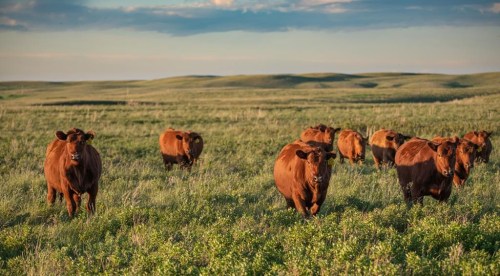
The McIntyre Ranch in southern Alberta is shown in this undated handout image provided by the Conservancy of Canada. An agreement to protect a sprawling ranch in southern Alberta from development is the largest of its kind in the country, the Nature Conservancy of Canada says, and will allow the family that owns it to continue raising cattle there. THE CANADIAN PRESS/HO-Conservancy of Canada-Leta Pezderic
**MANDATORY CREDIT **
The McIntyre Ranch in southern Alberta is shown in this undated handout image provided by the Conservancy of Canada. An agreement to protect a sprawling ranch in southern Alberta from development is the largest of its kind in the country, the Nature Conservancy of Canada says, and will allow the family that owns it to continue raising cattle there. THE CANADIAN PRESS/HO-Conservancy of Canada-Leta Pezderic **MANDATORY CREDIT **

“We’ve just maintained the legacy of sustainable ranching that the McIntyres began when they came up from Texas and saw the overgrazing that had occurred through the Midwest, and so they learned through others’ mistakes and left the grass rather than taking it all,” Ralph Thrall III said Sunday in a phone interview from Lethbridge.

The agreement, formally announced Monday in recognition of Earth Day, is a partnership between the Thrall family, the Nature Conservancy of Canada and Ducks Unlimited that gives both organizations conservation easements on the property in perpetuity to prevent it from future development, crop planting, or even wind and solar farms.

In return, Thrall says his family continues to own the property while getting a financial boost for their ranching business.

The Nature Conservancy says McIntyre Ranch contains some of Canada’s most significant uninterrupted blocks of rough fescue grasslands and over 1,000 hectares of wetlands which it says support an abundance of wildlife. It also provides carbon storage and water filtration.

Over 80 per cent of native prairie grasslands in the three Prairie provinces have been lost to other uses, the Conservancy says.

The property is home to over 150 species of birds, mammals, amphibians, reptiles and fish. Recent wildlife surveys have revealed 27 species of concern living there, including ferruginous hawk, chestnut-collared longspur and American badger.

The Conservancy says keeping the land sustainably grazed by cattle is important because their grazing behaviour approximates the historic actions of bison.

“The successful completion of the McIntyre Ranch campaign underscores the power of collaboration and community engagement in conserving Canada’s Prairie grasslands,” said Tom Lynch-Staunton, Nature Conservancy of Canada’s regional vice-president.

“We hope this significant milestone is just one of many future achievements in our efforts to safeguard our planet’s most endangered ecosystems.”

The Nature Conservancy says hundreds of donors made the agreement possible. It says contributions also came from the Government of Alberta through the Alberta Land Trust Grant Program, as well as from the federal government through the Natural Heritage Conservation Program.

The U.S. Fish and Wildlife Service and private contributors also chipped in.

Thrall himself wasn’t always interested in ranching. At one point in younger days, he spent a year as a professional golfer. But he says he and his siblings grew up understanding the family’s ranch was unique.

He encourages other ranchers interested in protecting their land from development to investigate similar easements.

“If it was about the money, then yeah, we would be selling the ranch and living far more comfortably on the interest from the proceeds,” Thrall says.

“That’s the price our family is prepared to make for the preservation of something that there isn’t very much left of.”

This report by The Canadian Press was first published April 22, 2024.

–By Rob Drinkwater in Edmonton

Report Error Submit a Tip

More Stories

Backstreet Boys’ 12-show Toronto run offers millennials a ticket to simpler times

Alex Nino Gheciu, The Canadian Press 5 minute read Preview

Backstreet Boys’ 12-show Toronto run offers millennials a ticket to simpler times

Alex Nino Gheciu, The Canadian Press 5 minute read Updated: Yesterday at 3:01 PM CDT

When Chelsea Smith heard the Backstreet Boys were coming to Toronto, she had a simple message for the five men who soundtracked her childhood.

“Here's my credit card, take all my money.”

The 35-year-old Vancouver fan wasn’t bluffing. Having already travelled to Las Vegas to see her teenybopper crushes, she's now preparing to fly across the country for two Toronto concerts, spending roughly $600 on tickets alone.

And she's hardly the only millennial willing to pay a tidy sum to party like it’s 1999.

Read
Updated: Yesterday at 3:01 PM CDT

MMF eyes Brandon for expansion of its real estate holdings

Gabrielle Piché 4 minute read Preview

MMF eyes Brandon for expansion of its real estate holdings

Gabrielle Piché 4 minute read Yesterday at 6:08 PM CDT

The Manitoba Métis Federation is ramping up its Brandon presence and it’s eyeing buildings downtown.

MMF President David Chartrand said the federation has placed a $2 million offer on two sites Assiniboine Credit Union owns.

It submitted an offer last week for a three-storey office and former branch at 220 10th St., and 1020 Princess Ave., Chartrand said.

Assiniboine Credit Union didn’t respond to an interview request by end of day Saturday.

Read
Yesterday at 6:08 PM CDT

Playoff hopes dwindle for Bombers after loss to Edmonton

Taylor Allen 6 minute read Preview

Playoff hopes dwindle for Bombers after loss to Edmonton

Taylor Allen 6 minute read Yesterday at 4:33 AM CDT

EDMONTON — It’s a script the Winnipeg Blue Bombers should’ve shredded, burned, and buried.

Go to Edmonton, dominate the first half, crumble in the final two quarters and lose.

That’s what happened in Week 12, when the Bombers blew an early 16-point lead in a 22-19 loss. And in their return to Commonwealth Stadium on Friday night, the Bombers went down a nearly identical path in a 35-27 defeat to the Edmonton Elks.

In their latest disappearing act, the Blue and Gold led 21-10 with less than a minute remaining in the first half before seemingly vanishing into thin air.

Read
Yesterday at 4:33 AM CDT

Inconsistency plagues Bombers as season hangs in balance

Taylor Allen 7 minute read Preview

Inconsistency plagues Bombers as season hangs in balance

Taylor Allen 7 minute read Updated: 9:13 AM CDT

It’s reached a point where members of the Winnipeg Blue Bombers can no longer hide their frustration.

They’ve been inconsistent all season, and it caught up with them again Friday at Commonwealth Stadium in a 35-27 loss to the Edmonton Elks.

The Bombers (8-9) could’ve clinched a playoff berth with a win. With both the Saskatchewan Roughriders (9-8) and Calgary Stampeders (9-9) winning Saturday, Winnipeg must now beat the B.C. Lions (10-7) in Vancouver on Friday to qualify for the post-season.

Meanwhile, the Elks improved to 13-4 and secured first place in the West Division for the first time since 2015.

Read
Updated: 9:13 AM CDT

Deal to protect ranch from development means family can keep raising cattle there

The Canadian Press 4 minute read Preview

Deal to protect ranch from development means family can keep raising cattle there

The Canadian Press 4 minute read Monday, Apr. 22, 2024

LETHBRIDGE, Alta. - An agreement to protect a sprawling ranch in southern Alberta from development is the largest of its kind in the country, the Nature Conservancy of Canada says, and will allow the family that owns it to continue raising cattle there.

The 22,000-hectare McIntyre Ranch was founded south of Lethbridge, Alta., in 1894 by William McIntyre and it remained in his family until his son, Billy, died in 1947.

A longtime family friend and employee, Ralph Thrall, bought the property after Billy's death and the Thrall family continues to own and operate it today.

"We've just maintained the legacy of sustainable ranching that the McIntyres began when they came up from Texas and saw the overgrazing that had occurred through the Midwest, and so they learned through others' mistakes and left the grass rather than taking it all," Ralph Thrall III said Sunday in a phone interview from Lethbridge.

Read
Monday, Apr. 22, 2024

Half Pints Brewing out of bankruptcy, back on shelves

Aaron Epp 5 minute read Preview

Half Pints Brewing out of bankruptcy, back on shelves

Aaron Epp 5 minute read Friday, Oct. 16, 2026

A pioneer of Winnipeg’s craft brewing scene has reopened under new ownership.

Read
Friday, Oct. 16, 2026