High school students, frustrated by lack of climate education, press for change
Advertisement
Read this article for free:
or
Already have an account? Log in here »
To continue reading, please subscribe:
Digital Subscription
One year of digital access for only $1.44 a week*
- Enjoy unlimited reading on winnipegfreepress.com
- Read the E-Edition, our digital replica newspaper
- Access News Break, our award-winning app
- Play interactive puzzles
*Billed as $5.77 plus GST every four weeks. After 52 weeks, price increases to the regular rate of $19.95 plus GST every four weeks. Offer available to new and qualified returning subscribers only. Cancel any time.
To continue reading, please subscribe:
Add Free Press access to your Brandon Sun subscription for only an additional
$1 for the first 4 weeks*
- Enjoy unlimited reading on winnipegfreepress.com
- Read the E-Edition, our digital replica newspaper
- Access News Break, our award-winning app
- Play interactive puzzles
*Your next Brandon Sun subscription payment will increase by $1.00 and you will be charged $17.95 plus GST for four weeks. After four weeks, your payment will increase to $24.95 plus GST every four weeks.
Read unlimited articles for free today:
or
Already have an account? Log in here »
Hey there, time traveller!
This article was published 08/05/2024 (895 days ago), so information in it may no longer be current.
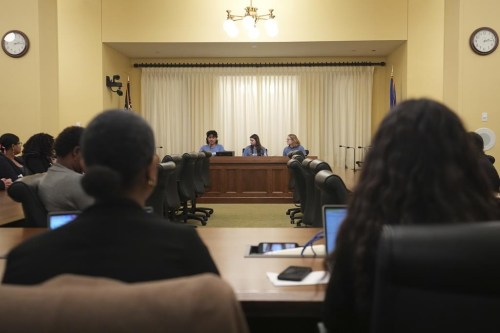
ST. PAUL, Minn. (AP) — Several dozen young people wearing light blue T-shirts imprinted with #teachclimate filled a hearing room in the Minnesota Capitol in St. Paul in late February. It was a cold and windy day, in contrast to the state’s nearly snowless, warm winter.
The high school and college students and other advocates, part of group Climate Generation, called on the Minnesota Youth Council, a liaison between young people and state lawmakers, to support a bill requiring schools to teach more about climate change.
Ethan Vue, who grew up with droughts and extreme temperatures in California, now lives in Minnesota and is a high school senior pushing for the bill.

“I just remember seeing my classmates always sweating, and they’d even drench themselves in water from the water fountains,” Vue said in a phone interview, noting climate change is making heat waves longer and hotter, but they didn’t learn about that in school.
“The topic is brushed on. If anything, we just learn about, there’s global warming, the planet’s warming up.”
In places that teach to standards formulated by the National Science Teachers Association, state governments and other organizations, many kids learn about air quality, ecosystems, biodiversity and land and water in Earth and environmental science classes.
But students and advocates say that is insufficient. They are demanding districts, boards and state lawmakers require more teaching about the planet’s warming and would like it woven into more subjects.
Some states and school districts have moved in the opposite direction. In Texas, the board of education turned down books with climate information. In Florida, school materials deny climate change.
“Someone could theoretically go through middle school and high school without really ever acknowledging the climate crisis,” said Jacob Friedman, a high school senior in Florida who hasn’t learned about climate except for in elective classes. “Or even acknowledging that there is an issue of global warming.”
That’s bizarre to Friedman, who experienced firsthand when Hurricane Ian closed nearby schools and submerged homes in 2022.
A study conducted after the storm found that climate change added at least 10% more rain to Hurricane Ian. Experts also say hurricanes are intensifying faster because of the extra greenhouse gases in the atmosphere that are collecting heat and warming the oceans.
“What an unfair reality to have a young person graduate from high school,” said Leah Qusba, executive director of nonprofit Action for the Climate Emergency, “without knowing about the biggest existential threat that they’re going to face in their lifetime.”
Some places are adding more instruction on the subject. In 2020, New Jersey required teaching climate change at all grade levels. Connecticut followed, then California. More than two dozen new measures across 10 states were introduced last year, according to the National Center for Science Education.
Where some proposals require teaching the basic science and human causes of climate change, the Minnesota bill goes further, requiring state officials to guide schools on teaching climate justice, including the idea that the changes hit disadvantaged communities harder.
Some legislators say they’ve heard from school administrators and teachers who say that goes too far.
“What was said to me is: ‘Why are we pushing a political perspective, a political agenda?’” Minnesota Rep. Ben Bakeberg, a Republican, said during a House Education Policy Committee hearing in March 2023. “That’s a reality.”
The bill didn’t advance in the 2023 session. Now it hasn’t this year either. Supporters say they will try again next year.
Aware of such opposition, some students interested in climate opt to campaign at their schools rather than through the legislative process.
Three years ago, floods destroyed Ariela Lara’s mom’s village in Oaxaca, Mexico, while they were visiting. Then Lara came home to California and was hit by smoke-filled skies caused by wildfires that pushed thousands to evacuate or be stuck inside for weeks.
Yet despite what she was seeing, Lara felt in school she was only taught about recycling and carbon footprints, a measure of a person’s personal greenhouse gas emissions.
So she went to the board of education.
“I had to really think about how I could go to the people in power to really rewrite the curriculum we were learning,” Lara said. “It would get so tiresome because for me, I was the one that was really trying to enforce it.”
By the time her school offered Advanced Placement Environmental Science, Lara was too senior to enroll in it. AP Enviro does cover climate change, according to the College Board, but it’s also more broad.
When targeted efforts don’t work, some students feel they’re on their own.
For high school junior Siyeon Joo, climate education seems like a no-brainer where she lives in Lafayette, Louisiana, which was hit hard by Hurricane Katrina in 2005 and has been affected by several other intense storms and heat waves.
But Joo wasn’t exposed to climate change at her public middle school and an educator there once told her it wasn’t real.
“I remember sitting in that classroom,” the now-16-year-old said, “being really angry that that was the system that was being forced upon me at the time.”
It took enrolling in a private school for Joo to learn about these topics. Many students don’t have that option.
Experts say climate material could be worked into lessons without burdening schools or putting the onus on students. But much like with legislation, that will take time students say they don’t have.
“I was part of these communities that were really just affirming how much is at stake if we don’t take action,” said Lara, the student in California, recalling how important to her it would have been to receive education about her experiences. “You should be able to go to school and learn about the gravity which the climate crisis is at.”
___
Alexa St. John reported from Detroit and Doug Glass reported from St. Paul, Minn.
___
Alexa St. John is an Associated Press climate solutions reporter. Follow her on X, formerly Twitter, @alexa_stjohn. Reach her at ast.john@ap.org.
___
The Associated Press’ climate and environmental coverage receives financial support from multiple private foundations. AP is solely responsible for all content. Find AP’s standards for working with philanthropies, a list of supporters and funded coverage areas at AP.org.
Related Articles
Getting climate action on the education agenda
Advertisement Advertise With Us
Advertisement Advertise With Us