Sites with radioactive material more vulnerable as climate change increases wildfire, flood risks
Advertisement
Read this article for free:
or
Already have an account? Log in here »
To continue reading, please subscribe:

Digital Subscription
One year of digital access for only $205*
- Enjoy unlimited reading on winnipegfreepress.com
- Read the E-Edition, our digital replica newspaper
- Access News Break, our award-winning app
- Play interactive puzzles
*First annual payment billed as $205.00 + GST for one year. This annual subscription will automatically renew at $233.00 + GST every 52 weeks (10% off the regular annual price of $259.35). Offer available to new and qualified returning subscribers only. Cancel any time.
To continue reading, please subscribe:
Add Free Press access to your Brandon Sun subscription for only an additional
$1 for the first 4 weeks*
- Enjoy unlimited reading on winnipegfreepress.com
- Read the E-Edition, our digital replica newspaper
- Access News Break, our award-winning app
- Play interactive puzzles
*Your next Brandon Sun subscription payment will increase by $1.00 and you will be charged $17.95 plus GST for four weeks. After four weeks, your payment will increase to $24.95 plus GST every four weeks.
Read unlimited articles for free today:
or
Already have an account? Log in here »
Hey there, time traveller!
This article was published 22/05/2024 (848 days ago), so information in it may no longer be current.
As Texas wildfires burned toward the nation’s primary nuclear weapons facility, workers hurried to ensure nothing flammable was around buildings and storage areas.
When the fires showed no sign of slowing, Pantex Plant officials urgently called on local contractors, who arrived within minutes with bulldozers to dig trenches and enlarge fire breaks for the sprawling complex where nuclear weapons are assembled and disassembled and dangerous plutonium pits — hollow spheres that trigger nuclear warheads and bombs — are stored.
“The winds can pick up really (quickly) here and can move really fast,” said Jason Armstrong, the federal field office manager at Pantex, outside Amarillo, who was awake 40 hours straight monitoring the risks. Workers were sent home and the plant shut down when smoke began blanketing the site.
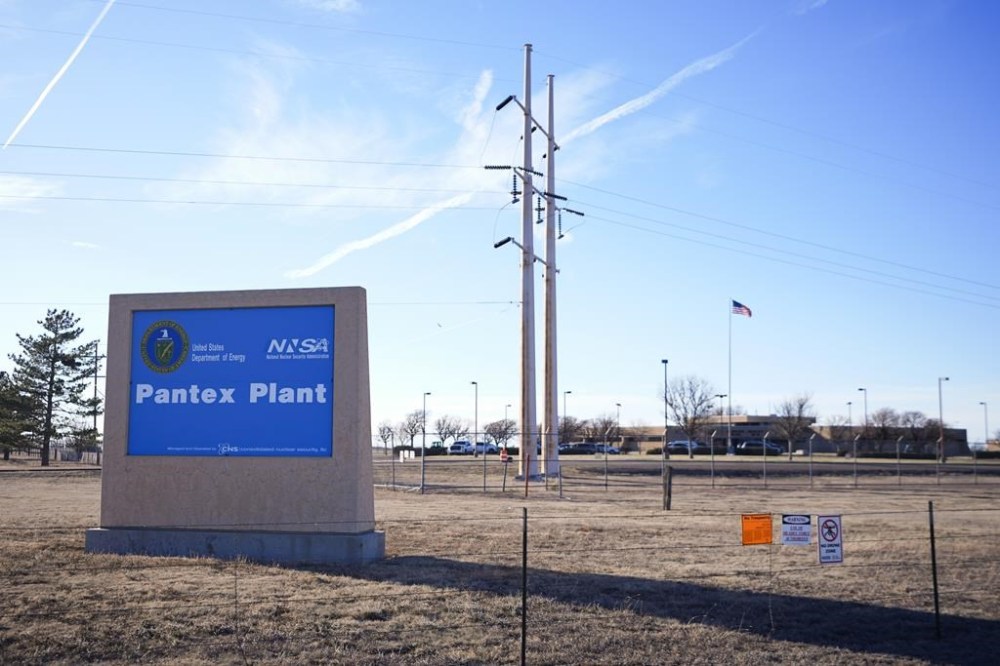
Those fires in February — including the largest in Texas history — didn’t reach Pantex, though flames came within 3 miles (5 kilometers). And Armstrong says it’s highly unlikely that plutonium pits, stored in fire-resistant drums and shelters, would have been affected by wildfire.
But the size and speed of the grassland fires, and Pantex’s urgent response, underscore how much is at stake as climate change stokes extreme heat and drought, longer fire seasons with larger, more intense blazes and supercharged rainstorms that can lead to catastrophic flooding. The Texas fire season often starts in February, but farther west it has yet to ramp up, and is usually worst in summer and fall.
Dozens of active and idle laboratories and manufacturing and military facilities across the nation that use, store or are contaminated with radioactive material are increasingly vulnerable to extreme weather. Many also perform critical energy and defense research and manufacturing that could be disrupted or crippled by fires, floods and other disasters.
There’s the 40-square-mile Los Alamos National Laboratory in New Mexico, where a 2000 wildfire burned to within a half mile (0.8 kilometers) of a radioactive waste site. The heavily polluted Santa Susana Field Laboratory in Southern California, where a 2018 wildfire burned 80% of the site, narrowly missing an area contaminated by a 1959 partial nuclear meltdown. And the plutonium-contaminated Hanford nuclear site in Washington, where the U.S. manufactured atomic bombs.
“I think we’re still early in recognizing climate change and … how to deal with these extreme weather events,” said Paul Walker, program director at the environmental organization Green Cross International and a former staff member of the House Armed Services Committee. “I think it’s too early to assume that we’ve got all the worst-case scenarios resolved … (because) what might have been safe 25 years ago probably is no longer safe.”
___
That realization has begun to change how the government addresses threats at some of the nation’s most sensitive sites.
The Department of Energy in 2022 required its existing sites to assess climate change risks to “mission-critical functions and operations,” including waste storage, and to develop plans to address them. It cited wildfires at Los Alamos and Lawrence Livermore national laboratories and a 2021 deep freeze that damaged “critical facilities” at Pantex.
Yet the agency does not specifically consider future climate risks when issuing permits or licenses for new sites or projects, or in environmental assessments that are reviewed every five years though rarely updated. Instead, it only considers how sites themselves might affect climate change — a paradox critics call short-sighted and potentially dangerous.
Likewise, the Nuclear Regulatory Commission considers only historical climate data rather than future projections in licensing decisions and oversight of nuclear power plants, according to a General Accounting Office study in April that recommended the NRC “fully consider potential climate change effects.” The GAO found that 60 of 75 U.S. plants were in areas with high flood hazard and 16 were in areas with high wildfire potential.
“We’re acting like … (what’s) happening now is what we can expect to happen in 50 years,” said Caroline Reiser, a climate and energy attorney at the Natural Resources Defense Council. “The reality of what our climate is doing has shifted dramatically, and we need to shift our planning … before we experience more and more of the extreme weather events.”
The National Nuclear Security Administration’s environmental safety and health division, which oversees active DOE sites, will conduct an internal review and convene a work group to develop “crucial” methodologies to address climate risks in permitting, licensing and site-wide assessments, John Weckerle, the division’s director of environmental regulatory affairs, told The Associated Press.
The agency said last year that climate change could “jeopardize the NNSA mission and pose a threat to national security.”
“We all know the climate is changing. Everybody’s thinking about, what effect are we having on the climate?” Weckerle said. “Now we need to flip that on its head and say, ‘OK … but what do we think is going to happen as a result of climate on a particular site?’”
Assessments before and after projects are built are critical to protecting infrastructure and waste materials, said Dylan Spaulding, a senior scientist at the Union of Concerned Scientists.
“We know that climate change makes it likely that these events will happen with increased frequency, and that brings the likelihood for unprecedented consequences,” Spaulding said. Sites “can be better protected if you are anticipating these problems ahead of time.”
___
One of the most dangerous radioactive materials is plutonium, said Edwin Lyman, director of nuclear power safety at the Union of Concerned Scientists. It can cause cancer, is most dangerous when inhaled, and just a few hundred grams dispersed widely could pose a significant hazard, he said.
Experts say risks vary by site. Most plutonium and other radioactive material is contained in concrete and steel structures or underground storage designed to withstand fire. And many sites are on large tracts in remote areas where risk to the public from a radiation release would be minimal.
Even so, potential threats have arisen.
In 2000, a wildfire burned one-third of the 580-square-mile (1,502-square-kilometer) Hanford site, which produced plutonium for the U.S. atomic weapons program and is considered the nation’s most radioactive place.
Air monitoring detected plutonium in nearby populated areas at levels higher than background, but only for one day and at levels not considered hazardous, according to a Washington State Department of Health report.
The agency said the plutonium likely was from surface soil blown by the wind during and after the fire, though site officials said radioactive waste is buried several feet deep or stored in concrete structures.
Because the Hanford site is fire-prone — with 130 wildfires between 2012 and 2023 — officials say they’re diligent about cutting fire breaks and removing flammable vegetation.
The 2018 Woolsey Fire in California was another wakeup call.
About 150,000 people live within 5 miles (8 kilometers) of the Santa Susana Field Laboratory, a former nuclear power research and rocket-engine testing site.
The fire burned within several hundred feet of contaminated buildings and soil, and about 600 feet (183 meters) from where a nuclear reactor core partially melted down 65 years ago.
The state’s Department of Toxic Substances Control said sampling by multiple agencies found no off-site radiation or other hazardous material attributable to the fire. But another study, using hundreds of samples collected by volunteers, found radioactive microparticles in ash just outside of the lab boundary and at three sites farther away that researchers say were from the fire.
The state ordered demolition of 18 buildings, citing “imminent and substantial endangerment to people and the environment because unanticipated and increasingly likely fires could result in the release of radioactive and hazardous substances.”
It also ordered cleanup of old burn pits contaminated with radioactive materials. Though the area was covered with permeable tarps and did not burn in 2018, the state feared it could be damaged by “far more severe” wildfire, high winds or flooding.
“It’s like these places we think, it’ll never happen,” said Melissa Bumstead, founder and co-director of Parents Against Santa Susana Field Laboratory. “But … things are changing very quickly.”
Jay Coghlan, executive director of Nuclear Watch New Mexico, said he and others successfully urged federal nuclear security officials to include a wildfire plan in a 1999 final environmental impact statement for the Los Alamos National Laboratory.
The next year, the 48,000-acre (19,000-hectare) Cerro Grande Fire burned 7,500 acres (3,035 hectares) at the laboratory, including structures, and came within a half-mile (0.8 kilometers) of an area with more than 24,000 above-ground containers of mostly plutonium-contaminated waste.
The plan’s hypothetical fire “eerily matched the real fire,” Coghlan said, adding that it “could have been catastrophic,” if containers had been compromised and plutonium become airborne. But the lab had cut fire breaks around the area — and since then, most containers have been shipped to a permanent storage site in southern New Mexico.
Remaining radioactive material — including from the World War II Manhattan Project — now is underground with barriers to prevent leaching, or in containers stored under fire-retardant fabric-and-steel domes with paved floors until it can be processed for disposal.
The amount of radioactive material in each container is kept low to prevent a significant release if it were compromised, said Nichole Lundgard, engineering and nuclear safety program manager at DOE contractor N3B.
The lab also emphasizes fire preparedness, including thinning forests to reduce the intensity of future fires, said Rich Nieto, manager of the site’s wildland fire program.
“What used to be a three-month (fire) season, sometimes will be a six-month season,” he said.
___
Wildfires aren’t the only climate-related risk. Flooding from increasingly intense rainstorms can wash away sediment — especially in areas that have burned. Floods and extreme cold also can affect operations and have forced the shutdown of several DOE sites in recent years.
The Lawrence Livermore National Laboratory in Northern California was evacuated during a 2020 wildfire, and last year the lab was forced to shut down for three weeks because of heavy flooding.
The 2000 fire at Los Alamos was followed by heavy rainstorms that washed away sediment with plutonium and other radioactive material.
In 2010, Pantex was inundated with 10 inches (25 centimeters) of rain that forced the plant to shut down, affecting operations for almost a month. The plutonium storage area flooded and corrosion later was found on some containers that’s since “been addressed,” said Armstrong, the field office manager.
In 2017, storms flooded facilities that processed nuclear material and led to power outages that affected a fire alarm control panel.
Then in 2021, Pantex was shut down for a week because of extreme cold that officials said led to “freeze-related failures” at 10 nuclear facilities and other plants. That included failure of a sprinkler head in a radiation safety storage area’s fire suppression system.
Pantex has since adopted freeze-protection measures and a cold weather response plan. And Armstrong says there have been upgrades, including to its fire protection and electrical systems and installation of backup generators.
Other DOE sites also are investing in infrastructure, the nuclear security agency’s Weckerle said, because what once was considered safe now may be vulnerable.
“We live in a time of increased risk,” he said. “That’s just the heart of it (and) … a lot of that does have to do with climate change.”
___
The Associated Press receives support for nuclear security coverage from the Carnegie Corporation of New York and Outrider Foundation. The AP is solely responsible for all content.