What to know about Mongolia as it holds a democratic election in the shadow of authoritarian giants

Advertisement

Advertise with us

ULAANBAATAR, Mongolia (AP) — Mongolia, where parliamentary elections were being held Friday, is a sparsely populated and landlocked Asian nation known for its bitter winter cold and independent spirit.

Read this article for free:


or

Already have an account? Log in here »

To continue reading, please subscribe:

Subscribe and receive a limited-edition Free Press branded hat or tote.

Digital Subscription

One year of digital access for only $205*

  • Enjoy unlimited reading on winnipegfreepress.com
  • Read the E-Edition, our digital replica newspaper
  • Access News Break, our award-winning app
  • Play interactive puzzles

*First annual payment billed as $205.00 + GST for one year. This annual subscription will automatically renew at $233.00 + GST every 52 weeks (10% off the regular annual price of $259.35). Offer available to new and qualified returning subscribers only. Cancel any time.

To continue reading, please subscribe:

Add Free Press access to your Brandon Sun subscription for only an additional

$1 for the first 4 weeks*

  • Enjoy unlimited reading on winnipegfreepress.com
  • Read the E-Edition, our digital replica newspaper
  • Access News Break, our award-winning app
  • Play interactive puzzles
Start now

*Your next Brandon Sun subscription payment will increase by $1.00 and you will be charged $17.95 plus GST for four weeks. After four weeks, your payment will increase to $24.95 plus GST every four weeks.

Hey there, time traveller!
This article was published 27/06/2024 (827 days ago), so information in it may no longer be current.

ULAANBAATAR, Mongolia (AP) — Mongolia, where parliamentary elections were being held Friday, is a sparsely populated and landlocked Asian nation known for its bitter winter cold and independent spirit.

As a democracy of just 3.4 million people in the shadow of two much larger authoritarian states, China and Russia, it has taken on symbolic importance in an era when democracy is under pressure or in crisis in many countries, including the United States.

In an earlier era, the fierce nomadic tribes of the Mongolian steppe were widely feared, at one point conquering China and expanding west across Asia to the edges of Europe.
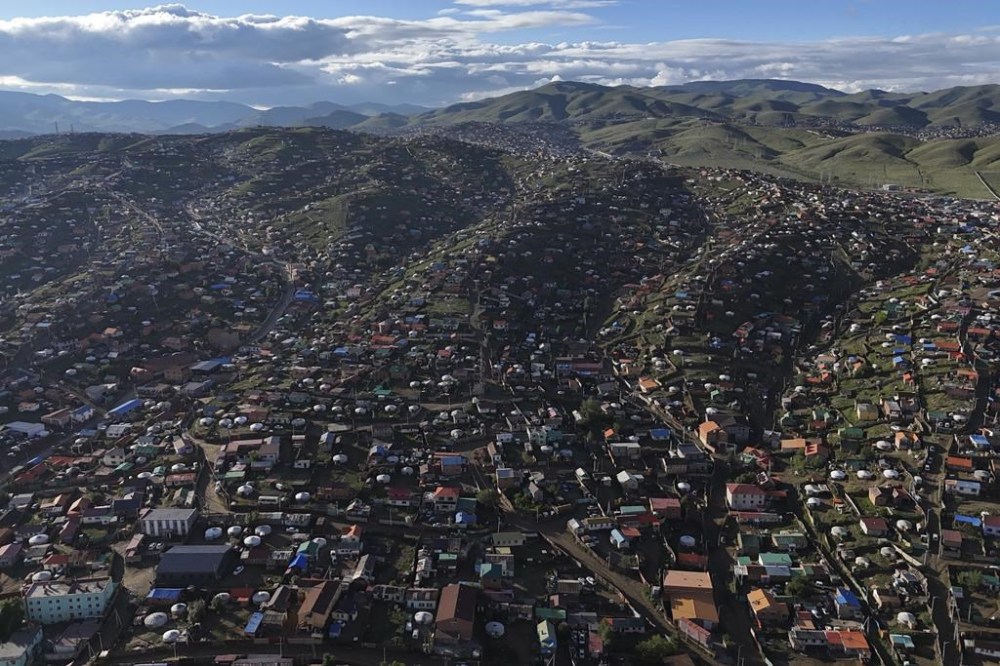
A view from a drone over the Ger District on the outskirts of Ulaanbaatar, Mongolia, Thursday, June 27, 2024. Parliamentary elections are being held Friday in this sparsely populated and landlocked Asian nation, known for its bitter winter cold and independent spirit. (AP Photo/Ng Han Guan)

Today, it is a country punctuated by extremes. Its vast mineral resources are sought by China and the West but generate wealth mainly for the elite: nearly a third of Mongolians lived below the poverty line in 2022 according to the Asian Development Bank.

The mineral wealth is helping power global decarbonization, yet it remains hooked to dirty coal that causes some of the worst air pollution in the world. Nomadic herding is integral to the country but millions of animals are lost to extreme weather worsened by climate change.

The dzud

The word dzud literally means disaster in Mongolian. It’s an extreme weather phenomenon that used to occur once a decade, but is becoming harsher and more frequent as the world warms. The deadly combination of perennial droughts and severe, snowy winters cause cataclysmic losses of livestock.

Herding is central to Mongolia’s economy and culture — contributing 80% of its agricultural production and 11% of its GDP — and the impacts of dzuds are profound. This year’s dzud, the sixth in the past decade and the worst yet, killed more than 7.1 million animals. Thousands of families have lost over 70% of their entire herds.

The minerals

Mongolia gets nearly a quarter of its GDP and around 90% of its exports from mining. The Oyu Tolgoi mine in the Gobi Desert in the country’s south is one of the world’s largest known copper and gold deposits. Some in Mongolia hope increased demand for so-called critical minerals for countries seeking to decarbonize will give it leverage against its larger neighbors.

But Mongolia has struggled to share the benefits and costs of its mineral wealth. Herders, who make up a third of the population, decry the loss of pasture land and alleged land grabs. In 2022, massive protests broke out in Mongolia over alleged corruption in the mining sector.

The election

After six decades of communist rule, protests sparked a transition to democracy in 1990. Overblown hopes that democracy would bring prosperity and solve all the country’s ills yielded to reality. As voters elect a new parliament this week, many are increasingly disappointed in a system that they see as riven with corruption and skewed toward serving mining and other business interests rather than ordinary citizens.

Voters will be choosing a larger parliament in this election. It has been expanded to 126 seats, up 50 from before. The ruling Mongolian People’s Party is favored to win but may see its now dominant majority reduced. The People’s Party ran the country during the communist era and now is a left-leaning centrist one.

The pollution
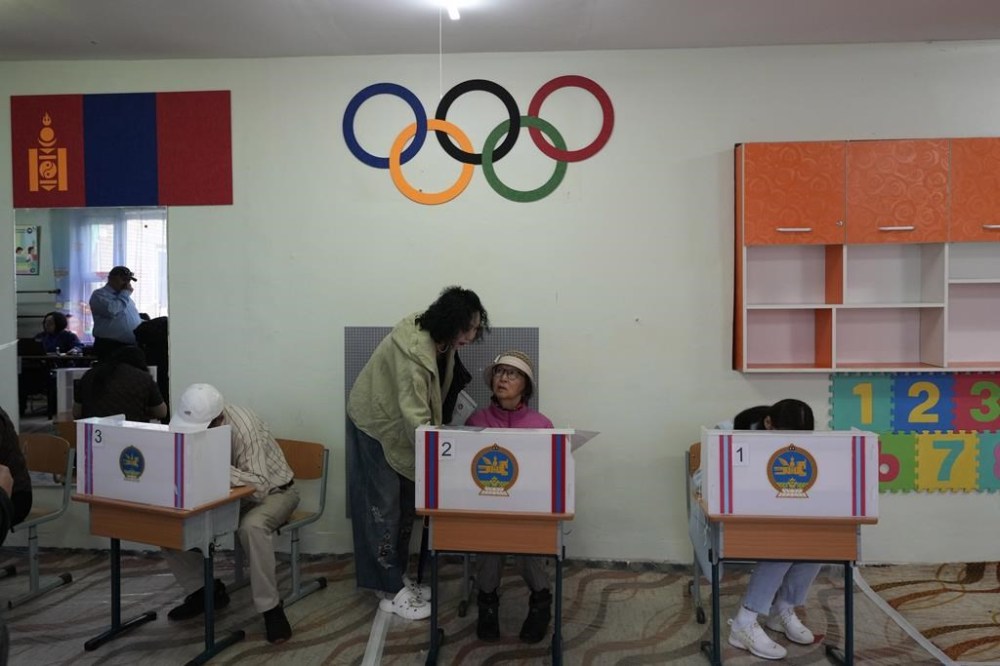
Mongolians prepare their votes at a polling station in Ulaanbaatar, Mongolia, Friday, June 28, 2024. Voters in Mongolia are electing a new parliament on Friday in their landlocked democracy that is squeezed between China and Russia, two much larger authoritarian states (AP Photo/Ng Han Guan)

The Mongolian capital, Ulaanbaatar, has some of the worst air in the world. Annual levels of fine, inhalable particles known as PM2.5 surpass levels considered safe by the World Health Organization by nearly 9-times. Children are particularly at risk.

Climate shocks like the dzud are forcing more and more people to move to the city. They live in traditional tents known as ‘gers’ and burn coal or wood for heat during the country’s brutal winters. That adds to smog from Mongolian coal-fired power plants and diesel-fueled vehicles.

The history

Genghis Khan, a national hero, amassed power to become the leader of the Mongols in the early 13th century and then set out to conquer lands to the south and west. Known as Chinggis Khan in Mongolian, his descendants subdued China, ruling it for nearly a century as the Yuan Dynasty.

In the 20th century, Mongolia got help from the Soviet Union in a bid for independence from China, which it won. The Soviet Union helped improve public health and education, but also turned the country into a virtual satellite state, its traditional culture subsumed by Russian communist influence.

Since Mongolia gained full autonomy and transitioned to democracy, Genghis Khan has served as a cornerstone of the country’s efforts to reclaim its national heritage. His likeness is everywhere, from bottles of vodka to a 40-meter- (130-foot-) tall stainless steel statue of him astride a horse outside Ulaanbaatar.

___

Ghosal reported from Hanoi, Vietnam.
Report Error Submit a Tip

More Stories

Health minister warns $1.2 billion in annual federal funding set to expire in March

Scott Billeck 4 minute read Preview

Health minister warns $1.2 billion in annual federal funding set to expire in March

Scott Billeck 4 minute read 6:58 PM CDT

Manitoba’s health minister is warning of possible cuts to health care with $1.2 billion in annual funding from Ottawa set to expire next year.

“We’re very concerned that what would be the largest cut to health care in a generation is right in front of us,” Health Minister Uzoma Asagwara said Thursday at the Manitoba legislature. “It means that services that Manitobans depend on will be in jeopardy and be at risk.

“Any reductions, any cuts from Canada, will have direct impacts on the health outcomes of Manitobans.”

Asagwara, who serves as the provincial and territorial health minister lead, chaired a virtual meeting Tuesday with provincial and territorial health ministers to discuss federal funding for health care, mental health care and substance use services, which is scheduled to expire March 31, 2027.

Read
6:58 PM CDT

Jets new backup Stevenson ‘stoked’ to be in tandem with Skinner

Mike McIntyre 6 minute read Preview

Jets new backup Stevenson ‘stoked’ to be in tandem with Skinner

Mike McIntyre 6 minute read Yesterday at 4:23 PM CDT

It didn’t take long to get the dirt on the newest member of the Winnipeg Jets.

Meet Clay Stevenson, who has no problem if you prefer to refer to him by his long-standing nickname of “Mud.”

“You know, Clay is in the mud, and there you go. That’s it, right there,” Stevenson said Wednesday with a laugh. “I got it in juniors when I was playing in Coquitlam, and kind of stuck ever since.”

Stevenson is now hoping to make a name for himself in a city that, quite fittingly, translates to “muddy water” in Cree. The 27-year-old from Alberta was placed on waivers by the Washington Capitals and claimed by the Jets, who were looking to clarify a goaltending situation which was as murky as the Red River.

Read
Yesterday at 4:23 PM CDT

Port of Churchill signs agreement with Dutch port

Aaron Epp 2 minute read Preview

Port of Churchill signs agreement with Dutch port

Aaron Epp 2 minute read Tuesday, Sep. 29, 2026

Arctic Gateway Group, operator of the Port of Churchill, has signed an agreement with the Port of Rotterdam in the Netherlands to attract business and strengthen supply chains linking Western Canada and Europe.

The agreement enables the two ports to work together to develop new trade in critical minerals and energy products, connect Canadian producers with European buyers, and identify opportunities to improve the supply chain from Western Canadian resource projects through Churchill and into European markets.

The Port of Rotterdam is Europe’s largest port and home to more than 3,000 businesses across its industrial complex, serving as a major gateway for critical raw materials and energy.

Meanwhile, the Port of Churchill has been identified as a transformative national strategy for Canada and is emerging as a northern trade corridor connecting Western Canada’s resources to global markets.

Read
Tuesday, Sep. 29, 2026

Today’s horoscope

Georgia Nicols 4 minute read Preview

Today’s horoscope

Georgia Nicols 4 minute read 2:01 AM CDT

MOON ALERT: Avoid shopping (except food and gas) and important decisions after 9 p.m. The moon is in Gemini.

ARIES (March 21-April 19)

Your mind is focused, giving you common sense and practical ideas. This is an excellent day to sign up for a course or learn something new. Don’t hesitate to listen to the advice of someone older or more experienced because after all, you don’t have to reinvent the wheel.

TAURUS (April 20-May 20)

Read
2:01 AM CDT

Robot study gives seniors say in era of AI

Conrad Sweatman 4 minute read Preview

Robot study gives seniors say in era of AI

Conrad Sweatman 4 minute read 8:15 PM CDT

It’s no longer the stuff of sci-fi: AI sidekicks that simulate emotional support and guide routines.

Robot companions are increasingly becoming part of everyday life for seniors, with certain U.S. states even subsidizing such devices for personal use through public health-care programs.

Among the many ethical questions this raises: what’s to be done with these robots, and all the secrets and personal data they carry, after the owner dies?

“We don’t know the answers. That’s why I’m running a study. It’s a participatory study with seniors,” said Clara Xie, a PhD student in computer science at the University of Calgary, who is conducting research at the University of Manitoba.

Read
8:15 PM CDT

Sisters relieved hospital takes accountability after mother’s death

Scott Billeck 5 minute read Preview

Sisters relieved hospital takes accountability after mother’s death

Scott Billeck 5 minute read 6:39 PM CDT

Eight months after losing their mother, two Winnipeg sisters say an internal hospital review has finally given them something they had been seeking since her death: accountability.

Chelsea Mann and Samantha Burns said St. Boniface Hospital officials acknowledged mistakes were made in the care of their mother, Judy Burns, during a recent meeting to discuss the findings of a critical incident review into her death.

The acknowledgement marked a significant departure from an earlier meeting with hospital officials, when they felt their concerns were largely dismissed.

Burns, 68, died on Jan. 21, three days after being admitted, after experiencing rectal bleeding.

Read
6:39 PM CDT