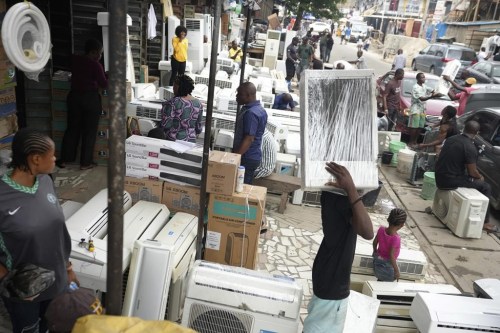
Africa’s demand for cooling systems is expanding. But regulating the industry is a struggle
Advertisement
Read this article for free:
or
Already have an account? Log in here »
To continue reading, please subscribe:

Digital Subscription
One year of digital access for only $205*
- Enjoy unlimited reading on winnipegfreepress.com
- Read the E-Edition, our digital replica newspaper
- Access News Break, our award-winning app
- Play interactive puzzles
*First annual payment billed as $205.00 + GST for one year. This annual subscription will automatically renew at $233.00 + GST every 52 weeks (10% off the regular annual price of $259.35). Offer available to new and qualified returning subscribers only. Cancel any time.
To continue reading, please subscribe:
Add Free Press access to your Brandon Sun subscription for only an additional
$1 for the first 4 weeks*
- Enjoy unlimited reading on winnipegfreepress.com
- Read the E-Edition, our digital replica newspaper
- Access News Break, our award-winning app
- Play interactive puzzles
*Your next Brandon Sun subscription payment will increase by $1.00 and you will be charged $17.95 plus GST for four weeks. After four weeks, your payment will increase to $24.95 plus GST every four weeks.
Read unlimited articles for free today:
or
Already have an account? Log in here »
Hey there, time traveller!
This article was published 25/07/2024 (799 days ago), so information in it may no longer be current.
ABUJA, Nigeria (AP) — As the sun blazes down in Nigeria’s capital Abuja, Ahmed Bukar turns on his home air conditioner to a blast of hot air. The charging valve on the outside unit is leaking out the cooling gas that the appliance runs on. A technician had recently helped him refill the air conditioner with gas, but he didn’t test for possible leaks.
In Abuja and across Nigeria, air conditioners sprout from the walls as the appliance turns from a middle-class luxury into a necessity in an increasingly hot climate. The industry is governed by regulations prohibiting the release of cooling gases into the air, for example by conducting leak tests after an appliance is fixed. Still, routine release of gases into the atmosphere due to shoddy installations, unsafe disposal at the end of use, or the addition of gas without testing for leaks is a common problem in Nigeria, though unlawful.
The gases known as refrigerants that make cooling systems work are hundreds to thousands of times the warming potency of carbon dioxide and the worst of them also harm the ozone layer. Following global agreements that promised to limit these gases being spewed into the air, like the Montreal Protocol and Kigali Amendments, Nigeria has enacted regulations guiding the use of these gases. But enforcement is a problem, threatening Nigeria’s commitments to slash emissions.
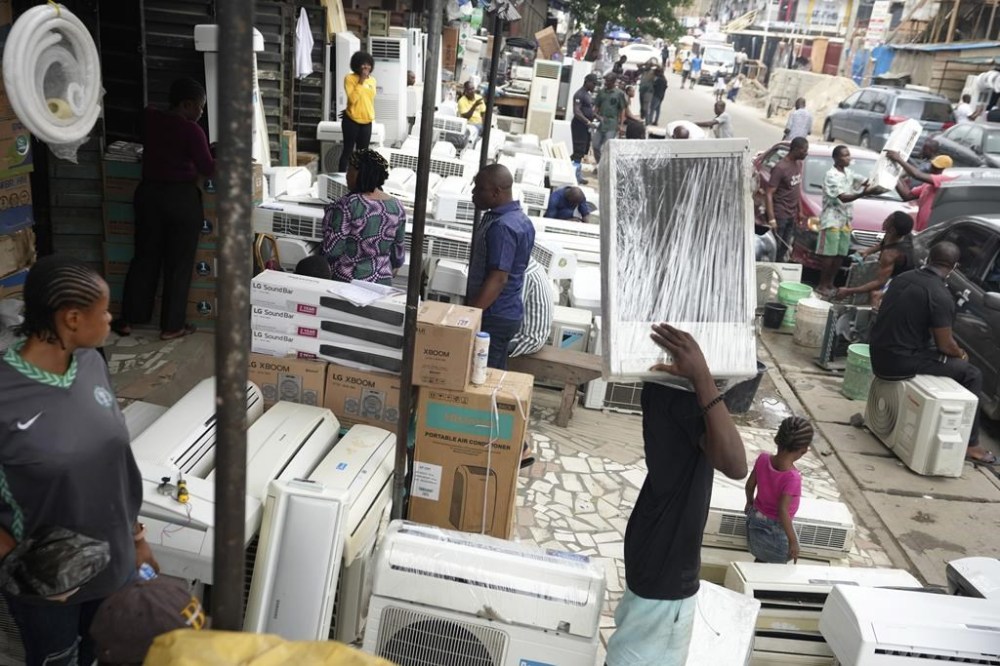
“Those laws, those rules, nobody enforces them,” said Abiodun Ajeigbe, a manager for the air conditioning business at Samsung in West Africa. “I have not seen any enforcement.”
‘I was not taught’
The weak regulatory system for the cooling industry in Nigeria is evident in the rampant lack of proper training and awareness of environmental harm caused by refrigerants among technicians, according to Ajeigbe. And it is common to see.
After uninstalling an air conditioner for a client who was moving to another neighborhood, Cyprian Braimoh, a technician in Abuja’s Karu district, casually frittered the gas from the unit into the air, preparing it to be refilled with fresh gas at the client’s new location.
If he followed the country’s regulations, he would collect the gas into a canister, preventing or minimizing the gas’s environmental harm. Technicians like Braimoh and those who serviced Bukar’s appliance without testing for leaks are self-employed and unsupervised. But they often get customers because they offer cheaper services.
“I was not taught that; I only release it into the air,” said Braimoh, who originally specialized in electrical wiring of buildings before fixing air conditioners to increase his income options. He received patchy training that did not include the required safety standards for handling refrigerants. And he still did not conduct a leakproof test after installing the air conditioning at his client’s new location, which is required by the country’s cooling industry regulations.
Installations done by well-trained technicians who follow environmental regulations can be costlier for customers. It’s often the case in Nigeria, where hiring the services of companies like Daibau, who later helped Bukar fix his leaks, could result in higher costs.
Manufacturers who offer direct refrigeration and air conditioning installation services to big commercial customers have tried to self-regulate with safety training and certifications for their technicians, Ajeigbe said.
Potent greenhouse gases
According to industry professionals and public records, the most common air conditioners in Africa still use what’s known as R-22 gas. This refrigerant is less harmful to the ozone layer compared to the older, even more damaging coolants called chlorofluorocarbons (CFCs). CFCs have been largely eliminated, thanks to the 1987 Montreal Protocol, which was created to protect the ozone layer, the vital shield in the atmosphere that protects against cancer-causing ultraviolet rays.
But R-22 is 1,810 times more damaging to the climate than carbon dioxide, according to the U.S. Environmental Protection Agency. Just one pound of the coolant is nearly as potent as a ton of carbon dioxide, the most common greenhouse gas, but while CO2 can stay in the atmosphere for over 200 years, R-22 stays in the atmosphere for around 12 years. R-22 air conditioners also have low energy efficiency and most of the electricity powering them in Africa is from fossil fuels.
Nigeria plans to phase out the R-22 refrigerant by January 1, 2030. But with lax enforcement, meeting the phaseout target is in doubt, Ajeigbe said.
Newer air conditioners that use a family of gases called hydrofluorocarbons (HFCs) don’t harm the ozone and consume less electricity. But HFCs are still potent greenhouse gases, and account for around 2% of all human-caused warming in the atmosphere.
One HFC, R-410A, which is still a common refrigerant in Europe and the United States, has a warming potential 2,088 times greater than that of carbon dioxide and lasts roughly 30 years in the atmosphere. Air conditioners running on it are the next most common in Africa.
Another HFC, R-32, is 675 times more potent than CO2, lasts about five years in the atmosphere, and is more energy-efficient. But it is just “marginally” in the African market, Ajeigbe said.
Air conditioners running on HFCs are more expensive, meaning they’re less popular than the more polluting ones, according to sellers and technicians in Abuja and Lagos.
A wider problem
It’s not just Nigeria. In Ghana, the cooling industry also struggles to get technicians to comply with environmental standards.
According to the Environmental Protection Agency, “poor servicing practices prevalent” in the country are largely driven by consumers, who choose low-trained technicians on price considerations and neglect recommended standards.
In Kenya, the demand for cooling systems is growing as temperatures warm, the population grows and electricity access expands. Air conditioners running on R-22 are still very common in Kenya, but the National Environmental Management Authority told The Associated Press there have not been new imports since 2021, in line with 2020 regulations.
The regulations require technicians handling refrigerants and cooling appliances to obtain a license, but that is not enforced, technicians told AP, leaving space for environmentally unsafe practices.
“You just need to be well trained and start installations, it’s a very simple industry for us who are making a living in it,” said Nairobi-based technician Jeremiah Musyoka.
One cooling gas that’s energy efficient and less harmful to the atmosphere, R-290, is slowly gaining traction as an alternative for refrigeration and air conditioning in developed markets like the EU. The demand for efficient heat pumps is rapidly expanding in the EU, but adoption in Africa remains insignificant due to cost barriers and limited awareness.
Countries like Nigeria, Ghana, and Kenya have also identified R-290 to ultimately replace HFCs, but models using it are not commercially available. And they still have to worry about specialized training for technicians because of R-290’s high flammability.
“It worries me there is not enough training and existing regulations are not enforced,” Ajeigbe, manager at Samsung, said. But he said enforcing the import ban on banned gases and the appliances that use them would make a difference.
Anastasia Akhigbe, a senior regulatory official at Nigeria’s National Environmental Standards and Regulations Agency, added that increasing awareness among appliance importers, technicians, and consumers about the environmental impacts of certain refrigerants would also help.
“Enforcement is a known challenge, but we are moving gradually,” Akhigbe said.
—
AP reporter Evelyne Musambi in Nairobi, Kenya, contributed to this report.
__
The Associated Press’ climate and environmental coverage receives financial support from multiple private foundations. AP is solely responsible for all content. Find AP’s standards for working with philanthropies, a list of supporters and funded coverage areas at AP.org.