Wolf pack that attacked Colorado livestock to be relocated as reintroduction program stumbles

Advertisement

Advertise with us

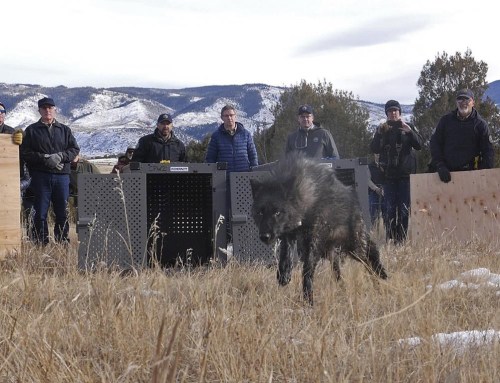
Wildlife agencies are trying to capture and relocate the first pack of wolves that formed under Colorado's ambitious wolf reintroduction program after the animals repeatedly attacked livestock, marking an early stumble in the voter-driven initiative.

Read this article for free:


or

Already have an account? Log in here »

To continue reading, please subscribe:

Subscribe and receive a limited-edition Free Press branded hat or tote.

Digital Subscription

One year of digital access for only $205*

  • Enjoy unlimited reading on winnipegfreepress.com
  • Read the E-Edition, our digital replica newspaper
  • Access News Break, our award-winning app
  • Play interactive puzzles

*First annual payment billed as $205.00 + GST for one year. This annual subscription will automatically renew at $233.00 + GST every 52 weeks (10% off the regular annual price of $259.35). Offer available to new and qualified returning subscribers only. Cancel any time.

To continue reading, please subscribe:

Add Free Press access to your Brandon Sun subscription for only an additional

$1 for the first 4 weeks*

  • Enjoy unlimited reading on winnipegfreepress.com
  • Read the E-Edition, our digital replica newspaper
  • Access News Break, our award-winning app
  • Play interactive puzzles
Start now

*Your next Brandon Sun subscription payment will increase by $1.00 and you will be charged $17.95 plus GST for four weeks. After four weeks, your payment will increase to $24.95 plus GST every four weeks.

Hey there, time traveller!
This article was published 28/08/2024 (766 days ago), so information in it may no longer be current.

Wildlife agencies are trying to capture and relocate the first pack of wolves that formed under Colorado’s ambitious wolf reintroduction program after the animals repeatedly attacked livestock, marking an early stumble in the voter-driven initiative.

The move comes only a week after state officials touted three pups born to the Copper Creek pack, which formed after 10 of the predators were released in December over bitter opposition from livestock groups. The pack has at least two adults.

The bid to capture them goes against Colorado’s wolf management plan that was adopted last year. It included guidance that relocation “has little technical merit” because it could create problems elsewhere if the animals continue attacking livestock. The plan calls for using non-lethal approaches, such as patrolling ranches with range riders and scaring away problem wolves, or killing them if necessary to stop ongoing attacks on livestock.
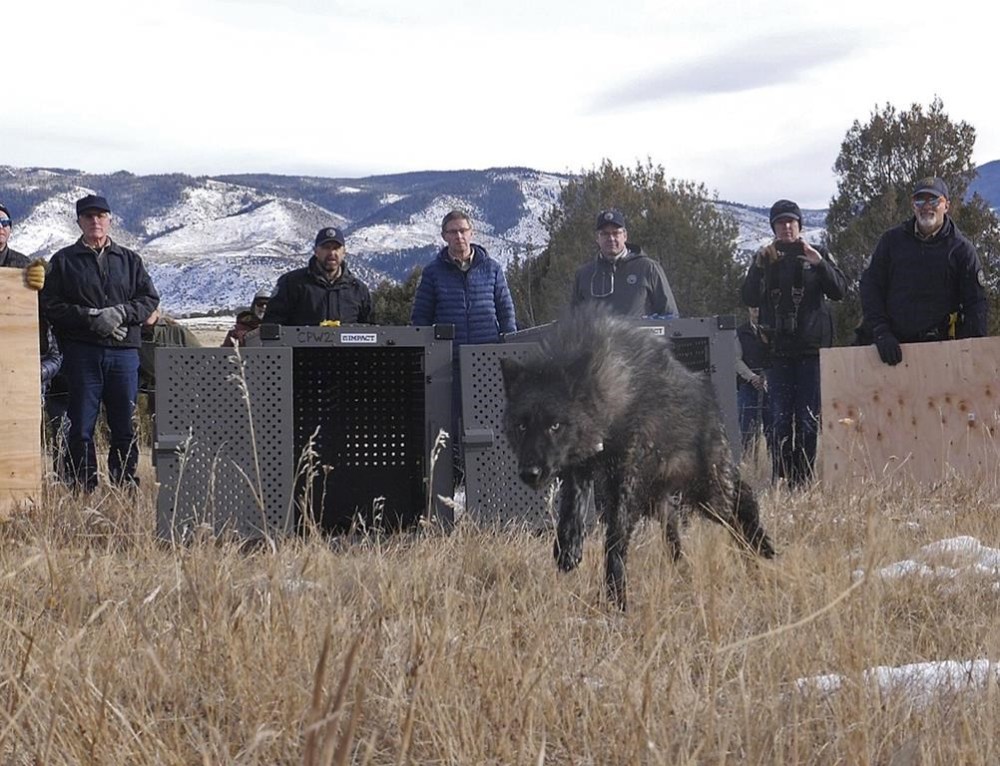
FILE - In this photo provided by Colorado Parks and Wildlife, wildlife officials release five gray wolves onto public land in Grand County, Colo., Monday, Dec. 18, 2023. (Colorado Natural Resources via AP)

Officials did not say where the Copper Creek pack would be relocated, nor whether they would be released into the wild or kept in captivity.

Ranching groups had wanted the wolf pack killed. Wildlife advocates said more should have been done to keep them from killing livestock, such as using electric fencing that can better deters attacks.

In other parts of the U.S. where wolves are well-established — including in the Northern U.S. Rocky Mountains and around the Great Lakes — the predators are routinely killed by wildlife officials in response to livestock attacks. Wolves are prolific breeders so removing some animals doesn’t have population-wide effects.

Colorado’s attempt to instead capture problem wolves comes after an agency spokesperson told The Associated Press last week that officials wanted to avoid killing them because “it’s too early in the process” of reintroduction.

“We don’t have enough wolves on the landscape to lethally remove” the pack, spokesperson Travis Duncan said.

State officials did not disclose where the capture operations were taking place but said the work was being done in conjunction with the U.S. Fish and Wildlife Service.

Michael Saul with Defenders of Wildlife said it was a “big setback” for the reintroduction.

“There are lots of ranchers using existing tools who are living with wolves and not having this problem,” Saul said.

Rancher Ted Ritschard, who lives about 15 miles (24 kilometers) from the ranch in Grand County, Colorado, where most of the livestock attacks took place, said he was glad the pack would be removed. He blamed them for killing at least 16 cattle and sheep and wants them in captivity so they don’t kill again.

“These pups have learned to kill livestock so they’re going to keep doing it,” said Ritschard, president of the Middle Park Stockgrowers Association. “Once they get a taste of sheep or cattle, that’s a whole different world.”

Ritschard said his group had sought permission earlier this year to kill the wolves that were causing problems but was denied. The state’s denial notice said livestock attacks decreased when a rancher in the area buried a “dead pit” used to dispose of dead animals that was suspected of attracting wolves.

Ritschard refuted the claim that the dead pit played a role in the attacks.

“We would see the wolves go by that dead pit at night. There was nothing fresh in that dead pit,” he said.

In a statement issued late Tuesday, Colorado Parks and Wildlife Director Jeff Davis characterized the Copper Creek pack relocation as a “unique case,” but did not elaborate.

“This action is by no means a precedent for how CPW will resolve wolf-livestock conflict moving forward,” Davis said in the statement. He said the goal was to relocate the pack “while we assess our best options for them.”

Wolf reintroduction in Colorado was narrowly approved by voters in a 2020 ballot measure. Wildlife officials expect to release an additional 30 to 50 wolves over the coming years. A handful of wolves have also wandered into Colorado from Wyoming.

Proponents argued that the apex predators would reestablish an ecological balance in the area. Wolves were largely hunted out of the state by the 1940s.

Owners of calves that are killed can be compensated by the state for the animal’s market value, up to $15,000. Ranchers have said that’s not enough.

Gray wolves killed some 800 domesticated animals across 10 states in 2022, including Colorado, according to a previous Associated Press review of depredation data from state and federal agencies.

While the losses can affect individual ranchers, it has a negligible effect on the industry at large. Ranchers say many additional kills go unrecorded because the dead livestock is never found or the cause of death can’t be confirmed.


Report Error Submit a Tip

More Stories

Khan should’ve taken high road: Goertzen

Carol Sanders 5 minute read Preview

Khan should’ve taken high road: Goertzen

Carol Sanders 5 minute read Yesterday at 6:39 PM CDT

The veteran Progressive Conservative who championed Obby Khan’s leadership bid says the former Blue Bomber dropped the ball by dissing his Tory teammates before he stepped down.

“I wouldn’t recommend it, and I didn’t recommend it,” Kelvin Goertzen (Steinbach) said in an interview Friday.

Khan resigned as PC leader and quit the caucus Monday saying some members were secretly plotting his ouster, even after he won a confidence vote on Sept. 25.

On Tuesday, Khan lashed out in a CJOB interview, naming the alleged plotters, saying constituents deserved to know which of their elected representatives “lacked moral integrity.” Khan told the Free Press he was “deeply emotionally hurt,” and felt stabbed in the back.

Read
Yesterday at 6:39 PM CDT

Volunteer pop-up library axed from Manitoba Youth Centre

Matthew Frank 4 minute read Preview

Volunteer pop-up library axed from Manitoba Youth Centre

Matthew Frank 4 minute read 2:01 AM CDT

Manitoba Corrections has cancelled a pop-up library program at the Manitoba Youth Centre, leaving inmates without librarian services and fewer options to borrow certain books.

The Prison Libraries Committee, part of the non-profit Manitoba Library Association, operated and funded the volunteer program since 2024 before it was shut down by the province last month. The group previously partnered with the province to offer the service because the facility has no dedicated library of its own.

“It is concerning that community members who are incarcerated, especially youth, are losing out on meaningful programming, access to information and rehabilitation efforts, which are offered at no cost to (Manitoba) Corrections. We urge Manitoba Justice to promote more library services and programming, not less,” said a Sept. 24 letter from the non-profit addressed to the justice minister.

Ashley Huot, chair of the Prison Libraries Committee, said she was puzzled when she received an email last month from Manitoba Corrections stating that the pop-up library was no longer needed.

Read
2:01 AM CDT

Puzzles Palace

1 minute read Monday, Jul. 27, 2026

To solve our puzzles, please subscribe with this special offer: |

May be whiff of truth to ex’s odour ardour

Maureen Scurfield 5 minute read 2:01 AM CDT

DEAR MISS LONELYHEARTS: I ran into an old boyfriend I used to curl on a team with, and we went for drinks. We’ve been almost eight years apart, and I couldn’t remember why we broke up, as we always had such a great time together.

It wasn’t until the second date — this time on a weekend — that it came back to me, with a jolt. Pee-yew! I remembered he doesn’t use deodorant on weekends. Why? He enjoys his own body odour. I recalled that a bit too late, and it was just as awful as ever! I went home early.

Tonight, he called and I refused him another date. I said, “Think back. You remember why we broke up?” Then he said, “Oh yeah, you hated my no-deodorant weekend policy. Well, guess what? Some women don’t mind!” I said I really doubted that, and that ended the conversation. Miss L., wouldn’t any women find stinky underarms offensive?

— Sensitive Nose, Fort Richmond

Wolf pack that attacked Colorado livestock to be relocated as reintroduction program stumbles

Matthew Brown, The Associated Press 5 minute read Preview

Wolf pack that attacked Colorado livestock to be relocated as reintroduction program stumbles

Matthew Brown, The Associated Press 5 minute read Wednesday, Aug. 28, 2024

Wildlife agencies are trying to capture and relocate the first pack of wolves that formed under Colorado's ambitious wolf reintroduction program after the animals repeatedly attacked livestock, marking an early stumble in the voter-driven initiative.

The move comes only a week after state officials touted three pups born to the Copper Creek pack, which formed after 10 of the predators were released in December over bitter opposition from livestock groups. The pack has at least two adults.

The bid to capture them goes against Colorado's wolf management plan that was adopted last year. It included guidance that relocation “has little technical merit” because it could create problems elsewhere if the animals continue attacking livestock. The plan calls for using non-lethal approaches, such as patrolling ranches with range riders and scaring away problem wolves, or killing them if necessary to stop ongoing attacks on livestock.

Officials did not say where the Copper Creek pack would be relocated, nor whether they would be released into the wild or kept in captivity.

Read
Wednesday, Aug. 28, 2024

International flavour: Canadian investors may want to make like Ottawa, diversify beyond U.S.

Joel Schlesinger 6 minute read Preview

International flavour: Canadian investors may want to make like Ottawa, diversify beyond U.S.

Joel Schlesinger 6 minute read 2:01 AM CDT

Canada is learning the hard way about the dangers of putting too many eggs in its U.S. economic basket.

Much has been made about the need to diversify our economy away from the United States.

Diversification is understandably beneficial. The more varied streams of revenue a nation has, the less affected the economy will be when one of those sources is interrupted.

The same can be said about investment portfolios.

Read
2:01 AM CDT