A week after Helene hit, thousands still without water struggle to find enough
Advertisement
Read this article for free:
or
Already have an account? Log in here »
To continue reading, please subscribe:

Digital Subscription
One year of digital access for only $205*
- Enjoy unlimited reading on winnipegfreepress.com
- Read the E-Edition, our digital replica newspaper
- Access News Break, our award-winning app
- Play interactive puzzles
*First annual payment billed as $205.00 + GST for one year. This annual subscription will automatically renew at $233.00 + GST every 52 weeks (10% off the regular annual price of $259.35). Offer available to new and qualified returning subscribers only. Cancel any time.
To continue reading, please subscribe:
Add Free Press access to your Brandon Sun subscription for only an additional
$1 for the first 4 weeks*
- Enjoy unlimited reading on winnipegfreepress.com
- Read the E-Edition, our digital replica newspaper
- Access News Break, our award-winning app
- Play interactive puzzles
*Your next Brandon Sun subscription payment will increase by $1.00 and you will be charged $17.95 plus GST for four weeks. After four weeks, your payment will increase to $24.95 plus GST every four weeks.
Read unlimited articles for free today:
or
Already have an account? Log in here »
Hey there, time traveller!
This article was published 04/10/2024 (718 days ago), so information in it may no longer be current.
ASHEVILLE, N.C. (AP) — Nearly a week after Hurricane Helene brought devastation to western North Carolina, a shiny stainless steel tanker truck in downtown Asheville attracted residents carrying 5-gallon containers, milk jugs and buckets to fill with what has become a desperately scare resource — drinking water.
Flooding tore through the city’s water system, destroying so much infrastructure that officials said repairs could take weeks. To make do, Anna Ramsey arrived Wednesday with her two children, who each left carrying plastic bags filled with 2 gallons (7.6 liters) of water.
“We have no water. We have no power. But I think it’s also been humbling,” Ramsey said.
Helene’s path through the Southeast left a trail of power outages so large the darkness was visible from space. Tens of trillions of gallons of rain fell and more than 200 people were killed, making Helene the deadliest hurricane to hit the mainland U.S. since Katrina in 2005. Hundreds of people are still unaccounted for, and search crews must trudge through knee-deep debris to learn whether residents are safe.
It also damaged water utilities so severely and over such a wide inland area that one federal official said the toll “could be considered unprecedented.” As of Thursday, about 136,000 people in the Southeast were served by a nonoperational water provider and more than 1.8 million were living under a boil water advisory, according to the Environmental Protection Agency.
Western North Carolina was especially hard hit. Officials are facing a difficult rebuilding task made harder by the steep, narrow valleys of the Blue Ridge Mountains that during a more typical October would attract throngs of fall tourists.
“The challenges of the geography are just fewer roads, fewer access points, fewer areas of flat ground to stage resources” said Brian Smith, acting deputy division director for the EPA’s water division in the Southeast.
After days without water, people long for more than just a sponge bath.
“I would love a shower,” said Sue Riles in Asheville. “Running water would be incredible.”
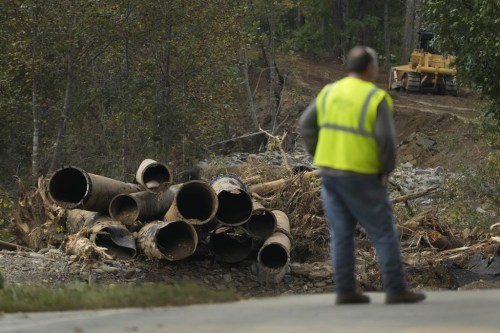
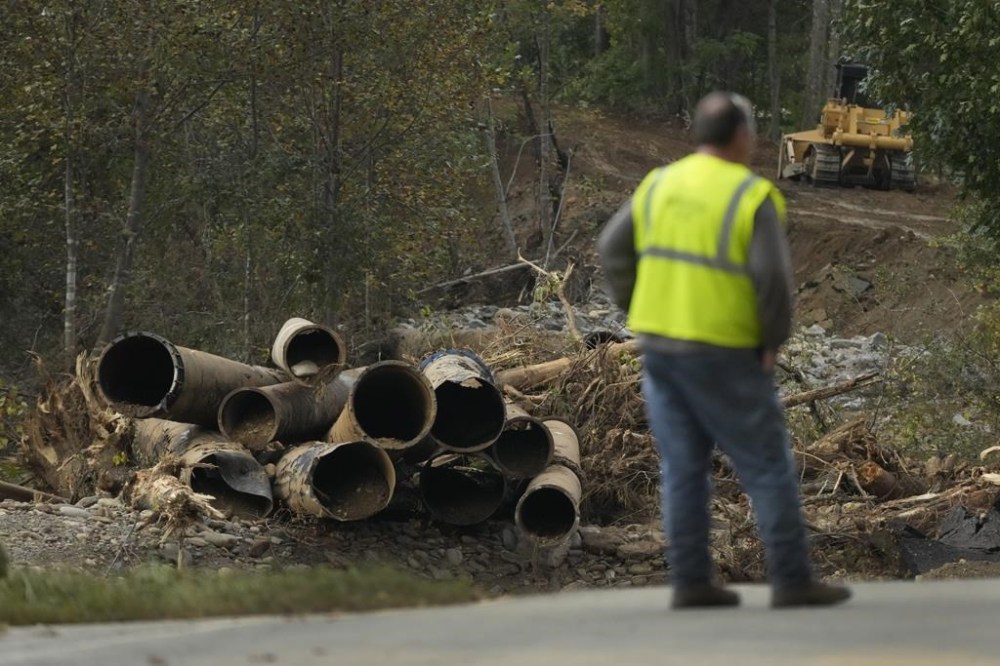
The raging floodwaters of Helene destroyed crucial parts of Asheville’s water system, scouring out the pipes that convey water from a reservoir in the mountains above town that is the largest of three water supplies for the system. To reach a second reservoir that was knocked offline, a road had to be rebuilt.
Boosted output from the third source restored water flow in some southern Asheville neighborhoods Friday, but without full repairs schools may not be able to resume in-person classes, hospitals may not restore normal operations, and the city’s hotels and restaurants may not fully reopen.
Even water that’s unfit to drink is scarce. Drew Reisinger, the elected Buncombe County register of deeds, worries about people in apartments who can’t easily haul a bucket of water from a creek to flush their toilet. Officials are advising people to collect nondrinkable water for household needs from a local swimming pool.
“One thing no one is talking about is the amount of poop that exists in every toilet in Asheville,” he said. “We’re dealing with a public health emergency.”
It’s a situation that becomes more dangerous the longer it lasts. Even in communities fortunate enough to have running water, hundreds of providers have issued boil water notices indicating the water could be contaminated. But boiling water for cooking and drinking is time consuming and small mistakes can cause stomach illness, according to Natalie Exum, an assistant professor at Johns Hopkins Bloomberg School of Public Health.
“Every day that goes by, you could be exposed to a pathogen,” Exum said. “These basic services that we take for granted in our everyday lives actually do do a lot to prevent illness.”
Travis Edwards’ faucet worked immediately after the storm. He filled as many containers as he could for himself and his child, but it didn’t take long for the flow to weaken, then stop. They rationed water, switching to hand sanitizer and barely putting any on toothbrushes.
“(We) didn’t realize how dehydrated we were getting,” he said.
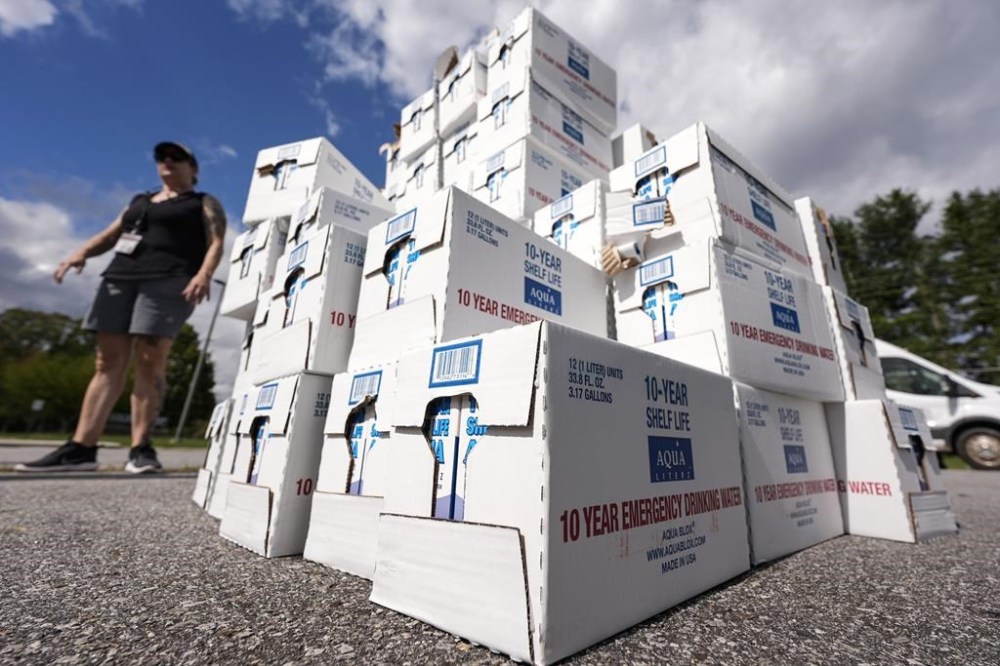
Federal officials have shipped millions of gallons of water to areas where people also might not be able to make phone calls or switch on the lights.
Power has been restored to about 62% of homes and businesses and 8,000 crews are out working to restore power in the hardest hit parts of North Carolina, federal officials said Thursday. In 10 counties, about half of the cell sites are still down.
The first step for some utilities is simply figuring out how bad the damage is, a job that might require EPA expertise in extreme cases. Ruptured water pipes are a huge problem. They often run beneath roads, many of which were crumpled and twisted by floodwaters.
“Pretty much anytime you see a major road damaged, there’s a very good chance that there’s a pipe in there that’s also gotten damaged,” said Mark White, drinking water global practice leader at the engineering firm CDM Smith.
Generally, repairs start at the treatment plant and move outward, with fixes in nearby big pipes done first, according to the EPA.
“Over time, you’ll gradually get water to more and more people,” White said.
Many people are still missing, and water repair employees don’t typically work around search and rescue operations. It takes a toll, according to Kevin Morley, manager of federal relations with the American Water Works Association.
“There’s emotional support that is really important for all the people involved. You’re seeing people’s lives just wiped out,” he said.
Even private well owners aren’t immune. Pumps on private wells may have lost power and overtopping floodwaters can contaminate them.
There’s often a “blind faith” assumption that drinking water won’t fail. In this case, the technology was insufficient, according to Craig Colten. Before retiring to Asheville, he was a professor in Louisiana focused on resilience to extreme weather. He hopes Helene will prompt politicians to spend more to ensure infrastructure withstands destructive storms.
And climate change will only make the problem more severe, said Erik Olson, a health and food expert at the nonprofit Natural Resources Defense Council.
“I think states and the federal government really need to step back and start looking at how we’re going to prepare for these extreme weather events that are going to be occurring and recurring every single year,” he said.
Edwards has developed a system to save water. He’ll soap dirty dishes and rinse them with a trickle of water with bleach, which is caught and transferred to a bucket — useable for the toilet.
Power and some cell service have returned for him. And water distribution sites have guaranteed some measure of normalcy: Edwards feels like he can start going out to see friends again.

“To not feel guilty about using more than a cup of water to, like, wash yourself … I’m really, really grateful,” he said.
___
Phillis reported from St. Louis. Associated Press writer Rebecca Santana contributed from Washington.
___
The Associated Press receives support from the Walton Family Foundation for coverage of water and environmental policy. The AP is solely responsible for all content. For all of AP’s environmental coverage, visit https://apnews.com/hub/climate-and-environment