How many smoke-related deaths from wildfires are linked to climate change every year?

Advertisement

Advertise with us

Climate change may be contributing to thousands more wildfire smoke-related deaths every year than in previous decades, a new study suggests — results a Canadian co-author says underline the urgency of reducing planet-warming emissions.

Read this article for free:


or

Already have an account? Log in here »

To continue reading, please subscribe:

Subscribe and receive a limited-edition Free Press branded hat or tote.

Digital Subscription

One year of digital access for only $205*

  • Enjoy unlimited reading on winnipegfreepress.com
  • Read the E-Edition, our digital replica newspaper
  • Access News Break, our award-winning app
  • Play interactive puzzles

*First annual payment billed as $205.00 + GST for one year. This annual subscription will automatically renew at $233.00 + GST every 52 weeks (10% off the regular annual price of $259.35). Offer available to new and qualified returning subscribers only. Cancel any time.

To continue reading, please subscribe:

Add Free Press access to your Brandon Sun subscription for only an additional

$1 for the first 4 weeks*

  • Enjoy unlimited reading on winnipegfreepress.com
  • Read the E-Edition, our digital replica newspaper
  • Access News Break, our award-winning app
  • Play interactive puzzles
Start now

*Your next Brandon Sun subscription payment will increase by $1.00 and you will be charged $17.95 plus GST for four weeks. After four weeks, your payment will increase to $24.95 plus GST every four weeks.

Hey there, time traveller!
This article was published 21/10/2024 (693 days ago), so information in it may no longer be current.

Climate change may be contributing to thousands more wildfire smoke-related deaths every year than in previous decades, a new study suggests — results a Canadian co-author says underline the urgency of reducing planet-warming emissions.

The international study published Monday is one of the most rigorous yet in determining just how much climate change can be linked to wildfire smoke deaths around the world, said Sian Kou-Giesbrecht, an assistant professor at Dalhousie University.

“What stands out to me is that this proportion is increasing just so much. I think that it really kind of attests to just how much we need to take targeted action to reducing greenhouse-gas emissions,” she said in an interview.
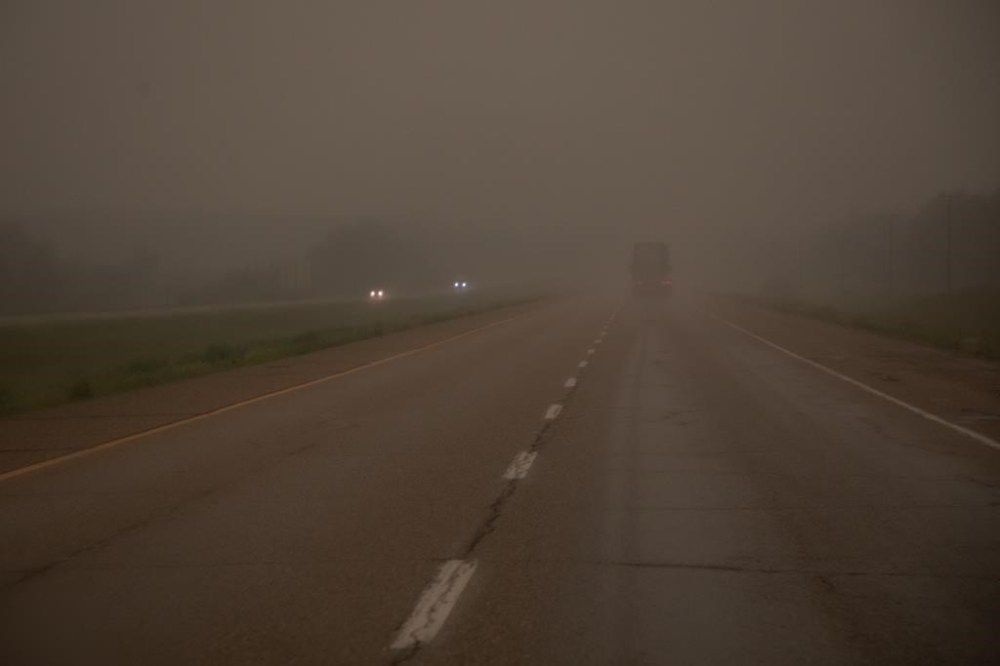
A new international study co-authored by a Canadian researcher says climate change is contributing to thousands more wildfire smoke-related deaths than in previous decades.Smoke hangs over Highway 16 westbound to Jasper, Alta. outside of Edmonton on Thursday July 25, 2024. THE CANADIAN PRESS/Amber Bracken

The study estimates, using mathematical modeling, that about 12,566 annual wildfire smoke-related deaths in the 2010s were linked to climate change, up from about 669 in the 1960s, when far less carbon dioxide was concentrated in the atmosphere.

Translated to a proportion of wildfire smoke mortality overall, the study estimates about 13 per cent of estimated excessdeaths in the 2010s were linked to climate change, compared to about 1.2 per cent in the 1960s.

“Adapting to the critical health impacts of fires is required,” read the study, published in the peer-reviewed journal Nature Climate Change.

While wildfires are a natural part of the boreal forest ecosystem, a growing number of studies have documented how climate change, driven by the burning of fossil fuels, is making them larger and more intense — and contributing more to air pollution.

The same research group is behind another study published in the same journal Monday that suggests climate change increased the global area burned by wildfire by about 16 per cent from 2003 to 2019.

Those climate-fuelled fires then churn out more fine particle pollution, known as PM2.5, that’s tiny enough to get deep into the lungs — and in the long run can have serious health effects.

The study that estimated the scale of those effects is based on modeling, not historical data about reported deaths from air pollution.

Researchers used established public-health metrics for when pollution is thought to contribute to mortality, then figured out the extent to which wildfire smoke may have played a role in that overall exposure to arrive at the estimates.

Meanwhile, Health Canada estimates that between 2013 and 2018, up to 240 Canadians died every year due to short-term exposure to wildfire air pollution.

Kou-Giesbrecht said Monday’s study did not find that climate change had a major influence on the number of smoke-related deaths from Canada’s boreal wildfires.

She suggested that’s likely due to the country’s relatively small population size, and how tricky it is to model forest fires in the region, given its unique mix of shrubs and peat.

But she also noted that a stretch of devastating Canadian wildfire seasons over the past several years was not captured in the study, and she expects future research could find a bigger increase in deaths and public-health problems linked to climate change.

The most affected regions in the study were South America, Australia and Europe.

Kou-Giesbrecht said the more studies that uncover the link between climate change and disasters as “tangible” as wildfires, the more the case for “drastic climate action” will be bolstered.

“I think that the more and more evidence that we have to support the role of climate change in shaping the past 100 years, and knowing that it will continue to shape the next 100 years, is really important,” she said.

“And I find that personally interesting, albeit scary.”

The study used three highly complex models to estimate the relationship between climate change, land use and fire.

The models, which each contain thousands upon thousands of equations, compare what wildfires look like in the current climate to what they may have looked like in pre-industrial times, before humans started to burn vast amounts of fossil fuels.

The researchers used the models to calculate gas and aerosol emissions from wildfires between 1960 and 2019, and then make estimates about annual smoke-related deaths.

The type of methodology used by Monday’s studies, known as attribution science, is considered one of the fastest-growing fields of climate science. It is bolstered in part by major strides in computing power.

This report by The Canadian Press was first published Oct. 21, 2024.

Report Error Submit a Tip

More Stories

Puzzles Palace

1 minute read Monday, Jul. 27, 2026

To solve our puzzles, please subscribe with this special offer: |

How many smoke-related deaths from wildfires are linked to climate change every year?

Jordan Omstead, The Canadian Press 4 minute read Preview

How many smoke-related deaths from wildfires are linked to climate change every year?

Jordan Omstead, The Canadian Press 4 minute read Monday, Oct. 21, 2024

Climate change may be contributing to thousands more wildfire smoke-related deaths every year than in previous decades, a new study suggests — results a Canadian co-author says underline the urgency of reducing planet-warming emissions.

The international study published Monday is one of the most rigorous yet in determining just how much climate change can be linked to wildfire smoke deaths around the world, said Sian Kou-Giesbrecht, an assistant professor at Dalhousie University.

"What stands out to me is that this proportion is increasing just so much. I think that it really kind of attests to just how much we need to take targeted action to reducing greenhouse-gas emissions," she said in an interview.

The study estimates, using mathematical modeling, that about 12,566 annual wildfire smoke-related deaths in the 2010s were linked to climate change, up from about 669 in the 1960s, when far less carbon dioxide was concentrated in the atmosphere.

Read
Monday, Oct. 21, 2024

Retired sportscaster Scott Oake determined as fundraising for women's addictions treatment facility enters home stretch

Melissa Martin 4 minute read Preview

Retired sportscaster Scott Oake determined as fundraising for women's addictions treatment facility enters home stretch

Melissa Martin 4 minute read Thursday, Sep. 10, 2026

For now, the patch of land just east of the Victoria Hospital doesn’t look like much: just a field of rocks, mounded dirt, and concrete piles driven into the earth. Yet when Scott Oake looks over the site, he can already imagine how it will look in just over a year’s time, when the new Anne Oake Family Recovery Centre is expected to open.

It’s easier to picture this time around. In 2020, when the recently-retired CBC sportscaster and his late wife, Anne, were building their first labour of intermingled grief and love, the Bruce Oake Recovery Centre for men, it was hard for him to wrap his mind around how a raw construction site could transform into a welcoming addictions treatment facility.

When that centre opened in 2021, Oake found it looked “almost identical” to the architect’s renderings. So it’s easy to hope the Anne Oake Centre will be the same. It will be the first facility of its kind, its founders believe, not only in Canada but in North America: a place where 50 to 70 women can pursue sobriety while staying with their children.

“At Bruce Oake there’s a culture of love, and most of all a culture of hope,” Oake said, speaking at the site Thursday after a media conference to announce the final push of the centre’s fundraising campaign. “I can feel it every time I walk into that building. And I know it will be the same here.”

Read
Thursday, Sep. 10, 2026

Child hospitalized after being hit in Walmart parking lot

1 minute read Yesterday at 3:46 PM CDT

Police are investigating after a child was struck by a vehicle in a Walmart parking lot on Kenaston Boulevard Friday evening.

At 9 p.m. officers from the Winnipeg Police Service traffic division attended to a motor vehicle-pedestrian collision in the 1600 block of Kenaston, police said Saturday.

A school-aged child was taken to hospital in unstable condition, police said, but the child was later upgraded to stable condition.

Police said the child sustained minor injuries and an investigation is ongoing.

Nifty neighbours also jonesing for geniality

Maureen Scurfield 4 minute read Yesterday at 2:01 AM CDT

DEAR MISS LONELYHEARTS: Recently, a new couple with no children moved onto our cul de sac, and everybody is taking notice! This attractive pair with no kids both drive amazing cars, work from home and leave their garage doors up a lot. Everybody on the street walks by to sneak a peek into the big garage at just about any time of day.

Lately, the man’s been out on his front lawn in a muscle shirt in the late afternoon, planting shrubs and putting up stylish fall-themed ornaments. At night they often leave the living-room curtains open. That makes for convenient viewing for curious neighbours like us!

A few days ago, my wife invited the new couple over for a barbecue and swim in our pool. They are really nice people, but mentioned that other people nearby have been pretty stand-offish. They wonder why. Should I tell them it’s probably just jealousy over their beautiful vehicles and enviable lifestyle, or should I just shut up?

—Wanting to Help, Sage Creek

Sunday-night auto aficionados work to steer away from unwelcome elements they say aren’t a part of their tradition

Zoe Pierce 12 minute read Preview

Sunday-night auto aficionados work to steer away from unwelcome elements they say aren’t a part of their tradition

Zoe Pierce 12 minute read Friday, Sep. 11, 2026

The red 1969 Dodge Coronet Super Bee out for a cruise on Portage Avenue draws admiring eyes from onlookers on a recent Sunday night, many of them seeing a specimen of the now-rare muscle car for the first time on a Winnipeg street. Or any other street, for that matter.

Longtime car enthusiast Bob Sudoma was behind the wheel, participating in the decades-old show-offy summer tradition.

The Sunday night cruise is built around a simple idea: proud car owners take their beloved vehicles for a spin to meet up with others of the same autophile ilk.

Less-fortunate appreciators, or just curious folks, also gather along the route to watch the highly-polished parade. Portage Avenue is one of cruise night’s best-known stretches.

Read
Friday, Sep. 11, 2026