It’s not official yet but Mount Fuji gets its trademark snowcap after the longest delay in 130 years

Advertisement

Advertise with us

TOKYO (AP) — Japan's Mount Fuji finally got its trademark snowcap early on Wednesday, more than a month after it normally would and after setting a record for the most-delayed snowfall in 130 years.

Read this article for free:


or

Already have an account? Log in here »

To continue reading, please subscribe:

Subscribe and receive a limited-edition Free Press branded hat or tote.

Digital Subscription

One year of digital access for only $205*

  • Enjoy unlimited reading on winnipegfreepress.com
  • Read the E-Edition, our digital replica newspaper
  • Access News Break, our award-winning app
  • Play interactive puzzles

*First annual payment billed as $205.00 + GST for one year. This annual subscription will automatically renew at $233.00 + GST every 52 weeks (10% off the regular annual price of $259.35). Offer available to new and qualified returning subscribers only. Cancel any time.

To continue reading, please subscribe:

Add Free Press access to your Brandon Sun subscription for only an additional

$1 for the first 4 weeks*

  • Enjoy unlimited reading on winnipegfreepress.com
  • Read the E-Edition, our digital replica newspaper
  • Access News Break, our award-winning app
  • Play interactive puzzles
Start now

*Your next Brandon Sun subscription payment will increase by $1.00 and you will be charged $17.95 plus GST for four weeks. After four weeks, your payment will increase to $24.95 plus GST every four weeks.

Hey there, time traveller!
This article was published 05/11/2024 (703 days ago), so information in it may no longer be current.

TOKYO (AP) — Japan’s Mount Fuji finally got its trademark snowcap early on Wednesday, more than a month after it normally would and after setting a record for the most-delayed snowfall in 130 years.

The first snowfall on Mt. Fuji, a UNESCO World Heritage site, could be seen from the southwestern side of the mountain, according to the Shizuoka branch of the Japan Meteorological Agency.

But the JMA’s Kofu Local Meteorological Office, which is on the other side of the mountain and has been in charge of making the announcement since 1984, still could not see the snow due to cloudy weather — meaning it’s not official yet.

The lack of snow on Mt. Fuji on Tuesday broke the previous record set on Oct. 26, 2016, meteorological officials said.

Usually, the 3,776-meter- (nearly 12,300-foot-) high mountain has sprinkles of snow falling on its summit starting Oct. 2, about a month after the summertime hiking season there ends. Last year, snow fell on the mountain on Oct. 5, according to the JMA.

The snowless Mt. Fuji has captured attention on social media. People posted photos showing the bare mountain, some expressing surprise and others concerned over climate change.

The JMA’s Kofu office has cited October’s surprisingly summery weather as the reason. The temperature earlier this year has been higher across Japan, including Mt. Fuji.

“Many people are waiting to see the snowcap and we’ve received many inquiries recently,” Kiryu said. He said clouds around the mountaintop have blocked the view since Wednesday morning, delaying the confirmation of the snowcap, but officials are continuing to try to get a peak at the first snowfall.

FILE - Mount Fuji in the early morning sunlight is seen from Lake Kawaguchi, Japan, on Aug. 7, 2019. (AP Photo/Jae C. Hong, File)

Kiryu said it is too early to link this year’s late snowcap to global warming, noting Mt. Fuji’s first snow last year was in early October, adding: “I think we need to examine data for a longer period of time to make any conclusion.”

The average October temperature is minus 2 degrees Celsius (28.4 degrees Fahrenheit) at the summit, but this year, it was 1.6 C, (34.9 F), a record high since 1932.

Japan this year also had an unusually hot summer and warm autumn.

A symbol of Japan, the mountain called “Fujisan” used to be a place of pilgrimage. The mountain with its snowy top and near symmetrical slopes have been the subject of numerous forms of art, including Japanese ukiyoe artist Katsushika Hokusai’s Thirty-six Views of Mount Fuji.

Today, it attracts hikers who climb to the summit to see the sunrise. But tons of trash left behind and overcrowding have triggered concern and calls for environmental protection and measures to control overtourism.
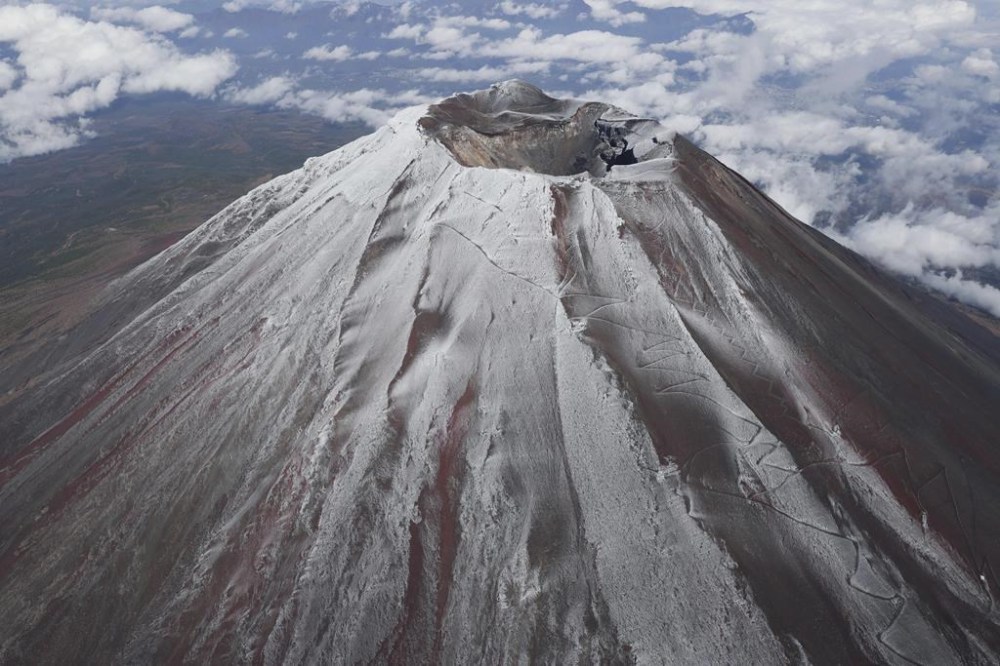
Mt. Fuji in Japan is covered with snow Wednesday, Nov. 6, 2024. (Kyodo News via AP)

Jun Kubota, a weather forecaster and a climber who grew up in Yamanashi, one of the two prefectures that are home to Mt. Fuji, says he is concerned if this year’s delayed snowfall is part of a trend.

“I wonder if the season we can enjoy the snow is getting shorter, not just at Mt. Fuji but also on other mountains in central Japan or on Hokkaido,” Kubota said in a Zoom call. i

He noted reports of snow shortage on ski slopes in recent years. “I’m afraid there could be an impact not only on snow mountain climbing, but also winter sports in general.”

___

AP video journalist Mayuko Ono contributed to this report.
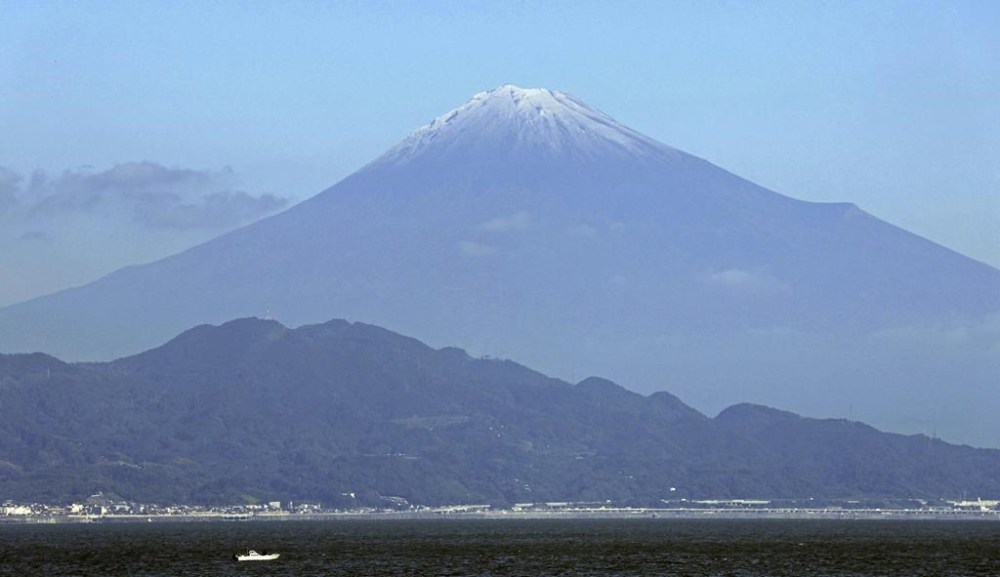
Mt. Fuji is snowcapped, seen from Shizuoka prefecture, central Japan Wednesday, Nov. 6, 2024. (Kyodo News via AP)
Report Error Submit a Tip

More Stories

‘Please excuse us from writing these notes …’

Editorial 4 minute read Preview

‘Please excuse us from writing these notes …’

Editorial 4 minute read 2:01 AM CDT

It’s a common-sense prescription for the health-care system. The only wonder is that it took so long to happen.

Read
2:01 AM CDT

Can’t cut your way to being a better city

Molly McCracken 5 minute read 2:00 AM CDT

The powers that be in Winnipeg have pushed for cheap property taxes for decades. As a result, the city doesn’t have enough money to balance the books, let alone maintain infrastructure, deliver services and respond to challenges like homelessness and the toxic drug crisis.

Winnipeg’s fiscal problem stems from decades of keeping property-tax increases below inflation and relying on inadequate revenues to fund a growing city. The result? Today, Winnipeg spends less money per person on city services than it did in 2001.

A look at the books at city hall is stark. Winnipeg has run a deficit almost every year since the COVID-19 pandemic because of climate-change-driven heavy ice and snowstorms, higher fuel costs and increased policing overtime. During this time, city council tried to cut and freeze public service spending where it could; as a result, community services have been cut to the bone.

Departments responsible for what makes a city a good place to live have been squeezed. Since 1999, community services — responsible for libraries, recreation, swimming lessons and aspects of Winnipeg’s poverty-reduction work — has 149 fewer staff positions, an 18 per cent reduction, even as the city’s population has grown 35 per cent, or by 220,000 people.

Get to know your Jet: Mario Ferraro

Mike McIntyre 8 minute read Preview

Get to know your Jet: Mario Ferraro

Mike McIntyre 8 minute read Yesterday at 5:39 PM CDT

A one-on-one conversation with a Winnipeg Jet about the stuff you don't always hear in the media scrum

Read
Yesterday at 5:39 PM CDT

Manitoba worker dead after fall from roof

Matthew Frank 3 minute read Updated: Yesterday at 5:56 PM CDT

The province is investigating after a worker died on the job after falling off a roof last month.

The worker, who was employed by Winnipeg-based Pristine Roofing & Siding, was critically injured on Sept. 22 after falling from a roof during a residential re-roofing project in the Rural Municipality of St. Andrews, a provincial spokesperson said in an email.

The man later died.

The investigation is ongoing, and no other information will be provided, the spokesperson said Thursday.

Other cities build rapid transit, while we wait

Ken Klassen 4 minute read Preview

Other cities build rapid transit, while we wait

Ken Klassen 4 minute read 2:00 AM CDT

Winnipeg’s civic election campaign has produced no shortage of promises to improve transit safety and fix problems with the new network. Those issues are real and urgent. But they should not distract from a larger failure — while other Canadian urban regions secure billions in federal support to transform their transit systems, Winnipeg is falling further behind.

Read
2:00 AM CDT

Alberta’s gopher museum closed until further notice as owners find new facility

Daniela Germano, The Canadian Press 3 minute read Preview

Alberta’s gopher museum closed until further notice as owners find new facility

Daniela Germano, The Canadian Press 3 minute read Updated: 12:54 PM CDT

A quirky Alberta roadside attraction that has delighted travellers for decades with its stuffed rodents in tiny costumes is closed until further notice.

The World Famous Gopher Hole Museum, located in Torrington, a hamlet about 120 kilometres north of Calgary, made the announcement online earlier this week.

Laural Kurta, museum director, said she was forced to close the doors because the two historical buildings that house the exhibits need to be replaced.

"We have done every patch repair, staple, spackle, everything we could possibly do, and it is just at its end," Kurta said in an interview Tuesday.

Read
Updated: 12:54 PM CDT