Hydrogen-heated home lays ground for low-carbon communities
Advertisement
Read this article for free:
or
Already have an account? Log in here »
To continue reading, please subscribe:

Digital Subscription
One year of digital access for only $205*
- Enjoy unlimited reading on winnipegfreepress.com
- Read the E-Edition, our digital replica newspaper
- Access News Break, our award-winning app
- Play interactive puzzles
*First annual payment billed as $205.00 + GST for one year. This annual subscription will automatically renew at $233.00 + GST every 52 weeks (10% off the regular annual price of $259.35). Offer available to new and qualified returning subscribers only. Cancel any time.
To continue reading, please subscribe:
Add Free Press access to your Brandon Sun subscription for only an additional
$1 for the first 4 weeks*
- Enjoy unlimited reading on winnipegfreepress.com
- Read the E-Edition, our digital replica newspaper
- Access News Break, our award-winning app
- Play interactive puzzles
*Your next Brandon Sun subscription payment will increase by $1.00 and you will be charged $17.95 plus GST for four weeks. After four weeks, your payment will increase to $24.95 plus GST every four weeks.
Read unlimited articles for free today:
or
Already have an account? Log in here »
Hey there, time traveller!
This article was published 21/11/2024 (664 days ago), so information in it may no longer be current.
On the outside, the new house just east of Edmonton in Sherwood Park looks like any other Canadian suburban home.
But inside, the home’s state-of-the-art furnace is fueled not by the Alberta norm of natural gas, but by pure hydrogen — making it the first of its kind in Canada.
Built as a demonstration and open to the public for tours, “HomeOne” aims to show that hydrogen gas can be used safely and effectively for heating buildings, while also being part of the clean energy transition.
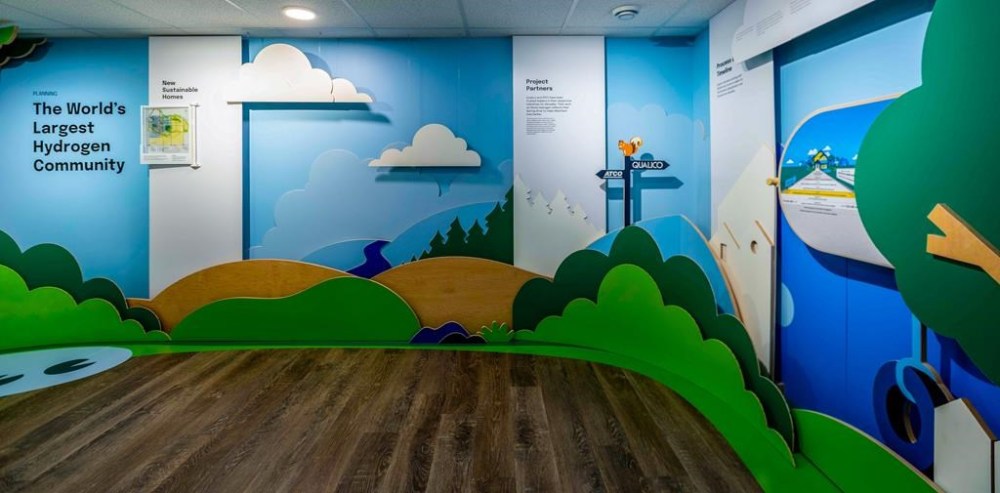
The home is a joint project between electricity and natural gas utility company Atco and residential developer Qualico, who say their ultimate goal is to have all of the 37,000 homes in Qualico’s proposed future Sherwood Park community of Bremner heated by pure hydrogen.
“We hear from our builders that there is a great deal of (public) interest in low-carbon living,” said Brad Armstrong, vice-president for community development with Qualico.
“Nobody is interested in polluting the environment, so I think there is a broad appeal there.”
Light, storable and energy-dense, hydrogen has garnered a great deal of global interest in recent years because it produces no direct greenhouse gas emissions.
Within Canada, hydrogen development is particularly attractive in Alberta because of the province’s vast reserves of natural gas.
While hydrogen fuel can be produced through a number of industrial processes, including using renewable electricity, the vast majority of the world’s current hydrogen production is produced using fossil fuels — in particular, natural gas.
A lot of the excitement around hydrogen’s potential has been related to its usefulness in the transportation or industrial sectors.
When it comes to the decarbonization of home heating, the focus in North America has been on electrification and the installation of heat pumps, not hydrogen.
But Greg Caldwell, Atco’s director of utility hydrogen strategy and decarbonization, said there are some jurisdictions where hydrogen makes more sense.
In Alberta, for example, the province’s electricity grid is already under pressure due to the rapid phase-out of coal-fired generation.
While there has been a corresponding boom in wind and solar energy generation in the province, the intermittent nature of these renewable sources of electricity means that during periods of extreme demand, the grid can become dangerously short of supply.
Forecasts show electricity demand in the province will only continue to grow as more people switch to electric vehicles and the growth of AI drives demand for power-hungry data centres.
To avoid blackouts during cold snaps and other periods of peak demand, Caldwell said it makes sense to look to hydrogen as a home-heating solution rather than invest in massive expansion of the electricity grid.
Although regulatory changes will have to be made to permit it, hydrogen can be transported through the same pipelines that already supply communities with natural gas. And doing so would be far cheaper than building wind and solar farms big enough to handle the few days a year when extreme cold causes home-heating demand to spike.
“When you look at the scale of the challenge of trying to get to an affordable, but also a lower-carbon heating system, hydrogen comes out as the winner in this jurisdiction,” Caldwell said.
Hydrogen home heating has been tried in a handful of other jurisdictions globally, such as the Netherlands, with mixed results. Some people have expressed concerns about the risk of explosion or pipeline leaks, though Caldwell said when done correctly, hydrogen heating is just as safe as natural gas.
He said the biggest drawback currently is cost. The cost of hydrogen fuel today is about double the cost of natural gas, Caldwell said, though he added homeowners would not see their utility bills double since the cost of the fuel itself is only a small portion of a utility bill.
The dual hydrogen-fueled gradient furnace and water heater installed in HomeOne is also more efficient than a traditional furnace, he added.
“I do think we’ll see the cost of the fuel come down with competition and with new projects being built,” Caldwell said, adding there are several new hydrogen production facilities currently underway in Alberta, including one by Air Products and one by Dow Chemicals.
In the meantime, Caldwell said he hopes the demonstration house in Sherwood Park helps show people that residential heating with hydrogen is viable.
“Hydrogen is just getting started,” he said.
“It can look a little scary economically, or it can look scary even technically, but what we’re telling you is we can do it. We can build it today.”
This report by The Canadian Press was first publishedNov. 21,2024.
Companies in this story: (TSX:ACO.X)