North Dakota regulators OK underground storage for proposed Midwest carbon dioxide pipeline
Advertisement
Read this article for free:
or
Already have an account? Log in here »
To continue reading, please subscribe:

Digital Subscription
One year of digital access for only $205*
- Enjoy unlimited reading on winnipegfreepress.com
- Read the E-Edition, our digital replica newspaper
- Access News Break, our award-winning app
- Play interactive puzzles
*First annual payment billed as $205.00 + GST for one year. This annual subscription will automatically renew at $233.00 + GST every 52 weeks (10% off the regular annual price of $259.35). Offer available to new and qualified returning subscribers only. Cancel any time.
To continue reading, please subscribe:
Add Free Press access to your Brandon Sun subscription for only an additional
$1 for the first 4 weeks*
- Enjoy unlimited reading on winnipegfreepress.com
- Read the E-Edition, our digital replica newspaper
- Access News Break, our award-winning app
- Play interactive puzzles
*Your next Brandon Sun subscription payment will increase by $1.00 and you will be charged $17.95 plus GST for four weeks. After four weeks, your payment will increase to $24.95 plus GST every four weeks.
Read unlimited articles for free today:
or
Already have an account? Log in here »
Hey there, time traveller!
This article was published 11/12/2024 (645 days ago), so information in it may no longer be current.
BISMARCK, N.D. (AP) — North Dakota regulators approved permits Thursday for underground storage of carbon dioxide delivered through a massive pipeline proposed for the Midwest, marking another victory for a project that has drawn fierce opposition from landowners.
The governor-led Industrial Commission voted unanimously to approve permits for Summit Carbon Solutions’ three proposed storage sites in central North Dakota. Summit says construction of the project would begin in 2026 with operations beginning in 2027, but it’s expected that resistant landowners will file lawsuits seeking to block the storage plans.
“With these permits, we’re one step closer to providing vital infrastructure that benefits farmers, ethanol producers, and communities across the Midwest,” Summit Executive VP Wade Boeshans said in a statement.
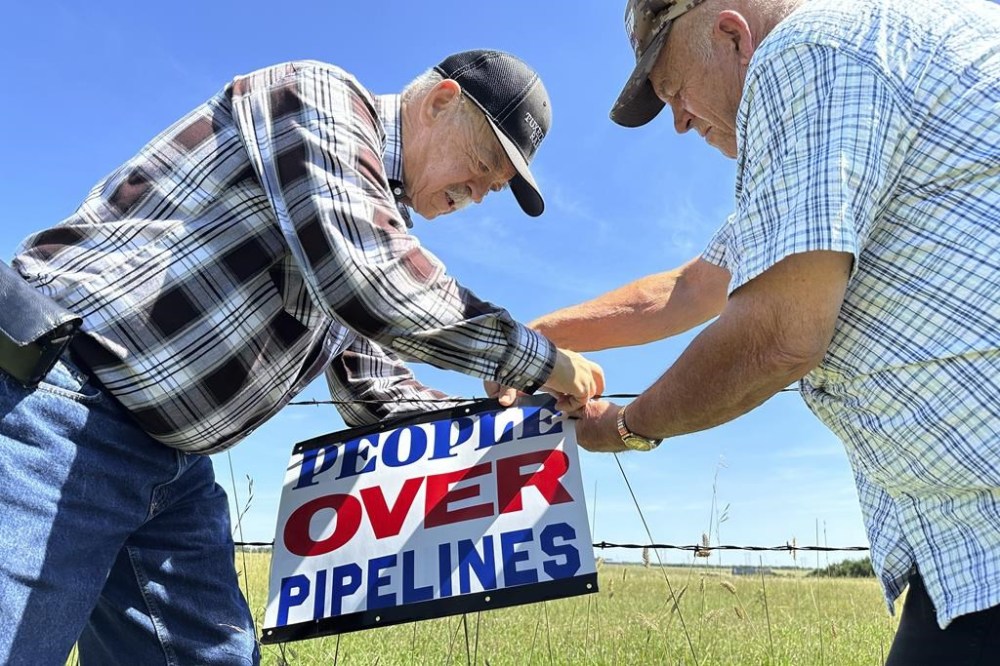
Summit’s proposed 2,500-mile (4,023-kilometer), $8 billion pipeline would transport planet-warming CO2 emissions from 57 ethanol plants in North Dakota, South Dakota, Iowa, Minnesota and Nebraska for underground storage. Carbon dioxide would move through the pipeline in a pressurized form to be injected deep underground into a rock formation.
The company has permits for its route in North Dakota and Iowa but can’t yet begin construction. Also on Thursday, Minnesota regulators approved a permit for a 28-mile (45-kilometer) leg of the project in western Minnesota.
Summit also recently applied in South Dakota, where regulators denied the company’s previous application last year.
Last month, the company gained approval for its North Dakota route, and Iowa regulators also have given conditional approval.
Summit faces several lawsuits related to the project, including a North Dakota Supreme Court appeal over a property rights law related to the underground storage plan. Further court challenges are likely.
North Dakota Republican Gov. Doug Burgum, who chairs the Industrial Commission, is President-elect Donald Trump’s choice for Interior Secretary and to lead a new National Energy Council. Burgum has frequently touted North Dakota’s underground carbon dioxide storage as a “geologic jackpot.” In 2021, he set a goal for the No. 3 oil-producing state to be carbon-neutral by 2030. His term ends Saturday.
Summit’s storage facilities would hold an estimated maximum of 352 million metric tons of CO2 over 20 years. The pipeline would carry up to 18 million metric tons of CO2 per year to be injected about 1 mile (1.6 kilometers) underground, according to an application fact sheet.
Jessie Stolark, who leads a group that supports the project and includes Summit, said the oil industry has long used similar technology.
“We know that this can be done safely in a manner that is protective of human health and underground sources of drinking water,” said Stolark, executive director of the Carbon Capture Coalition.
Summit’s project has drawn the ire of landowners around the region. They oppose the potential taking of their property for the pipeline and fear a pipeline rupture releasing a cloud of heavy, hazardous gas over the land.
A North Dakota landowners group is challenging a property rights law related to the underground storage, and attorney Derrick Braaten said they likely would challenge the granting of permits.
“The landowners that I’m working with aren’t necessarily opposed to carbon sequestration itself,” Braaten said. “They’re opposed to the idea that a private company can come in and use their property without having to negotiate with them or pay them just compensation for taking their private property and using it.”
Carbon capture projects such as Summit’s are eligible for lucrative federal tax credits intended to encourage cleaner-burning ethanol and potentially result in corn-based ethanol being refined into jet fuel.
Some opponents argue the amount of greenhouse gases sequestered through the process would make little difference and could lead farmers to grow more corn despite environmental concerns about the crop.
In Minnesota, regulators granted a route permit that would connect an ethanol plant in Fergus Falls to Summit’s broader network. They attached several conditions, including requirements that Summit first begin construction in North Dakota.
An administrative law judge who conducted hearings concluded in November that the environmental impacts from the Minnesota segment would be minimal and noted that Summit has secured agreements from landowners along most of the recommended route.
Environmental groups that oppose the project disputed the judge’s finding that the project would have a net benefit for the environment.
Iowa regulators required Summit to obtain approvals for routes in the Dakotas and underground storage in North Dakota before it can begin construction in Iowa. The Iowa Utilities Commission’s approval sparked lawsuits related to the project.
In Nebraska, where there is no state regulatory process for CO2 pipelines, Summit is working with individual counties to advance its project. At least one county has denied a permit.
___
Karnowski reported from Minneapolis.