Thirty years on, is Quebec headed for another independence referendum?
Advertisement
Read this article for free:
or
Already have an account? Log in here »
To continue reading, please subscribe:
Digital Subscription
One year of digital access for only $1.44 a week*
- Enjoy unlimited reading on winnipegfreepress.com
- Read the E-Edition, our digital replica newspaper
- Access News Break, our award-winning app
- Play interactive puzzles
*Billed as $5.77 plus GST every four weeks. After 52 weeks, price increases to the regular rate of $19.95 plus GST every four weeks. Offer available to new and qualified returning subscribers only. Cancel any time.
To continue reading, please subscribe:
Add Free Press access to your Brandon Sun subscription for only an additional
$1 for the first 4 weeks*
- Enjoy unlimited reading on winnipegfreepress.com
- Read the E-Edition, our digital replica newspaper
- Access News Break, our award-winning app
- Play interactive puzzles
*Your next Brandon Sun subscription payment will increase by $1.00 and you will be charged $17.95 plus GST for four weeks. After four weeks, your payment will increase to $24.95 plus GST every four weeks.
Read unlimited articles for free today:
or
Already have an account? Log in here »
Hey there, time traveller!
This article was published 04/01/2025 (653 days ago), so information in it may no longer be current.
MONTREAL – Ten years ago, Jean-François Lisée predicted that Quebec’s independence movement would be reborn.
“It could rise again given the right circumstances,” he said in 2015. “What could trigger it, I cannot say.”
Three years later, as leader of the sovereigntist Parti Québécois, Lisée lost his riding and saw his party reduced to 10 seats when the upstart Coalition Avenir Québec, led by François Legault, swept to power for the first time.
The 2018 election was widely seen as proof that separatism was no longer a defining issue in Quebec politics, and pollsters speculated that the PQ’s days were numbered. The province’s new leader was a former sovereigntist at the helm of a conservative-leaning, nationalist party promising not to hold a referendum, and Quebecers rewarded him with a decisive majority.
“There are many Quebecers who put aside a debate that has divided us for 50 years,” Legault said after his victory.
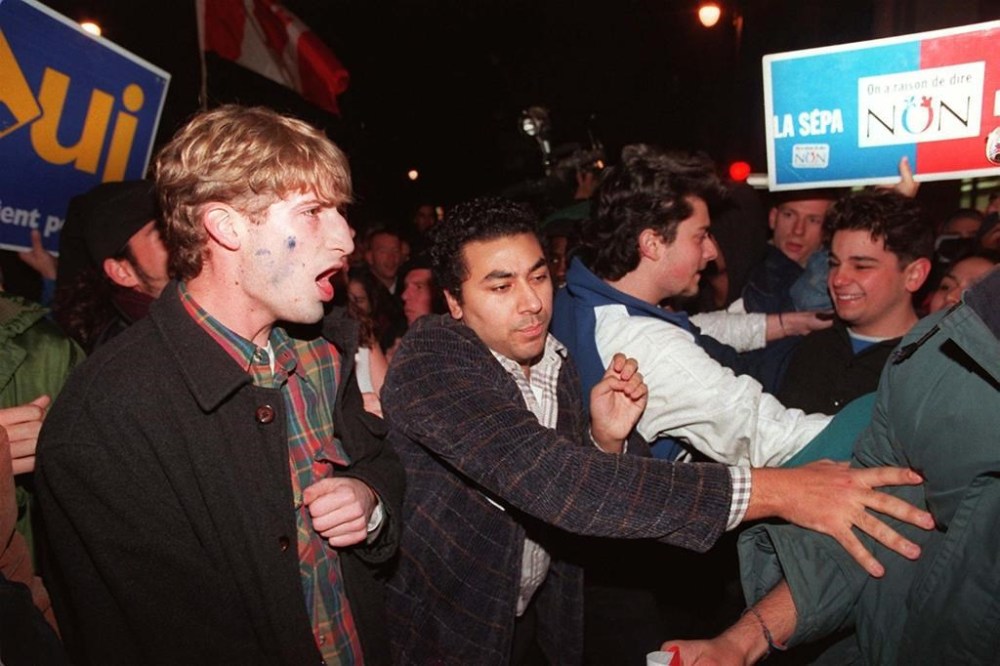
Now, on the eve of the 30th anniversary of Quebec’s second independence referendum — the first one was in 1980 — it seems the tide could be turning again. Legault is deeply unpopular after six years in power, and the Parti Québécois, with a young, charismatic leader, has been ahead in the polls for more than a year.
It remains to be seen, however, whether the party, which is promising to hold a third referendum by 2030, can breathe new life into the province’s aging independence movement.
If an election were held today, polls suggest the Parti Québécois would easily win a majority. Leader Paul St-Pierre Plamondon, an Oxford-educated 47-year-old, has injected youthful energy into a party on the verge of extinction.
Émile Simard, leader of the PQ’s youth wing, believes the party’s popularity will renew the appetite for independence in Quebec. He grew up in a sovereigntist family in the Saguenay—Lac-Saint-Jean region, and took out his membership card when he turned 16.
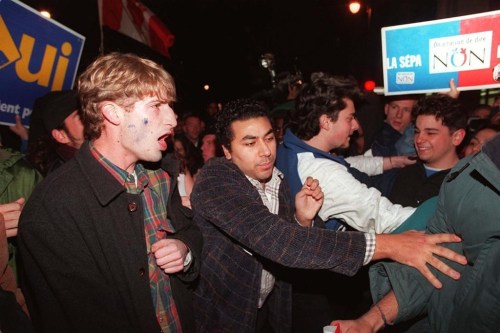
Now 22, he says the reasons for independence have changed somewhat since the 1995 referendum, when the “No” campaign eked out a win. He pointed to climate change in particular.
“It doesn’t make sense that as Quebecers we contribute several billion dollars every year through our taxes, and then we’re going to invest massively in Alberta’s fossil fuels,” he said.
But surveys suggest the PQ’s ascendancy has not yet boosted support for independence, which has hovered around 35 per cent for years.
“One of the major weaknesses of the independence movement in Quebec is the fact that it’s not resonating in the younger generation,” said David Heurtel, political analyst and former Quebec Liberal minister.
“Independence in Quebec, back in the ’60s, ’70s, the ’80s, even in ’95, it was the hip, younger generation thing,” he said. “You’re not seeing that today.”
Simard wasn’t born until years after the 1995 referendum. In fact, he pointed out, no Quebecer under the age of 47 has ever cast a vote on independence. He believes young people say they support the status quo because they’ve never seriously considered an alternative.
“For them it remains a hypothetical debate,” he said.
Simard said a referendum campaign would force young people to think more deeply about the question. “To me, it’s obvious that we should give ourselves the opportunity to decide on this issue,” he said.
Though young Quebecers aren’t especially sovereigntist, they’re also not particularly federalist, said Charles Breton, executive director of the Centre of Excellence on the Canadian Federation at the Institute for Research on Public Policy.
“They just don’t know, and part of it is because that’s not a question that we’ve been talking about,” he said.
Breton worries that if a new independence movement does take hold, many Canadians might respond with a shrug. In 1995, an estimated 100,000 people gathered for the unity rally in Montreal to urge Quebecers to vote “No.”
But this time, Breton said, “Who would be leading the ‘No’ team in Quebec and who would be the voice in the rest of Canada to try to keep Quebec in?”
The prospect of a federal Conservative government looms large over any conversation about Quebec independence. Heurtel said a change in Ottawa could hurt the PQ’s prospects, since Conservative Leader Pierre Poilievre favours a more hands-off approach to the provinces.
“Poilievre is not going to be the same type of nemesis for nationalists and sovereigntists to exploit, whereas (Prime Minister Justin) Trudeau is a much better target,” he said.
But Simard said a Conservative government in Ottawa coupled with a Trump administration south of the border could drive home the idea that Quebec is better off alone.
“Is this the kind of Canada that interests us, a Canada where values like the environment … are set aside?” he said.
Breton said it’s hard to imagine Poilievre, who remains unpopular in Quebec, as the point man for unity during a third referendum campaign. Trudeau is better suited to that job, he said.
He’s not the only one who thinks so. Eddie Goldenberg, chief of staff to former prime minister Jean Chrétien, wrote an op-ed in October calling on Trudeau to step down as prime minister and prepare “to take a leading role in speaking up for Canada in a possible Quebec independence referendum.”
As it stands, the sovereigntist Bloc Québécois could well form the official Opposition for the first time since 1993 in this year’s federal election, which seems likely to decimate the Liberals. The addition of a PQ victory in 2026 could give the independence movement more clout than it has had in decades.
It’s possible, however, that the PQ could face a challenge from the provincial Liberals, who will kick off a leadership race this month. Pablo Rodriguez, a former minister in the Trudeau government, is seen as a front-runner.
Heurtel said the PQ is partly just “a parking lot for opposition” to the government, and that could change with a new Quebec Liberal leader. He also pointed out that many federal Liberal staffers might soon be looking for jobs, and could help “rebuild and reorganize” the provincial party.
For now, Breton said, independence is still “not the main thing that people care about.” But it seems the next Quebec election could once again be fought over the same old question that was set aside back in 2018.
“I’m confident that a referendum is coming and that the population is ready,” Simard said. “I think it’s time to write the end of this chapter in Quebec.”
This report by The Canadian Press was first published Jan. 4, 2025.

Advertisement Advertise With Us
Advertisement Advertise With Us