Study reveals annual activity of sneezing sea sponge off B.C. coast

Advertisement

Advertise with us

VANCOUVER - A study into the behaviour of a sea sponge off the coast of British Columbia has revealed the animals have the humanlike ability to sneeze.

Read this article for free:


or

Already have an account? Log in here »

To continue reading, please subscribe:

Subscribe and receive a limited-edition Free Press branded hat or tote.

Digital Subscription

One year of digital access for only $205*

  • Enjoy unlimited reading on winnipegfreepress.com
  • Read the E-Edition, our digital replica newspaper
  • Access News Break, our award-winning app
  • Play interactive puzzles

*First annual payment billed as $205.00 + GST for one year. This annual subscription will automatically renew at $233.00 + GST every 52 weeks (10% off the regular annual price of $259.35). Offer available to new and qualified returning subscribers only. Cancel any time.

To continue reading, please subscribe:

Add Free Press access to your Brandon Sun subscription for only an additional

$1 for the first 4 weeks*

  • Enjoy unlimited reading on winnipegfreepress.com
  • Read the E-Edition, our digital replica newspaper
  • Access News Break, our award-winning app
  • Play interactive puzzles
Start now

*Your next Brandon Sun subscription payment will increase by $1.00 and you will be charged $17.95 plus GST for four weeks. After four weeks, your payment will increase to $24.95 plus GST every four weeks.

Hey there, time traveller!
This article was published 07/01/2025 (631 days ago), so information in it may no longer be current.

VANCOUVER – A study into the behaviour of a sea sponge off the coast of British Columbia has revealed the animals have the humanlike ability to sneeze.

Researcher Sally Leys said her team examined footage captured over a span of four years by eight cameras installed on the sea floor by Ocean Networks Canada in an effort to study the sponge’s response to the changing climate and weather patterns.

She said they observed the sponge performing regular “sneeze-like” contractions lasting upwards of a day at a time to clear debris that accumulated while it was filter feeding.
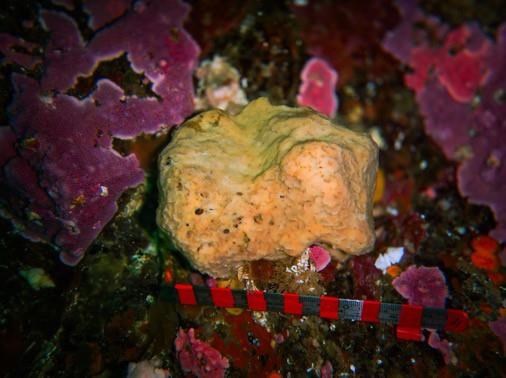
Image of Belinda the sea sponge underwater is shown in this handout image provided by Ocean Networks Canada. A study into the behaviour of a sea sponge off the coast of British Columbia has revealed the animals possess the ability to sneeze. 
THE CANADIAN PRESS/HO-Ocean Networks Canada
*MANDATORY CREDIT *
Image of Belinda the sea sponge underwater is shown in this handout image provided by Ocean Networks Canada. A study into the behaviour of a sea sponge off the coast of British Columbia has revealed the animals possess the ability to sneeze. THE CANADIAN PRESS/HO-Ocean Networks Canada *MANDATORY CREDIT *

“If you put dirt onto the sponge … it’s an irritant to the system, and it has to get rid of it, so it wraps it up in mucus, and it pumps it through and out it goes,” she said in an interview. “But it’s a slow sneeze.”

Leys said the smaller the sponge, the quicker the sneeze.

“A little, tiny sponge — they’re about an hour, maybe 40 minutes, for a sneeze, and then for Belinda, it’s like a day.”

Belinda was the nickname researchers gave to the sea sponge they focused their study on, which Leys noted is about the size of a fist.

She said it was “a pretty active critter,” although if a diver went down to view the sponges in their natural habitat — like a plant in the garden — it would seem unmoving.

Long-term monitoring of the animals proved otherwise, she said.

“I was blown away of how active it was,” Leys said. “This thing was bouncing up and down, and doing all kinds of things.”

Leys, who is a professor in the faculty of science at the University of Alberta, said the experiment tracked the animal over daily, yearly and seasonal changes in shape, colour and size.

Hundreds of hours of video was collected between 2012 and 2015 from the research site about 25 metres under the surface off the Vancouver Island coast. Leys said researchers then spent the next decade analyzing the data.

The study, recently published in Marine Ecology Progress Series, highlighted the sea sponge’s response to its changing environment, she said.

Leys said she was “most surprised” by the sponge’s “annual behaviour.”

She said the sponge contracted to half its size, and entered a dormant state during winter months, despite lacking muscles and a nervous system.

“It suggests the mechanism doesn’t require nerves to withdraw. Once you stop feeding, once there’s less food, there’s sort of an innate response,” she said. “The really interesting question (is) how this animal reduces its activity in response to less food by becoming smaller.”

The study said the sneezing behaviour was observed during the summer months, when phytoplankton blooms increased particulates in the water as the sponge regained its shape.

Ley said studying behaviours will allow researchers to better understand how sponges respond to changes in their environments.

This study marks the longest continuous recording of the animals in the wild.

Although the camera array was removed in 2015 with the conclusion of the project, Leys said divers have confirmed as recently as two months ago that Belinda remains at the site, and is healthy and back to its original colour.

Leys said she is hopeful that researchers will reinstall the cameras to continue the study as ongoing monitoring could reveal even more about how sea sponges respond to changing ocean conditions.

“I’d like to see 10 years of dormancy, then we would be completely sure of this pattern that goes on,” she said.

“I think that having cameras back down there would allow us to really get a long-term view of why it’s undergoing these different kinds of behaviours, whether they are very predictable, and I think, in the long run, it would allow us to understand whether it correlates with changes that we see in the bigger picture of the ocean.”

This report by The Canadian Press was first published Jan. 7, 2025.

Report Error Submit a Tip

More Stories

Puzzles Palace

1 minute read Monday, Jul. 27, 2026

To solve our puzzles, please subscribe with this special offer: |

Woman took ‘meaningful’ responsibility after disposing of body: lawyer

Dean Pritchard 5 minute read Preview

Woman took ‘meaningful’ responsibility after disposing of body: lawyer

Dean Pritchard 5 minute read 6:00 AM CDT

A woman who was threatened with death if she didn’t help dispose the body of a Mexican man murdered in the basement of a North End home should serve no more jail time, a judge has been told.

Devlin Langlois, 25, has pleaded guilty to accessory after the fact to murder in the March 2025 killing of 28-year-old Diego Moscoza.

“By pleading guilty, Ms. Langlois has already taken meaningful accountability for her actions,” defence lawyer Joshua Rogala told King’s Bench Justice Candace Grammond at a sentencing hearing Monday.

He urged the judge to sentence Langlois to the equivalent of 14 months already served, plus two years supervised probation.

Read
6:00 AM CDT

Obsessed stalker who shot, killed young woman at bus stop in 1993 dies behind bars at age 74

Erik Pindera 3 minute read Preview

Obsessed stalker who shot, killed young woman at bus stop in 1993 dies behind bars at age 74

Erik Pindera 3 minute read Yesterday at 5:53 PM CDT

A Winnipeg man who stalked a woman for several years before shooting her dead in the street in 1993 has died in Stony Mountain prison.

On Monday, 74-year-old Ronald Edd Bell died of apparent natural causes at the federal prison just north of Winnipeg, the Correctional Service of Canada said.

Bell had been in prison since May 30, 1994, when he was given a life sentence with no chance of parole for 18 years for killing Terry-Lyn Babb, 25, on Jan. 21, 1993.

Bell walked up behind an unsuspecting Babb, who was waiting at a bus stop at Sherbrook Street and Wolseley Avenue, and shot her in the head with a pistol in front of horrified witnesses, says the Free Press report of his sentencing hearing.

Read
Yesterday at 5:53 PM CDT

Canada resorting to its tried and true playbook

Niigaan Sinclair 5 minute read Preview

Canada resorting to its tried and true playbook

Niigaan Sinclair 5 minute read Monday, Sep. 28, 2026

In 1846, Britain faced an emergency influenced by the Irish famine, so leaders repealed the country’s “Corn Laws” and restrictions on imported food and grain, transitioning to a system of free trade.

This created a crisis in the then Province of Canada, which had relied on British “preferential” status to prop up its agricultural and resource industries.

As a result, Canada looked south for new markets and eventually negotiated a free trade agreement with the United States.

This required land to be acquired and converted for industrial use quickly, so Canada quickly dispatched Commissioner William Robinson to negotiate with Indigenous communities along Lake Huron and Lake Superior for land.

Read
Monday, Sep. 28, 2026

Study reveals annual activity of sneezing sea sponge off B.C. coast

Brieanna Charlebois, The Canadian Press 4 minute read Preview

Study reveals annual activity of sneezing sea sponge off B.C. coast

Brieanna Charlebois, The Canadian Press 4 minute read Tuesday, Jan. 7, 2025

VANCOUVER - A study into the behaviour of a sea sponge off the coast of British Columbia has revealed the animals have the humanlike ability to sneeze.

Researcher Sally Leys said her team examined footage captured over a span of four years by eight cameras installed on the sea floor by Ocean Networks Canada in an effort to study the sponge's response to the changing climate and weather patterns.

She said they observed the sponge performing regular “sneeze-like” contractions lasting upwards of a day at a time to clear debris that accumulated while it was filter feeding.

"If you put dirt onto the sponge … it's an irritant to the system, and it has to get rid of it, so it wraps it up in mucus, and it pumps it through and out it goes," she said in an interview. "But it's a slow sneeze."

Read
Tuesday, Jan. 7, 2025

Jets pick up netminder as relatively new 23-man roster announced

Mike McIntyre 7 minute read Preview

Jets pick up netminder as relatively new 23-man roster announced

Mike McIntyre 7 minute read Monday, Sep. 28, 2026

Let’s get the caveats out of the way: Nothing is set in stone, nor written in permanent ink, and what you see right now could change in the blink of an eye.

With that being said, allow us to introduce you to the 2026-27 Winnipeg Jets — where change is very much in the air.

The 23-man roster submitted to the NHL offices by Monday’s 4 p.m. deadline includes seven players who were not on the team at this time last year. In fact, there could be as many as 10 new faces in the opening-night lineup on Friday against Boston when you factor in three regulars didn’t start the 2025-26 campaign due to injury.

That’s a lot of turnover, which isn’t surprising for a team that finished 26th overall in the standings and was — to most fans and pundits — too old and too slow.

Read
Monday, Sep. 28, 2026