It’s not really the typical time for nasty California fires. What are the factors that changed that?
Advertisement
Read this article for free:
or
Already have an account? Log in here »
To continue reading, please subscribe:

Digital Subscription
One year of digital access for only $205*
- Enjoy unlimited reading on winnipegfreepress.com
- Read the E-Edition, our digital replica newspaper
- Access News Break, our award-winning app
- Play interactive puzzles
*First annual payment billed as $205.00 + GST for one year. This annual subscription will automatically renew at $233.00 + GST every 52 weeks (10% off the regular annual price of $259.35). Offer available to new and qualified returning subscribers only. Cancel any time.
To continue reading, please subscribe:
Add Free Press access to your Brandon Sun subscription for only an additional
$1 for the first 4 weeks*
- Enjoy unlimited reading on winnipegfreepress.com
- Read the E-Edition, our digital replica newspaper
- Access News Break, our award-winning app
- Play interactive puzzles
*Your next Brandon Sun subscription payment will increase by $1.00 and you will be charged $17.95 plus GST for four weeks. After four weeks, your payment will increase to $24.95 plus GST every four weeks.
Read unlimited articles for free today:
or
Already have an account? Log in here »
Hey there, time traveller!
This article was published 08/01/2025 (635 days ago), so information in it may no longer be current.
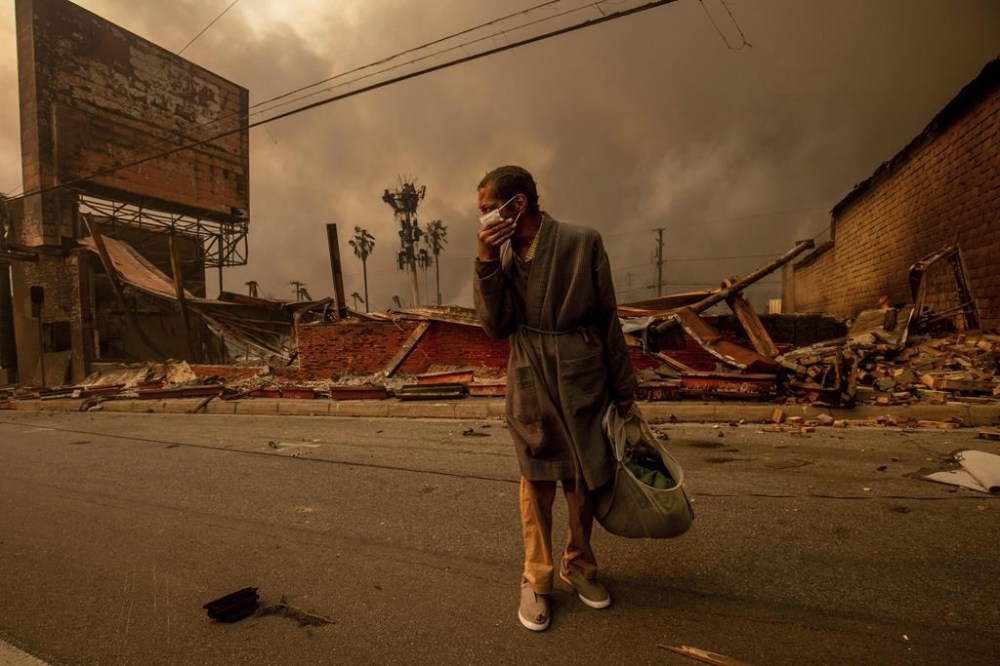
Southern California is experiencing its most devastating winter fires in more than four decades. Fires don’t usually blaze at this time of year, but specific ingredients have come together to defy the calendar in a fast and deadly manner.
Start with supersized Santa Ana winds whipping flames and embers at 100 mph — much faster than normal — and cross that with the return of extreme drought. Add on weather whiplash that grew tons of plants in downpours then record high temperatures that dried them out to make easy-to-burn fuel. Then there’s a plunging and unusual jet stream, and lots of power lines flapping in those powerful gusts.
Experts say that’s what is turning wildfires into a deadly urban conflagration.
Speed is the killer
“Tiny, mighty and fast” fires have blazed through America’s west in the last couple of decades as the world warms, said University of Colorado fire scientist Jennifer Balch. She published a study in the journal Science last October that looked at 60,000 fires since 2001 and found that the fastest-growing ones have more than doubled in frequency since 2001 and caused far more destruction that slower, larger blazes.
“Fires have gotten faster,” Balch said Wednesday. “The big culprit we’re suspecting is a warming climate that’s making it easier to burn fuels when conditions are just right.”
Summer fires are bigger usually, but they don’t burn nearly as fast. Winter fires “are much more destructive because they happen much more quickly” said U.S. Geological Survey fire scientist Jon Keeley.
AccuWeather estimated damage from the latest fires could reach $57 billion, with the private firm’s chief meteorologist, Jonathan Porter, saying “it may become the worst wildfire in modern California history based on the number of structures burned and economic loss.”
Conditions are ideal
“It’s really just the perfect alignment of everything in the atmosphere to give you this pattern and strong wind,” said Tim Brown, director of the Western Regional Climate Center.
Wind speed and the speed of spreading flames are clearly linked.
“The impact increases exponentially as wind speed increases,” said fire scientist Mike Flannigan of Thompson Rivers University in Canada. If firefighters can get to the flames within 10 minutes or so, its spread can be contained, but “15 minutes, it’s too late and it’s gone. The horse has left the barn.”
There’s no sure link between Santa Ana winds — gusts from the east that come down the mountains, gain speed and hit the coast — to human-caused climate change, said Daniel Swain, climate scientist for the California Institute for Water Resources.
But a condition that led to those winds is a big plunge in the temperature of the jet stream — the river of air that moves weather systems across the globe — which helped bring cold air to the eastern two-thirds of the nation, said University of California Merced climate and fire scientist John Abatzoglou. Other scientists have preliminarily linked those jet stream plunges to climate change.
Santa Ana winds are happening later and later in the year, moving more from the drier fall to the wetter winter, Keeley said. Normally, that would reduce fire threats, but this isn’t a normal time.
Dry fuel makes it worse
After two soaking winters, when atmospheric rivers dumped huge amounts of water on the region causing lots of plants to grow, a fast onset of drought dried them out, providing perfect tinder, according to Swain and Abatzoglou.
Swain says this weather whiplash is happening more often.
There is a clear link between climate change and the more frequent dry falls and winters that provide fuel for fires, Swain said.
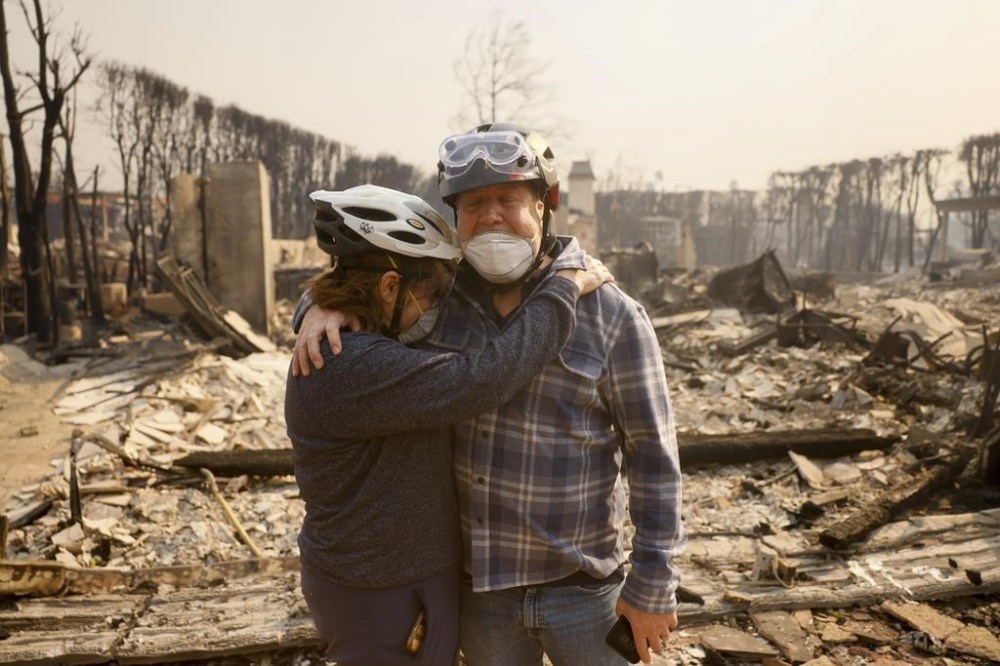
These devastating fires couldn’t happen without the dry and hot conditions, nor would they be blazing without the extreme wind speed, Abatzoglou and others said.
It’s also a people problem
The human factor in this can’t be ignored, said Keeley.
“I think that we need to look at it from the perspective of global changes. And climate is just one global change. And certainly one of the other important global changes is population growth. And California has been growing at a phenomenal rate in the last 20 years,” Keeley said. “You add more people and that means you add more power lines and more potential for failure to occur.”
While the ignition sources for these fires have yet to be determined, Flannigan bets they’ll end up being power lines blown down by high winds. That’s what started California’s devastating fires in 2016 and 2017, leading to utility Pacific Gas & Electric declaring bankruptcy after facing $30 billion in lawsuits.
The calendar seems wrong
An analysis of 423 California wildfires that have grown to at least 15 square miles (39 square kilometers) since 1984 shows only four of those burned during the winter. About two-thirds of those larger fires sparked in June, July or August.
Federal data shows just six wildfires have burned more than 2 square miles (5 square kilometers) in any January in California since 1984. Until the Palisades and Eaton fires this year, the largest had been the Viejas Fire, which burned 17.1 square miles (44.3 square kilometers) in 2001 in the mountains east of San Diego.
“Winter wildfires should be an oxymoron,” University of Colorado’s Balch said. “Well, because, you know, temperatures drop and we get precipitation. We’re supposed to get precipitation.”
Fire officials used to talk about fire seasons, said David Acuña, a battalion chief for Cal Fire: “Now we talk about fire years.”
___
Associated Press writers Peter Prengaman in New York; Mary Katherine Wildeman in Hartford, Connecticut; and Christopher Keller in Albuquerque, New Mexico, contributed.