California is years behind in implementing a law to make homes more fire resistant
Advertisement
Read this article for free:
or
Already have an account? Log in here »
To continue reading, please subscribe:
Digital Subscription
One year of digital access for only $1.44 a week*
- Enjoy unlimited reading on winnipegfreepress.com
- Read the E-Edition, our digital replica newspaper
- Access News Break, our award-winning app
- Play interactive puzzles
*Billed as $5.77 plus GST every four weeks. After 52 weeks, price increases to the regular rate of $19.95 plus GST every four weeks. Offer available to new and qualified returning subscribers only. Cancel any time.
To continue reading, please subscribe:
Add Free Press access to your Brandon Sun subscription for only an additional
$1 for the first 4 weeks*
- Enjoy unlimited reading on winnipegfreepress.com
- Read the E-Edition, our digital replica newspaper
- Access News Break, our award-winning app
- Play interactive puzzles
*Your next Brandon Sun subscription payment will increase by $1.00 and you will be charged $17.95 plus GST for four weeks. After four weeks, your payment will increase to $24.95 plus GST every four weeks.
Read unlimited articles for free today:
or
Already have an account? Log in here »
Hey there, time traveller!
This article was published 16/01/2025 (641 days ago), so information in it may no longer be current.
SACRAMENTO, Calif. (AP) — Reeling from destructive wildfires, including the deadliest in California history, state lawmakers in 2020 passed new requirements for clearing combustible materials like dead plants and wooden furniture within 5 feet (1.5 meters) of homes in risky areas.
The rules were set to take effect on Jan. 1, 2023. But as Los Angeles grapples with blazes that have destroyed thousands of homes in what could be the costliest natural disaster in U.S. history, the regulations still haven’t been written. The state Board of Forestry and Fire Protection has no firm timeline for completing them.
“It’s frustrating at every level of government,” said Democratic state Sen. Henry Stern, who was part of a group of lawmakers who authored the legislation. “I feel like a failure on it, being quite frank.”

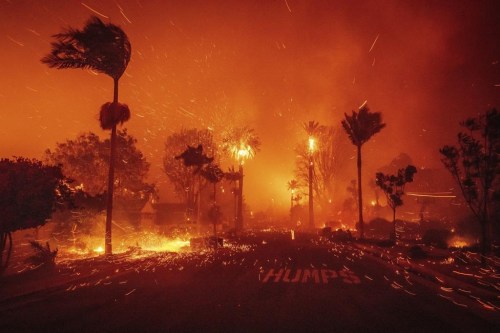
Most of the neighborhoods ravaged by the Palisades Fire are in areas that must follow state requirements to keep the immediate surroundings of their homes free of combustible materials and would be subject to the new rules because they are deemed at highest fire risk by the California Department of Forestry and Fire Protection. The fire, driven by hurricane-force winds that spread embers by air, destroyed at least 5,000 structures across areas including Pacific Palisades, Malibu and Topanga Canyon.
Under the latest proposal, existing homes would have three years to comply with the regulations, so it’s not clear how many homes would have been saved. But clearing the immediate area around homes likely would have made some difference, several experts said.
“We feel really strongly that it would” have made a difference in some cases based on previous research, said Steve Hawks, a former state firefighter who now works for an insurance industry research group that supported the law. “There’s no guarantees, of course, particularly when you have a high intensity wildfire like these.”
So-called defensible space laws require homeowners in fire-prone places to keep the area immediately around their homes free of landscaping and other materials that could catch fire. California already enforces some of the most stringent defensible space laws in the West. The state began requiring homeowners in high-risk areas to clear flammable materials within 30 feet (9 meters) of their houses in the 1960s and then expanded the rules to include areas within 100 feet (30.5 meters) of structures in 2006.
The latest measure creates a new “ember-resistant” zone, dubbed “zone zero,” that bars things like brush, wooden fencing, furniture, sheds and mulch within 5 feet (1.5 meters) of homes. The idea is to clear all materials that could catch fire from flying embers carried by winds and spread to the structure. State officials and researchers said embers are responsible for 90% of structures destroyed by wildfire.
The zone-zero law passed with bipartisan support after California experienced record-breaking fires in 2017 and 2018, including a fire that wiped out the town of Paradise, destroying more than 17,000 structures and killing 85 people.
Homes have a much better chance of surviving a wildfire when homeowners follow defensible space requirements and various home-hardening recommendations like using vent covers to keep out flying embers, said Yana Valachovic, a fire scientist with the University of California’s Cooperative Extension in Humboldt and Del Norte Counties. She is helping CalFire survey the LA fires’ destruction this week.
“I’m hesitant to put a number factor on exactly how much greater survival rate we’ll get,” she said. “But, you know, we have to do everything to push the equation.”
The Board of Forestry and Fire Protection said it’s still in “the pre-rulemaking phase” while it finds money to alleviate the potential costs under the new requirements. State officials said in a November meeting that the draft language likely won’t be considered by the board until late this year, though CalFire has already encouraged homeowners to take up the practice on its website. The agency recommended the adoption of zone zero requirements as part of a report on fire strategies requested by Gov. Gavin Newsom in 2019.
Lawmakers last year also passed legislation to extend the deadline to comply — from one year to three years — for existing homes once the regulations are adopted. Some cities and homeowners are already taking on the practice voluntarily.
“There are many facets to consider as part of this complex process,” Edith Hannigan, executive officer of the board, said in a statement to The Associated Press. “This topic remains a priority for the Board of Forestry and Fire Protection, and staff aims to have a draft proposal to present to the Board as soon as is feasible.”
On Friday, state officials told The Associated Press that Newsom has planned to direct $25 million to help homeowners create zone zero areas and follow other defensible space requirements in his budget proposal unveiled last week. The money will come from a $10 billion bond approved by voters in 2024 to pay for climate change initiatives.
Some of the most effective strategies include clearing dead vegetation and debris off a structure’s roof and out of gutters and replacing bark with pea gravel, said Kimiko Barrett, who authored a 2024 study looking at the costs for retrofitting existing structures in California. Replacing wooden fencing could cost more, but it also helps better protect a home.
“The cost of not doing anything could be far, far greater,” Barrett said.
Zone zero discussions have been underway for the past decade, and the idea isn’t always popular. Stern, the state senator who also lost his home in another Los Angeles fire in 2018, said he struggles to convince his family to follow the practice. His parents dismissed his advice like clearing out the rosemary bush next to their home as minor things, Stern said.
“What I don’t know is whether people are going to see that as a headache,” he said.
U.S. Rep. Laura Friedman, a Democrat who led the effort to pass the zone-zero law in 2020 as a state assemblymember, said the implementation “shouldn’t have taken years and years.” She then deferred questions to the state.
“I hope that the state acts with the urgency that the issue and these guidelines deserve,” she said.
Under the latest draft, the rules would immediately apply to new homes and allow existing buildings three years to comply.