How better water systems can help a city survive the next firestorm
Advertisement
Read this article for free:
or
Already have an account? Log in here »
To continue reading, please subscribe:

Digital Subscription
One year of digital access for only $205*
- Enjoy unlimited reading on winnipegfreepress.com
- Read the E-Edition, our digital replica newspaper
- Access News Break, our award-winning app
- Play interactive puzzles
*First annual payment billed as $205.00 + GST for one year. This annual subscription will automatically renew at $233.00 + GST every 52 weeks (10% off the regular annual price of $259.35). Offer available to new and qualified returning subscribers only. Cancel any time.
To continue reading, please subscribe:
Add Free Press access to your Brandon Sun subscription for only an additional
$1 for the first 4 weeks*
- Enjoy unlimited reading on winnipegfreepress.com
- Read the E-Edition, our digital replica newspaper
- Access News Break, our award-winning app
- Play interactive puzzles
*Your next Brandon Sun subscription payment will increase by $1.00 and you will be charged $17.95 plus GST for four weeks. After four weeks, your payment will increase to $24.95 plus GST every four weeks.
Read unlimited articles for free today:
or
Already have an account? Log in here »
Hey there, time traveller!
This article was published 18/02/2025 (560 days ago), so information in it may no longer be current.
LOUISVILLE, Colorado (AP) —
Santa Rosa. Paradise. Boulder County. Lahaina. Los Angeles.
All are places that have shown that American cities and their water systems weren’t built to withstand wildfire, experts say.
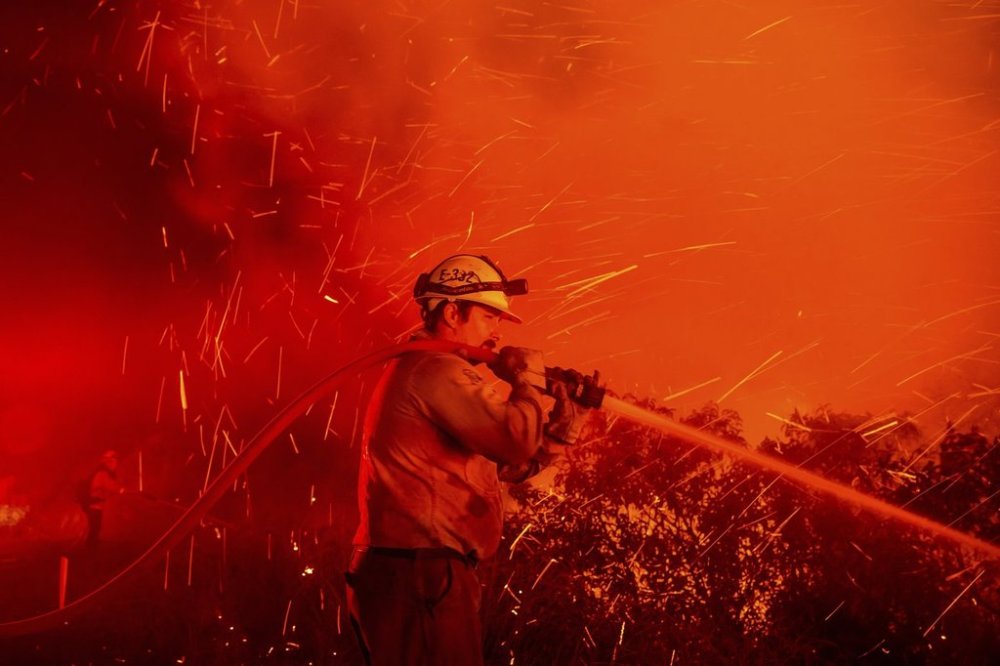
Hydrants trickled. Pumps and treatment plants lost power. Chemical contaminants were sucked into pipes, requiring extensive and costly work. In Paradise alone, where the 2018 Camp Fire killed at least 85 people and destroyed more than 18,000 structures, rebuilding the drinking water system is expected to cost $125 million and take three-and-a half more years.
As wildfires grow more frequent and intense with climate change, and become a greater threat to cities, water utilities are reckoning with the reality that they must build back better.
“People are starting to ask some of these same questions that people asked decades ago for hurricanes and earthquakes,” said Greg Hentschel, vice president of engineering at CST Industries, which makes water storage tanks. He noted the adoption of building regulations and new engineering standards to toughen the urban environment against those risks.
Better water infrastructure by itself won’t protect neighborhoods from fire, experts say, and many of the ideas are expensive. But there are things that communities can do.
Here are some of them:
Remote shutoff valves
As buildings burn, so do their pipes, which spill water until a utility worker can safely get in to shut off the supply valve. The delay can be hours or days, all while precious water for firefighting is lost.
Since the Marshall Fire burned more than 500 homes in the city of Louisville, Colorado in 2021, the city has worked to install remote shutoff valves at meters at all the homes that have been rebuilt.
It can “keep ourselves from death by a thousand cuts,” said Kurt Kowar, Louisville’s public works and utilities director.
A standard meter costs around $400, while one with remote shutoff capabilities is about twice that. They require cell signal to operate, making them a possible vulnerability if telecommunications are lost where fire is burning, but Kowar says swift action can reduce that risk.
Remote shutoff valves can be installed on main distribution pipes, too, allowing utilities to redirect water more easily to areas that need it.
Emergency water sources
There’s a simple idea for making water available to firefighting helicopters right in cities so they don’t have to fly to distant reservoirs or the ocean. They’re called “heli-hydrants” — concrete tanks that hold a few thousand gallons of water. Helicopters can fill up in less than a minute, and the heli-hydrant refills quickly from a gravity-fed tank.
In November, a 5,000-gallon heli-hydrant in San Diego County was tapped nearly 30 times by aircraft fighting the 48-acre Garden Fire. The Rainbow Municipal Water District, a small utility that serves several unincorporated communities, paid around $200,000 to install its heli-hydrant in 2021 after the 2017 Lilac Fire burned more than 100 buildings nearby.
Meanwhile, homes and businesses can take steps to protect themselves by storing water on site for firefighting. Some commercial properties and large residential properties, such as condos or apartment buildings, are already doing this, Hentschel said. Those tanks can range from $100,000 to millions of dollars depending on size.
Individual homes and neighborhoods can do the same, but only if they have deep pockets. Hentschel estimated a tank to protect a 2,000-square-foot home could cost $15,000 to $30,000, even before piping and a sprinkler system. He said neighborhoods could lower costs by collaborating on a single large tank.
Dedicated pipes for firefighting
It’s not a fantasy: Separate, high-pressure pipes that move water— even ocean water if needed — across town to dedicated hydrants that can be tapped for the worst fires have been standard in much of San Francisco for more than a century after the 1906 earthquake sparked widespread fires that burned more than 500 city blocks.
Today, 135 miles of pipe are fed by a reservoir and two large tanks, used only for the biggest fires. The city has a backup reservoir, about 200 backup underground cisterns that hold 70,000 gallons each, and can pump in seawater if needed. The regular drinking water system is tapped first for small fires and is sufficient under normal conditions.
“In the case of the Pacific Palisades, a system like this would have done a lot of good,” said Steve Ritchie, who oversees the system for the San Francisco Public Utility Commission.
The utility has invested billions to update the system and is expanding it to west and southeast neighborhoods over the next 15 years for another $4.5 billion.
Building a comparable system today would be too costly for most communities, but “there are elements of it that you could do that might be very useful,” Ritchie said. That could include installing dispersed underground cisterns, or a couple of high-pressure lines with dedicated hydrants in high-risk areas.
Backup power
Grid-supplied electricity typically powers large treatment plants and pumps that keep drinking water flowing. When power is cut off, as frequently happens during fires and storms, the water system will quickly fail without the right kind of backup power.
Louisville had generators on critical water infrastructure during the Marshall Fire, but they were powered by the local natural gas utility, which shut off gas citywide as a precaution since it was an additional fire risk.
Without power for pumps — a common vulnerability for towns across the United States — water pressure plummeted. Officials wound up sending untreated water into the drinking system to restore pressure — saving homes and possibly lives, but contaminating the water system.
Today, they’re converting their generators to run on diesel, which can run for several days before refueling.
Contamination mitigation
One risk of fires reaching cities is chemical contaminants getting into drinking water. When toxic chemicals from burned synthetics common in homes reach drinking water pipes, even filtering or boiling water won’t make it safe to drink, experts say.
Backflow prevention devices can help solve that, said Andrew Whelton, an engineering professor at Purdue University. The devices are installed at water meters and only allow water to flow in one direction.
Utilities in both Louisville and Paradise, California, are installing them as they rebuild homes.
Damaged service lines and water meters are another common source of contamination, even if the home or building is intact. When heated, plastic, a common material in water systems, can release toxic chemicals. Even indirect heat damage to pipes and fittings that commonly use some plastic can result in contamination.
To limit heat damage to those parts, pipes should be buried 3 feet underground, shrubs and buildings should be set back from the meter box, and the box itself should have a metal or concrete cover.
These measures could be adopted as part of a national water infrastructure wildfire code, and insurers could offer discounts in municipalities that have taken steps to reduce risk, Whelton said.
“There’s one approach to allowing people to make their own decisions,” he said. “Another is to say look, we have this happening, we’re spending so much taxpayer money to fix it, so at some point we need to help everybody limit the financial impacts so we can use funds wisely.”
___
The Associated Press receives support from the Walton Family Foundation for coverage of water and environmental policy. The AP is solely responsible for all content. For all of AP’s environmental coverage, visit https://apnews.com/hub/climate-and-environment