Operation snowfall: A look at how Montreal is cleaning up after back-to-back storms

Advertisement

Advertise with us

MONTREAL - In Montreal's southwest, by the Lachine Canal, trucks come and go like clockwork, dumping loads of snow as blowers the size of tanks send it cascading in the air onto a 10-storey-high bank. Known as the Angrignon snow depot, it is one of 10 sites across Montreal storing the record-breaking snowfall that hit the city in recent days.

Read this article for free:


or

Already have an account? Log in here »

To continue reading, please subscribe:

Subscribe and receive a limited-edition Free Press branded hat or tote.

Digital Subscription

One year of digital access for only $205*

  • Enjoy unlimited reading on winnipegfreepress.com
  • Read the E-Edition, our digital replica newspaper
  • Access News Break, our award-winning app
  • Play interactive puzzles

*First annual payment billed as $205.00 + GST for one year. This annual subscription will automatically renew at $233.00 + GST every 52 weeks (10% off the regular annual price of $259.35). Offer available to new and qualified returning subscribers only. Cancel any time.

To continue reading, please subscribe:

Add Free Press access to your Brandon Sun subscription for only an additional

$1 for the first 4 weeks*

  • Enjoy unlimited reading on winnipegfreepress.com
  • Read the E-Edition, our digital replica newspaper
  • Access News Break, our award-winning app
  • Play interactive puzzles
Start now

*Your next Brandon Sun subscription payment will increase by $1.00 and you will be charged $17.95 plus GST for four weeks. After four weeks, your payment will increase to $24.95 plus GST every four weeks.

Hey there, time traveller!
This article was published 22/02/2025 (574 days ago), so information in it may no longer be current.

MONTREAL – In Montreal’s southwest, by the Lachine Canal, trucks come and go like clockwork, dumping loads of snow as blowers the size of tanks send it cascading in the air onto a 10-storey-high bank. Known as the Angrignon snow depot, it is one of 10 sites across Montreal storing the record-breaking snowfall that hit the city in recent days.

Each winter, Montreal deploys an army of people to clear the roads and sidewalks, many of whom are working overtime after the city received more than one-third of its annual snowfall over four days earlier this month. On Friday, city officials estimated that the cavalry will be at work for at least another 10 days to clear the more than 70 centimetres that fell between Feb. 13-16.

“We’ve removed 32 per cent of the snow … There’s still a lot of work to do,” Montreal Mayor Valérie Plante told reporters at the Angrignon depot, after dismounting a snowblower. Each of the 10 storage sites can collect approximately 800 Olympic swimming pools’ worth of snow, Plante said.
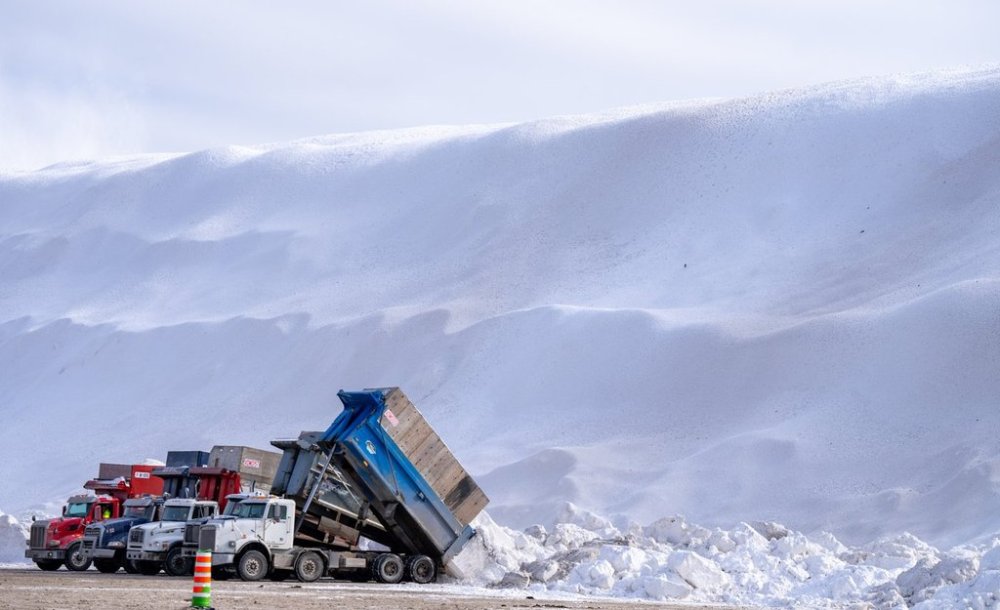
Trucks drop their loads of snow at the Angrignon snow deposit site in Montreal on Friday, Feb. 21, 2025. THE CANADIAN PRESS/Christinne Muschi

Brian Levasseur Gallagher, spokesperson for Beluga Construction, which manages the Angrignon site with the city, said trucks are making 3,000 trips to the depot each day to dump snow.

On average, 12 million cubic metres of snow are removed from the streets of Montreal each winter, enough to fill the Olympic Stadium 10 times, City of Montreal spokesperson Philippe Sabourin said in an interview Thursday. Environment Canada estimates that Montreal receives a yearly average of 217 cm of snow, and this winter so far 172 cm have fallen – 42 per cent of it over four days in February.

Winter storms are a significant expense for taxpayers. About 20 cm of snow accumulates during the average snowstorm, which takes four days to remove, with each centimetre costing the city about $1 million, Sabourin said. Montreal’s snow budget is just over $200 million.

Aside from depositing snow at sites such as Angrignon, the city also dumps about 20 per cent of its cleared snowfall into 13 sewers, which carry it to a wastewater treatment plant before it is released it into the St. Lawrence River. 

The city has deployed some 3,000 workers and 2,500 vehicles, Sabourin said, with half of those workers employed through the private sector. About 450 are involved in towing operations alone. 

Each year, Sabourin said, the city purchases about 200,000 tons of snow salt and crushed limestone, which is stored in 30 municipal garages. At each facility, a “cook” mixes the stone and salt: the recipe is 90 per cent salt and 10 per cent rock for roads, and a 50-50 mixture for sidewalks, he said.

And there is a lot of road to clear. The city has 11,000 kilometres of streets, sidewalks and bike paths, equalling the distance between Montreal and London, England – back and forth, he said. 

The municipal agency that issued parking violations – Agence de mobilité durable de Montréal – says about 6,000 to 9,000 vehicles are towed each time a snow-removal operation takes place. Over last year’s winter, which was milder compared to this year’s, the agency ticketed and towed nearly 17,400 vehicles over two snow-loading operations. About 2,770 vehicles were ticketed but not towed. 

Those figures are way up this winter. As of Thursday, the agency ticketed and towed nearly 26,700 vehicles over four snow-removal operations; 6,415 vehicles were ticketed but not towed. A driver whose car is towed faces a ticket of $194.

Matthew Stanwyck, who owns and operates West Island Tow Trucks, has been towing cars for nearly four decades. He specializes in towing luxury vehicles, and come winter his phone rings non-stop from people whose vehicles are snowed-in. This winter is the busiest in recent years.

A one-man show, Stanwyck said he has pulled up to 130 vehicles out of the snow since Feb. 13, and towed about 30 vehicles. “I don’t go home until the phone stops ringing,” he said in an interview Thursday.

Paulo Saade, who owns and operates Remorquage Elite, says he pulled up to 500 vehicles out of the snow and towed 150 vehicles over the past seven days. “The whole city is going crazy. Everybody’s stuck. Everybody’s having issues. I think we received about 300 to 500 calls a day,” he said in an interview Thursday. 

Meanwhile, the snow that is deposited across the 10 storage sites can take years to melt. At the Francon quarry in Montreal’s north end, where the city dumps about one-third of snow from clearing operations, there is still snowpack from 10 years ago.

Mounds of snow turn into a type of glacier, Sabourin said, while the crushed limestone inside the snow rises to the top of each dumped layer, creating an insulating barrier that slows the melting process – even in the summer.

“It’s crazy,” he said. “Think about it.”

This report by The Canadian Press was first published Feb. 22, 2025.

Report Error Submit a Tip

More Stories

Hellebuyck standoff caused by… Nathan MacKinnon?

Mike McIntyre 6 minute read Preview

Hellebuyck standoff caused by… Nathan MacKinnon?

Mike McIntyre 6 minute read Yesterday at 6:34 PM CDT

Looking for someone to blame in the Connor Hellebuyck fiasco and cast as public enemy No. 1? How about long-time Winnipeg Jets nemesis Nathan MacKinnon?

Allow us to explain as we fire up the time machine and head back to February in Italy.

Oh, what could have been if MacKinnon had been able to score on what appeared to be an open net late in the third period of the men’s gold medal game with Hellebuyck down and seemingly out of position.

Instead, the star forward fired wide, keeping the score deadlocked at 1-1 as the clock ticked down on regulation.

Read
Yesterday at 6:34 PM CDT

Cabernet Sauvignon star of wine festival

Ben Sigurdson 5 minute read Preview

Cabernet Sauvignon star of wine festival

Ben Sigurdson 5 minute read 3:00 AM CDT

The Winnipeg Wine Festival will celebrate the king of red wine grapes next weekend — the theme of this year’s festival, which takes place Sept. 25 and 26 at the RBC Convention Centre, is Cabernet Sauvignon.

Cab Sauv, as it’s also known, is the world’s most widely planted wine grape of any colour, first coming to prominence in the 1800s in France’s Bordeaux region, where the grape is still popular. Rather than single-variety wines, Bordeaux reds tend to be blends, with those coming from the left bank of the Gironde estuary being Cabernet-dominant, while right-bank wines are Merlot-dominant, with Cabernet Sauvignon playing a supporting role. Cabernet and Merlot work well together and many other countries have followed suit in blending the two.

A team at University of California Davis put Cabernet Sauvignon through a DNA test in 1996 and discovered its parent grapes are Cabernet Franc and Sauvignon Blanc — it’s likely that at some point the two varieties, planted next to each other in some vineyard, crossed and mutated and became the grape we know today. (Someone growing grapes in the 19th century must have had an inkling of what was up, as the grape has been called Cabernet Sauvignon since long before the DNA test.)

Flavour-wise, most Cabernet Sauvignon wines are big and bold, with a core of deep dark berry flavours, some graphite and spice notes and relatively bright acidity. It’s a grape that is well-suited to barrel aging, with most examples seeing at least some time in wood.

Read
3:00 AM CDT

Kinew delivered what most of us wanted; now we’ll have to deal with the consequences

Dan Lett 5 minute read Preview

Kinew delivered what most of us wanted; now we’ll have to deal with the consequences

Dan Lett 5 minute read Updated: Yesterday at 8:43 AM CDT

Premier Wab Kinew has decided to adopt permanent daylight savings time, which means a permanent end to the spring forward, fall back tradition of adjusting our clocks. And absolutely no one is surprised.

Read
Updated: Yesterday at 8:43 AM CDT

Grieving child builds backyard rocket ship

Harriet Zaidman 4 minute read 2:01 AM CDT

I Built a Rocket Ship (Kids Can Press, 32 pages, hardcover, $22) by Winnipegger Anna Lazowski is a tender story for children ages 4-8 about a little girl trying to make sense of her mother’s death. The child engages in conversation with her late mom, agreeing and disagreeing about things said as she carries objects (and of course, the cat) to the backyard. There, she is building a rocket ship she will pilot into the skies to find her mom again.

Jennica Lounsbury’s varied perspectives show the range of emotions the little girl experiences.

● ● ●

Northwoods Lullaby by Mary Casanova (University of Minnesota Press, 32 pages, hardover, $25) is a bedtime book for readers up to age eight, perfect to bring a busy, happy day to a close. Just like children who are listening to adults reading the book, all the animal babies are being tucked into their nests and burrows by loving parents: “Thump and scamper,/nimble clover./ Soon it’s time to rest. Baby loon/ nestles in/as Papa floats along.”

Not falling back means time loop remains unclosed

Jen Zoratti 4 minute read 2:01 AM CDT

I demand restitution. Where’s my hour?

In the traditional fall-back, spring-forward time change set up — you know, ol’ trusty that’s been effect for lo these 63 years — we lost an hour in the spring that we got back in the fall.

That was the social contract: you commit to feeling like you’re on cold medication for a week in March because you know a glorious extra hour of sleep will be returned to you in November. (Unless, of course, you have little kids, but look: we all make our choices.)

Well, that transaction, flawed as it was, isn’t happening this year. That hour you sacrificed to the sun gods in the spring? Gone. Not coming back. We’ve sprung forward and we shan’t be falling back — not in November, and (possibly) not ever. The scale shall remain unbalanced and the loop shall remain unclosed as Manitoba has adopted permanent daylight time.

Canada-U.S. trade relationship is broken, but the damage can — and will — be repaired

Tom Brodbeck 5 minute read Preview

Canada-U.S. trade relationship is broken, but the damage can — and will — be repaired

Tom Brodbeck 5 minute read Thursday, Sep. 17, 2026

Canada needs to get serious about diversifying its trade beyond the United States. But at the same time, Canadians should expect relations with the U.S. to normalize after Donald Trump is no longer in the White House.

For generations, Canada-U.S. trade was considered almost a fact of geography. The two countries share the world’s longest undefended border, deeply integrated supply chains and a century of commercial relationships.

Canadian manufacturers depend on American customers. American manufacturers depend on Canadian suppliers. Energy, agriculture, automotive production and countless other industries operate across the border as though it barely exists.

That isn’t going to change dramatically, even in the midst of a bitter trade war unleashed by the U.S. president.

Read
Thursday, Sep. 17, 2026