Midwest winters are changing. So is the ancient sport of falconry
Advertisement
Read this article for free:
or
Already have an account? Log in here »
To continue reading, please subscribe:
Digital Subscription
One year of digital access for only $1.44 a week*
- Enjoy unlimited reading on winnipegfreepress.com
- Read the E-Edition, our digital replica newspaper
- Access News Break, our award-winning app
- Play interactive puzzles
*Billed as $5.77 plus GST every four weeks. After 52 weeks, price increases to the regular rate of $19.95 plus GST every four weeks. Offer available to new and qualified returning subscribers only. Cancel any time.
To continue reading, please subscribe:
Add Free Press access to your Brandon Sun subscription for only an additional
$1 for the first 4 weeks*
- Enjoy unlimited reading on winnipegfreepress.com
- Read the E-Edition, our digital replica newspaper
- Access News Break, our award-winning app
- Play interactive puzzles
*Your next Brandon Sun subscription payment will increase by $1.00 and you will be charged $17.95 plus GST for four weeks. After four weeks, your payment will increase to $24.95 plus GST every four weeks.
Read unlimited articles for free today:
or
Already have an account? Log in here »
Hey there, time traveller!
This article was published 28/02/2025 (602 days ago), so information in it may no longer be current.
GREENLEAF, Wis. (AP) — Stephanie Stevens has a good reason to love the bone-numbing cold of a Wisconsin winter. Every weekend, she loads up her minivan with a large green box and drives out to rural areas, usually the edges of friends’ farm fields.
After she slips on a thick leather glove, out of the box and onto her wrist hops her unconventional hunting buddy, Alexie Echo-Hawk, Echo for short: a juvenile red-tailed hawk.
“She’s intense,” Stevens says, stroking her dappled feathers lightly.
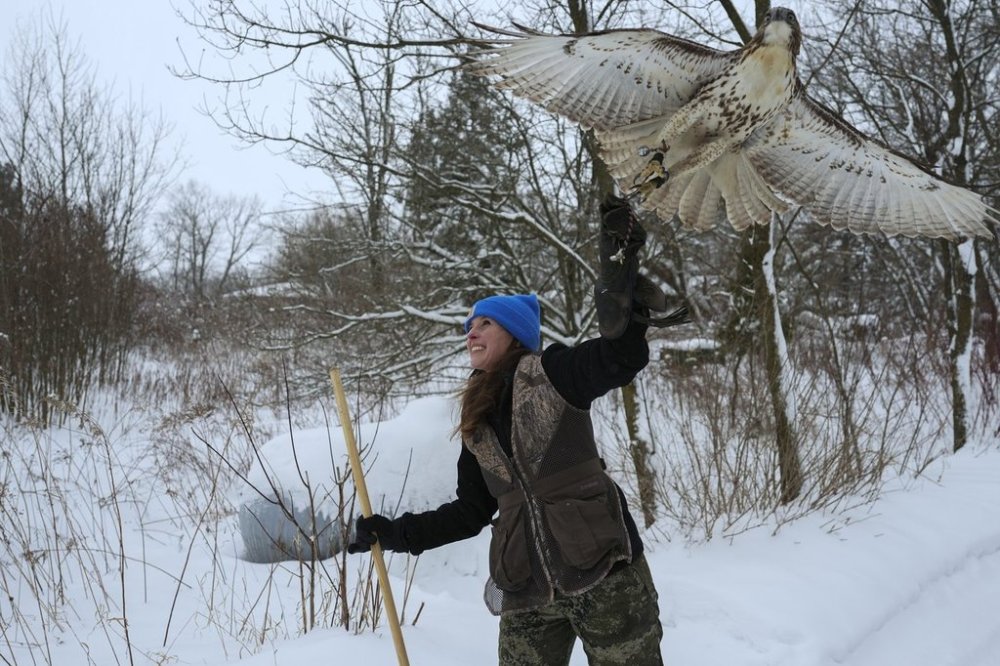
Falconers dedicate large chunks of the coldest season of the year to spending time outdoors, working together with their birds to hunt small game like rabbits and grouse. Many falconers say it’s evident that climate change, development of rural areas and agricultural and forestry practices are all shaping the landscapes and the prey they rely on. The signs are everywhere, from the range of snowshoe hares moving north to patchy snow cover that doesn’t last as long to new subdivisions cropping up in rural areas. That means falconers are having to hunt different prey than they’re used to, start their seasons later or end earlier, and reckon with the emotions of watching the natural world change.
Falconry also lends its practitioners extra motivation preserve the lands where they and their birds hunt — and a greater sense of loss as climate change and other human drivers forever alter those places.
“My empathy is just as much to what I’m hunting as to the bird I have in my hand,” said Tom Doolittle, a retired Fish and Wildlife Service biologist and lifelong falconer in northern Wisconsin. Falconry, he says, is “a sport of observation and participation. And it changed dramatically.”
An intimate connection to nature
As Echo takes flight and perches high in the trees, Stevens and her son and daughter crunch through the snow below, looking for mainly cottontail rabbits.
Ideal “rabbitat” looks like brush piles or thickets of brambles and thorns. Stevens wades right in and smacks the brush piles with a stick or jumps right on top of them in hopes of flushing something out.
Then it happens — a rabbit darts. The hawk dives. Faster than a blink, the bells on her anklets tinkling, Echo reaches out her talons.
She comes up with a tuft of fur. A near miss.
“Even when the hawk misses it, it’s always so close,” Stevens’ son Daniel said. ”That moment really wakes you up.”
Falconry has existed for millennia, but in North America, where the sport is neither indigenous nor easily accessible to the average person, it’s governed by federal and state laws as well as a code of ethics developed by falconry associations.
Falconers usually trap a wild bird after it’s learned to hunt on its own and eventually return it back to the wild, so it’s a temporary and practical relationship. If the birds wanted to, they could fly off and never come back. They return because humans essentially act as the falcons’ version of a hunting dog, turning up prey. And if they don’t catch anything, they still get a meal.
In return, the humans get to “see a lot of nature that we normally wouldn’t see,” Stevens said.
That gives falconers a greater feeling of responsibility to observe and preserve nature, said Hillary Neff, president of the Wisconsin Falconers Association. She said she pays more attention to weather and population shifts of animals than she ever did before; some falconers record their observations.
Neff said she was frustrated that the falconry season got off to a late start this year thanks to an unusually warm fall.
“When you are hunting with a raptor, you truly are inserting yourself into the circle of life all the way,” she said. “You’re on the mercy of nature’s whim.”
Changing populations of small animals
When Doolittle, the retired biologist, hunts at home in the woods about an hour south of Lake Superior, he uses goshawks, dappled gray birds with orange eyes.
Goshawks naturally hunt snowshoe hares, and Doolittle has seen firsthand on his homestead how these small mammals that change from brown to snowy white in the winter are disappearing from his area.
Last year, when the ground lay bare in the middle of winter, he watched one hare, seeking camouflage, that ran and hid in front of his hawk house — the only thing around with a white background for miles.
“I felt so sad for him,” Doolittle said.
Snow cover is highly variable from year to year, but the consistent trend over decades has been that snow cover isn’t lasting as long. Warmer temperatures on average mean that when snow does fall, it melts faster and its physical properties change.
Animals that rely on snow are in trouble.
When Doolittle treks out to what should be ideal hare habitat and sees nothing but one soft trail of snowshoe prints beneath the pines, “somehow you’ve lost something,” he says. “You’ve lost that one piece of the puzzle that to me represents the North Country.”
That’s something Jonathan Pauli, a professor of wildlife ecology at the University of Wisconsin-Madison, has observed by systematically capturing, collaring and monitoring carnivores and their prey across the state and comparing their historical numbers to current-day ones. He said his team has observed a “relatively fast range contraction” of snowshoe hares, moving northward as climate change increasingly turns them into “white lightbulbs” highly visible to their predators in the winter.
“That’s sad to me, that a species that has persisted for millennia are no longer going to be abundant or eventually not within our state,” Pauli said.
Pauli said studies have shown concerted forestry efforts can counteract the pressures of climate change on hares — though what benefits hares might have drawbacks for other species like martens. He thinks the challenge will be for federal and state forest managers, tribes and scientists to come together to strategically conserve multiple winter-adapted species at the same time.
Climate change among many factors affecting falconry
Falconers know that every hunt is different, and the reasons why abound.
Less snow cover might make it easier to get around but lose the advantage of slowing down fleeing prey or making animals and their tracks more visible. Birds don’t necessarily love hunting in polar temperatures like the ones the U.S. saw repeatedly this winter. Localized extreme weather events like floods can temporarily reshape game populations, too.
Agricultural pesticides applied too liberally can kill off the insects eaten by raptors’ prey. Human development like new subdivisions can shape entire landscapes in rural areas. Everything, from coyote numbers to land zoning decisions, matters.
Doolittle said the changes he’s observed over decades all relate to the human footprint, often to the detriment of other species.

“We have to recognize that we as a species are the largest changing environmental effect on the planet, period,” he said. “I know you’re supposed to get over change, but it’s very difficult when it means something to you or it’s a way of life.”
___
Follow Melina Walling on X @MelinaWalling and Bluesky @melinawalling.bsky.social.
___
The Associated Press’ climate and environmental coverage receives financial support from multiple private foundations. AP is solely responsible for all content. Find AP’s standards for working with philanthropies, a list of supporters and funded coverage areas at AP.org.
Related Articles
50-year forecast: Shorter, drier, warmer Prairie winters will result in fewer outdoor recreational opportunities
Advertisement Advertise With Us
Advertisement Advertise With Us