What to know about Greenpeace after the Dakota Access protest case decision

Advertisement

Advertise with us

A North Dakota jury on Wednesday found Greenpeace must pay hundreds of millions of dollars to a pipeline company in connection with protests against the Dakota Access oil pipeline.

Read this article for free:


or

Already have an account? Log in here »

To continue reading, please subscribe:

Subscribe and receive a limited-edition Free Press branded hat or tote.

Digital Subscription

One year of digital access for only $205*

  • Enjoy unlimited reading on winnipegfreepress.com
  • Read the E-Edition, our digital replica newspaper
  • Access News Break, our award-winning app
  • Play interactive puzzles

*First annual payment billed as $205.00 + GST for one year. This annual subscription will automatically renew at $233.00 + GST every 52 weeks (10% off the regular annual price of $259.35). Offer available to new and qualified returning subscribers only. Cancel any time.

To continue reading, please subscribe:

Add Free Press access to your Brandon Sun subscription for only an additional

$1 for the first 4 weeks*

  • Enjoy unlimited reading on winnipegfreepress.com
  • Read the E-Edition, our digital replica newspaper
  • Access News Break, our award-winning app
  • Play interactive puzzles
Start now

*Your next Brandon Sun subscription payment will increase by $1.00 and you will be charged $17.95 plus GST for four weeks. After four weeks, your payment will increase to $24.95 plus GST every four weeks.

Hey there, time traveller!
This article was published 19/03/2025 (561 days ago), so information in it may no longer be current.

A North Dakota jury on Wednesday found Greenpeace must pay hundreds of millions of dollars to a pipeline company in connection with protests against the Dakota Access oil pipeline.

The jury found Greenpeace liable for defamation and other claims and awarded Dallas-based Energy Transfer and subsidiary Dakota Access more than $650 million in damages.

The lawsuit accused Netherlands-based Greenpeace International, Greenpeace USA and funding arm Greenpeace Fund Inc. of defamation, trespass, nuisance, civil conspiracy and other acts.
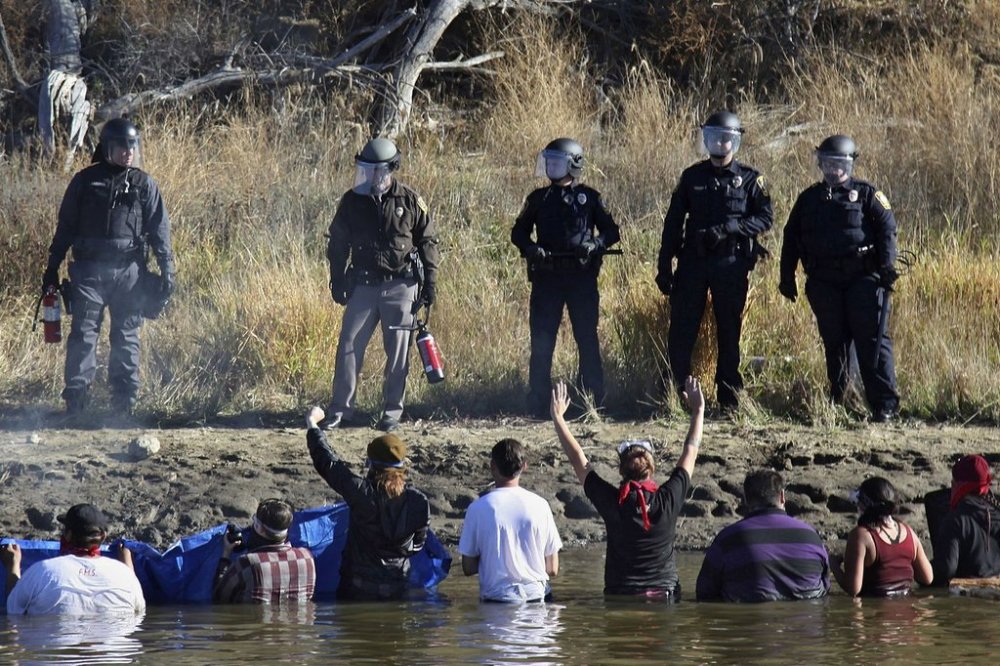
FILE - Protestors demonstrating against the expansion of the Dakota Access Pipeline wade in cold creek waters confronting local police, near Cannon Ball, N.D., Nov. 2, 2016. (AP Photo/John L. Mone, File)

Greenpeace said earlier that a large award to the pipeline company would threaten to bankrupt the environmental group. Following the nine-person jury’s verdict, Greenpeace’s senior legal adviser said the organization’s work “is never going to stop.”

The independent global campaigning network has been fighting for a wide array of environmental issues for more than half a century and has a long history of contentious legal battles.

Here are some things to know:

How was Greenpeace founded?

Environmental activists founded the group in Vancouver, Canada, in 1971.

The network’s first action was to work to stop more nuclear weapons tests on Amchitka Island in the Aleutian island chain in southwest Alaska. They took a ship toward the island to “bear witness,” which is a Quaker protest tradition, but were intercepted by the U.S. Navy, according to the Greenpeace website.

The U.S. later opted to abandon their nuclear testing grounds on the island, marking Greenpeace’s first major victory.

Where did the name Greenpeace come from?

During initial work to stop the nuclear weapons tests on Amchitka, Canadian ecologist Bill Darnell was leaving one of the group’s meetings when someone held up two fingers and said “peace!” according to Greenpeace’s website.

Darnell, who is considered a founding member of Greenpeace, replied: “Let’s make it a Green Peace.”

The name was condensed into one word so it could fit on buttons for the group’s first fundraiser.

What does Greenpeace do today?

Greenpeace describes itself as the largest environmental campaigning organization in the world. It is made up of dozens of independent national or regional organizations in more than 55 countries, according to its website.

Its work to preserve and restore valuable ecosystems and push back on fossil fuel corporations is centered on nonviolent action. Its protests have ranged from efforts to stop Shell from drilling for oil in the Alaskan Arctic to demonstrations to put an end to France’s atmospheric tests in the South Pacific to campaigns to conserve Canada’s coastal rainforest.

Greenpeace and its activists have also been the target of charges and lawsuits, including in 2023 when four activists were arrested for scaling the country estate of former U.K. Prime Minister Rishi Sunak and draping it in black fabric to protest his plan to expand oil and gas drilling in the North Sea. They were later cleared of criminal charges.

It was also one of the environmental groups that filed a lawsuit seeking to block the Willow oil project in Alaska in recent years.

Who supports Greenpeace?

Greenpeace is an independent network that does not take money from governments, corporations or political parties, according to its website. Its funding comes from individual contributions, along with foundation grants.

In 2023, Greenpeace USA had about $40 million in revenue and support, and about $38 million in expenses, according to its online financial statement.

Its website says it does not consider anyone a permanent friend or enemy.

“If your government or company is willing to change, we will work with you to achieve your aims,” its website states. “Reverse course, and we will be back.”

Report Error Submit a Tip

More Stories

Canada resorting to its tried and true playbook

Niigaan Sinclair 5 minute read Preview

Canada resorting to its tried and true playbook

Niigaan Sinclair 5 minute read Monday, Sep. 28, 2026

In 1846, Britain faced an emergency influenced by the Irish famine, so leaders repealed the country’s “Corn Laws” and restrictions on imported food and grain, transitioning to a system of free trade.

This created a crisis in the then Province of Canada, which had relied on British “preferential” status to prop up its agricultural and resource industries.

As a result, Canada looked south for new markets and eventually negotiated a free trade agreement with the United States.

This required land to be acquired and converted for industrial use quickly, so Canada quickly dispatched Commissioner William Robinson to negotiate with Indigenous communities along Lake Huron and Lake Superior for land.

Read
Monday, Sep. 28, 2026

Jets new backup Stevenson ‘stoked’ to be in tandem with Skinner

Mike McIntyre 6 minute read Preview

Jets new backup Stevenson ‘stoked’ to be in tandem with Skinner

Mike McIntyre 6 minute read 4:23 PM CDT

It didn’t take long to get the dirt on the newest member of the Winnipeg Jets.

Meet Clay Stevenson, who has no problem if you prefer to refer to him by his long-standing nickname of “Mud.”

“You know, Clay is in the mud, and there you go. That’s it, right there,” Stevenson said Wednesday with a laugh. “I got it in juniors when I was playing in Coquitlam, and kind of stuck ever since.”

Stevenson is now hoping to make a name for himself in a city that, quite fittingly, translates to “muddy water” in Cree. The 27-year-old from Alberta was placed on waivers by the Washington Capitals and claimed by the Jets, who were looking to clarify a goaltending situation which was as murky as the Red River.

Read
4:23 PM CDT

Manitoba PCs choose Narth as interim leader; ‘deeply hurt’ Khan blasts former caucus colleagues

Carol Sanders 7 minute read Preview

Manitoba PCs choose Narth as interim leader; ‘deeply hurt’ Khan blasts former caucus colleagues

Carol Sanders 7 minute read Updated: Yesterday at 9:46 PM CDT

Manitoba’s Progressive Conservative caucus chose MLA Konrad Narth as interim party leader Tuesday to replace Obby Khan, who quit a day earlier after he said he was stabbed in the back by a small group of caucus members plotting in secret to oust him.

Read
Updated: Yesterday at 9:46 PM CDT

‘We’ll stand for the children’: crowds gather for Orange Shirt Day in Winnipeg

Matthew Frank 5 minute read Preview

‘We’ll stand for the children’: crowds gather for Orange Shirt Day in Winnipeg

Matthew Frank 5 minute read Updated: 6:08 PM CDT

A sea of people clad in orange shirts and waving flags marched through downtown Winnipeg to honour those who survived and died in residential schools.

Read
Updated: 6:08 PM CDT

Jets defenceman spent whole summer working on getting to the next level

Ken Wiebe 8 minute read Preview

Jets defenceman spent whole summer working on getting to the next level

Ken Wiebe 8 minute read Monday, Sep. 28, 2026

Tyrel Bauer makes no apologies for the pugilistic piece of his path.

The Winnipeg Jets defenceman is ready to drop the gloves and throw down when the situation calls for it and he takes great pride in protecting his teammates.

It’s a big part of the reason Bauer will be among the 23 players submitted by the Jets on the opening-day roster on Monday.

“I’ve fought and clawed, both metaphorically and literally and now I just want to show that I can play as well,” Bauer said during a chat with the Free Press during training camp. “(Toughness) is always something that I have, it’s always something in my back pocket and something that I take a lot of pride in doing, for my teammates, for the city and the people who invest in this hockey club. That will never change.

Read
Monday, Sep. 28, 2026

Perfumer battling city hall to keep his shop open

Gabrielle Piché 5 minute read Preview

Perfumer battling city hall to keep his shop open

Gabrielle Piché 5 minute read Monday, Sep. 28, 2026

Michael O’Malley has been here before — fighting the City of Winnipeg to keep his business open.

He usually spends his days concocting scents. He’s owned La Parfumerie, a Wolseley shop, since 1993.

Twenty-seven natural perfumes line shelves on 145 Evanson St.’s bottom floor. O’Malley lives above the space.

Now, he’s required to change the home’s zoning or shut out walk-in customers. Either would kill the company, O’Malley said.

Read
Monday, Sep. 28, 2026