World’s largest deforestation project fells forests for bioethanol fuel, sugar and rice in Indonesia
Advertisement
Read this article for free:
or
Already have an account? Log in here »
To continue reading, please subscribe:
Digital Subscription
One year of digital access for only $1.44 a week*
- Enjoy unlimited reading on winnipegfreepress.com
- Read the E-Edition, our digital replica newspaper
- Access News Break, our award-winning app
- Play interactive puzzles
*Billed as $5.77 plus GST every four weeks. After 52 weeks, price increases to the regular rate of $19.95 plus GST every four weeks. Offer available to new and qualified returning subscribers only. Cancel any time.
To continue reading, please subscribe:
Add Free Press access to your Brandon Sun subscription for only an additional
$1 for the first 4 weeks*
- Enjoy unlimited reading on winnipegfreepress.com
- Read the E-Edition, our digital replica newspaper
- Access News Break, our award-winning app
- Play interactive puzzles
*Your next Brandon Sun subscription payment will increase by $1.00 and you will be charged $17.95 plus GST for four weeks. After four weeks, your payment will increase to $24.95 plus GST every four weeks.
Read unlimited articles for free today:
or
Already have an account? Log in here »
Hey there, time traveller!
This article was published 07/04/2025 (561 days ago), so information in it may no longer be current.
JAKARTA, Indonesia (AP) — Indonesia plans to clear forests about the size of Belgium to produce sugarcane-derived bioethanol, rice and other food crops, potentially displacing Indigenous groups who rely on the land to survive.
Local communities say they’re already experiencing harm from the government-backed project, which environmental watchdogs say is the largest current planned deforestation operation in the world.
A vast tropical archipelago stretching across the equator, Indonesia is home to the world’s third-largest rainforest, home to many endangered species of wildlife and plants, including orangutans, elephants and giant forest flowers. Some live nowhere else.

Indonesia has been building food estates, massive plantations designed to improve the country’s food security for decades, with varying level of success. The concept was revived by former President Joko Widodo during his 2014- 2024 administration.
The current president, Prabowo Subianto, has expanded such projects to include crops to produce bioethanol, a renewable fuel made from plants like sugar cane or corn, in pursuit of Indonesia’s ambition to improve its energy mix and develop more renewable sources.
“I am confident that within four to five years at the latest, we will achieve food self-sufficiency,” Prabowo said in October 2024. “We must be self-sufficient in energy and we have the capacity to achieve this.”
Biofuels, such as bioethanol, play an important role in decarbonizing transport by providing a low-carbon solution for sectors that heavily rely on fossil fuels such as trucking, shipping and aviation, according to the International Energy Agency. But the agency also cautions expansion of biofuel should have minimal impact on land-use, food and other environmental factors in order to be developed sustainably.
That’s of particular concern in Indonesia, where more than 74 million hectares (285,715 square miles) of Indonesian rainforest — an area twice the size of Germany — have been logged, burned or degraded for development of palm oil, paper and rubber plantations, nickel mining and other commodities since 1950, according to Global Forest Watch.
Indonesia has vast potential for bioethanol production due to its extensive agricultural land but currently lacks sustainable feedstocks, like sugarcane and cassava. A previous attempt to introduce bioethanol-blended fuel in 2007 was discontinued a few years later due to a lack of feedstock supply.
Since then, the government has accelerated work on its food and energy estate mega-project, which spans 4.3 million hectares (about 10.6 million acres) on the islands of Papua and Kalimantan. Experts say the combined size of the numerous project sites makes the mega-project the largest current deforestation project in the world.
The largest site, called the Merauke Integrated Food and Energy Estate, will cover more than 3 million hectares (7.4 million acres) in the far-eastern region of Papua, according to the international environmental organization Mighty Earth.
Overlapping with the Trans-Fly ecoregion, it’s home to critically endangered and endemic mammals, birds and turtles and to several Indigenous groups who rely on traditional ways of living.
“Imagine every piece of vegetation in that area being completely cleared … having all the trees and the wildlife erased from the landscape and replaced with a monoculture,” said Glenn Horowitz, CEO of Mighty Earth. “It’s creating a zone of death in one of the most vibrant spots on Earth.”
An unpublished government feasibility assessment obtained and reviewed by The Associated Press estimates that carbon dioxide emissions from clearing land for the project will total 315 million tons of C02 equivalent. An independent assessment by the Indonesia-based think tank Center of Economic and Law Studies estimated double that.
Deforestation contributes to erosion, damages biodiverse areas, threatens wildlife and humans who rely on the forest and intensifies disasters from extreme weather.
Hashim Djojohadikusumo, Subianto’s brother and envoy for energy and the environment, said the government will reforest 6.5 million hectares (16 million acres) of degraded and deforested land.
“Thus, the food estate program continues while we mitigate the possible negative impacts with new programs, one of which is reforestation,” he said.
But experts warn that reforestation, while essential, cannot match the ecological benefits of old-growth ecosystems, which store vast amounts of carbon in their soils and biomass, regulate water cycles and support biodiversity.
Indonesia’s Ministry of Agriculture, which oversees the food and energy estate project, did not respond to requests for comment from The AP. Merauke Sugar Group and Jhonlin Group, the two main Indonesian companies in charge of the project in Merauke, did not respond to requests for comment from The AP.
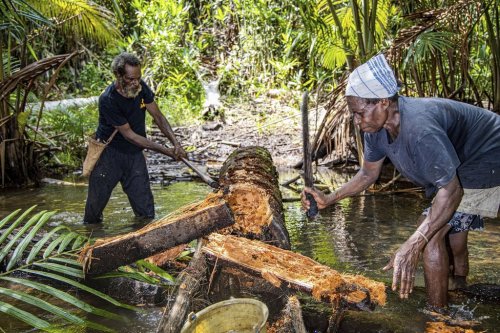
Local communities in Papua that rely on the area for hunting, fishing and other aspects of their cultural identity say their basic needs have been harmed by the projects.
Vincen Kwipalo, 63, a villager living in the area, said that land he and other villagers used for hunting was turned into sugarcane nurseries guarded by groups of men, preventing them from engaging in their usual ways of surviving.

“We know the forests of Papua are one of the biggest lungs of the world, yet we are destroying it,” Kwipalo said. “Indonesia should be proud to protect Papua … not destroy it.”
Environmental watch groups say the projects’ development will impact generations of Indigenous groups for generations to come
“Where are they going to hunt, fish and live?” said Horowitz. “For an Indigenous community that’s relied on the rainforest to provide for centuries, are they supposed to live in a sugar plantation?”
___
The Associated Press’ climate and environmental coverage receives financial support from multiple private foundations. AP is solely responsible for all content. Find AP’s standards for working with philanthropies, a list of supporters and funded coverage areas at AP.org.