Crime, energy and geopolitics define the leaders’ key exchanges in English debate
Advertisement
Read this article for free:
or
Already have an account? Log in here »
To continue reading, please subscribe:

Digital Subscription
One year of digital access for only $205*
- Enjoy unlimited reading on winnipegfreepress.com
- Read the E-Edition, our digital replica newspaper
- Access News Break, our award-winning app
- Play interactive puzzles
*First annual payment billed as $205.00 + GST for one year. This annual subscription will automatically renew at $233.00 + GST every 52 weeks (10% off the regular annual price of $259.35). Offer available to new and qualified returning subscribers only. Cancel any time.
To continue reading, please subscribe:
Add Free Press access to your Brandon Sun subscription for only an additional
$1 for the first 4 weeks*
- Enjoy unlimited reading on winnipegfreepress.com
- Read the E-Edition, our digital replica newspaper
- Access News Break, our award-winning app
- Play interactive puzzles
*Your next Brandon Sun subscription payment will increase by $1.00 and you will be charged $17.95 plus GST for four weeks. After four weeks, your payment will increase to $24.95 plus GST every four weeks.
Read unlimited articles for free today:
or
Already have an account? Log in here »
Hey there, time traveller!
This article was published 17/04/2025 (544 days ago), so information in it may no longer be current.
OTTAWA – Federal party leaders laid out some of their electoral priorities and took each other to task on policy during the English-language debate Thursday.
These were some of the key exchanges:
Pipeline griping
Conservative Leader Pierre Poilievre repeatedly attacked the Liberals for not getting pipelines built — but kept getting interrupted by NDP Leader Jagmeet Singh.
“It sounds wild when you say that,” Singh said at one point.
“They built a pipeline. I don’t know what Pierre is complaining about,” he said later.
Singh also cut off Poilievre when he said energy projects “should have strong rules, enforced once” instead of multiple reviews. “It’s the first time I’ve heard you care about the environment,” Singh said.
That remark had Liberal Leader Mark Carney chuckling.
While the debate included “energy and climate” among its five themes, environmental concerns were largely raised by Singh and Bloc Québécois Leader Yves-François Blanchet.
Trudeau’s legacy
Poilievre repeatedly attempted to link Carney closely with his predecessor’s legacy.
“Justin Trudeau’s staffers are actually here with you at this debate in Montreal, writing the talking points that you are regurgitating into the microphone. How can we possibly believe that you are any different than the previous 10 years of Liberal government,” the Tory leader said.
“Ooh, that hurts,” Blanchet jeered.
“I do my own talking points, thank you very much,” Carney replied.
He later suggested Poilievre needs to update his own talking points.
“I know you want to be running against Justin Trudeau,” he said. “Justin Trudeau isn’t here.”
Crime in the streets
When facing criticism about promising to use the notwithstanding clause to implement stiff sentences that might infringe on Charter rights, Poilievre said Carney was ignoring Canadians’ right to safety.
“I don’t think you appreciate, sir, the chaos that is unfolding in communities. In Toronto right now, the police have been forced to tell people to just let the thief steal the car. When they break into the house, just take the keys,” he said.
“People are living in terror in many of our communities,” he said, blaming Liberal bail reforms.
Patriotism
Blanchet challenged Carney to meet with all party leaders one week after the election to sort out a response to U.S. threats, claiming he hasn’t responded to Blanchet’s offers to meet in recent weeks and accusing him of being “alone in your little kingdom.”
Carney said he’d gladly meet with all leaders, adding “you need to bring the country along with you” in a crisis.
All of the leaders said it was a privilege to meet with Canadians across the country during the campaign.
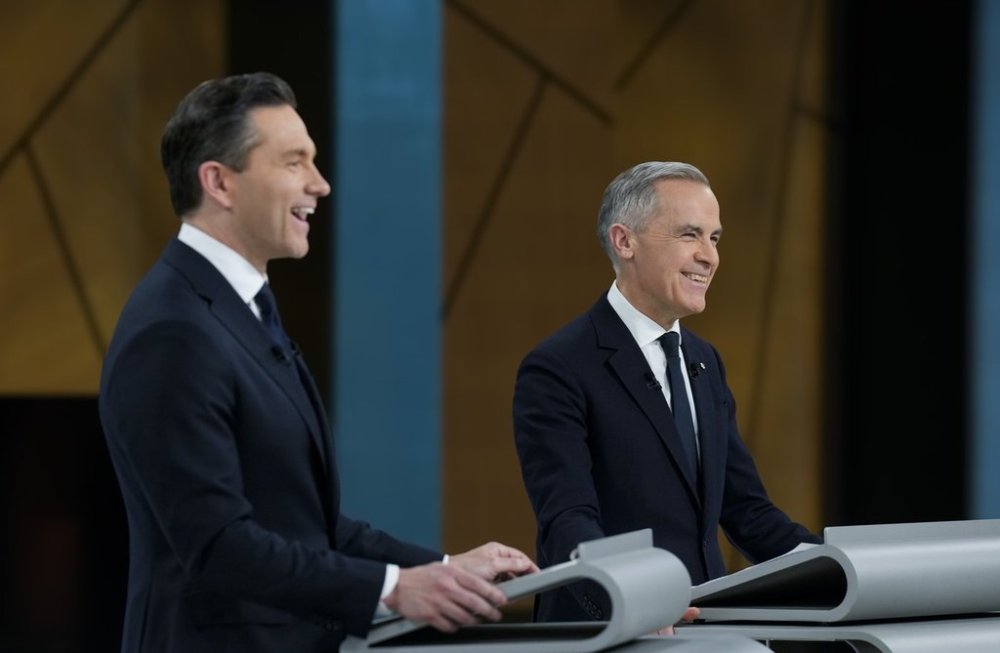
“One of the honours of my job is to be able to meet people and to hear their stories, and then to take their stories and concerns and bring them to Ottawa,” Singh said.
Poilievre got emotional at one point when he said he thinks often of people he wasn’t able to meet at rallies.
“That was always touching to me, that they would put their faith in me or in any of us,” he said. “I want you to know out there, I haven’t forgot about you.”
Carney agreed, calling Canada “an astonishing country.”
Blanchet said Quebec and Canada must be “partners to be stronger in front of Mr. Trump.”
Ukraine
Poilievre did not answer directly when asked whether “Canada should commit more to assist” Ukraine’s defence if the U.S. pulls back funding.
“We should continue to support Ukraine,” he said, adding later that “we don’t need to follow the Americans in everything they do.”
Carney said that didn’t clarify whether Poilievre would boost support for Ukraine.
“Mr. Poilievre wants to cut foreign aid, including for Ukraine, or not — he didn’t mention support for aid for Ukraine,” he said.
Biggest threats
When asked to name the biggest security threat facing Canada, none of the leaders mentioned U.S. President Donald Trump.

“The biggest security threat to Canada is China,” said Carney, who has been accused of having too many business dealings with Beijing.
He later added that he agreed with Poilievre that Iran’s proxies, such as Hamas, are a huge threat to the Middle East. “We have to be clear-eyed about the fundamental risks of Iran and do everything with our international partners to check it and turn it,” Carney said.
Poilievre said the top threat is “the rampant crime wave that is running out of control.” Singh cited illegal guns and drugs amid public-safety cuts, and repeatedly mentioned health care.
Blanchet said Canada is “entirely dependent on Americans to protect us.”
This report by The Canadian Press was first published April 17, 2025.
Related Articles
Liberals win 4th mandate as NDP vote collapses and Singh announces he will resign








Advertisement Advertise With Us
Advertisement Advertise With Us