Facing an electoral headwind
Climate change has been a key campaign platform in recent federal elections, however voter anxiety is pushing it to the backburner

Advertisement
Read this article for free:
or
Already have an account? Log in here »
To continue reading, please subscribe:

Digital Subscription
One year of digital access for only $205*
- Enjoy unlimited reading on winnipegfreepress.com
- Read the E-Edition, our digital replica newspaper
- Access News Break, our award-winning app
- Play interactive puzzles
*First annual payment billed as $205.00 + GST for one year. This annual subscription will automatically renew at $233.00 + GST every 52 weeks (10% off the regular annual price of $259.35). Offer available to new and qualified returning subscribers only. Cancel any time.
To continue reading, please subscribe:
Add Free Press access to your Brandon Sun subscription for only an additional
$1 for the first 4 weeks*
- Enjoy unlimited reading on winnipegfreepress.com
- Read the E-Edition, our digital replica newspaper
- Access News Break, our award-winning app
- Play interactive puzzles
*Your next Brandon Sun subscription payment will increase by $1.00 and you will be charged $17.95 plus GST for four weeks. After four weeks, your payment will increase to $24.95 plus GST every four weeks.
Read unlimited articles for free today:
or
Already have an account? Log in here »
Hey there, time traveller!
This article was published 18/04/2025 (530 days ago), so information in it may no longer be current.
It was only six years ago, but 2019 feels worlds away.
Prime Minister Justin Trudeau was living at 24 Sussex, still floppy-haired and fun-socked; there hadn’t yet been a global pandemic to grind the gears of the status quo to a halt. Canada and the United States were on solid ground as neighbours and trade partners, having successfully renegotiated a North American trade deal.
And every Friday, inspired by Swedish environmental activist Greta Thunberg, students across the country walked out of classes to demand their governments take the climate crisis seriously.
The Fridays for Future protests were complemented by widespread climate strikes and marches; more than 10,000 Winnipeggers joined a global demonstration in late September that year. More than a million Canadians took to the streets that day.
One thing was clear: climate change was top of mind going into that fall’s federal election. For the first time, it ranked among voters’ top issues as they headed to the ballot boxes.
Two years later, during the 2021 election, though dominated by debate over the federal pandemic response, climate change still took a starring role. A string of environmental emergencies — a deadly heat dome in British Columbia, a devastating wildfire season and a two-week long deep freeze on the Prairies — helped prompt Canadians to rank climate change as a top issue influencing their votes.
Things are a little different this time around.
It’s an election dominated by anxiety: anxiety over the economy, American politics, the cost of living and the security of the future. In all that turmoil, climate anxiety seems to have fallen by the wayside: polling suggests voters aren’t thinking about the environment as they prepare to head to the ballot box; leaders have hardly mentioned climate action on the campaign trail.
But those watching this election closely say it’s not so clear-cut. Canadians still care about the environment — it’s just being packaged a little differently.
“It’s not because Canadians don’t care about climate,” Abacus Data vice-president Eddie Sheppard said in an interview. “It’s just being out-shouted by louder and more immediate concerns.”
At face value, the polls paint a grim picture for the fate of climate policy.
In 2021, Abacus polling found “dealing with climate change” ranked third behind cost of living and health-care concerns as a top election issue in the month leading up to election day, with about 20 per cent of Canadians ranking climate change as their No. 1 election concern.
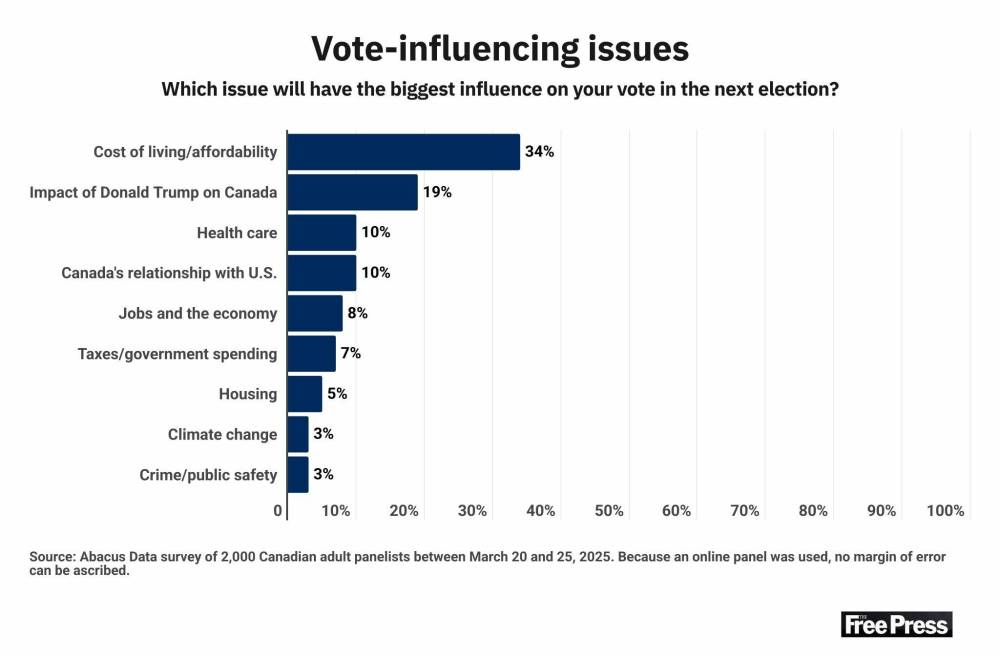
This year, the deck has shuffled considerably. An Abacus survey of 2,000 Canadians conducted in late March found cost of living still topped the election-issue list, but climate change had fallen to eighth in the rankings, with just three per cent of respondents picking the environment as their most important voting issue.
Similar results appeared in February and March polls from Ipsos, Nanos and Angus Reid, with the share of voters ranking climate change as a top-three election issue even lower among Prairie voters.
Instead, Canada’s relationship with the United States and the threats of annexation and tariffs posed by President Donald Trump have dominated news cycles — and voter priorities. Housing affordability, jobs and taxes have jumped to the forefront of Canadians’ concerns.
“I think what that shows us is that there are very immediate, pressing concerns that are really capturing the headlines, capturing Canadians’ attention and shaping how they’re viewing this election,” Sheppard said. “Climate change has gradually been pushed down the list.”
Respondents said immediate issues like the cost of living and housing were more important.
Typically, he explained, polls tend to reflect more concern about climate change around severe weather events, like the heat waves and forest fires in summer 2021. Canadians’ attention to climate change peaked last July, coinciding with the forest fires that devastated Jasper, Alta., but “since then it hasn’t been as top of mind,” he said.
In 2023, an Abacus poll found more than three-quarters of Canadians were concerned about climate change and its potential impact on their future. Last year, that share fell 14 points to just 62 per cent.
Respondents said immediate issues like the cost of living and housing were more important.
It echoes findings from the Consortium on Electoral Democracy, an election research network that collects voter opinions on climate change as part of annual democracy surveys.
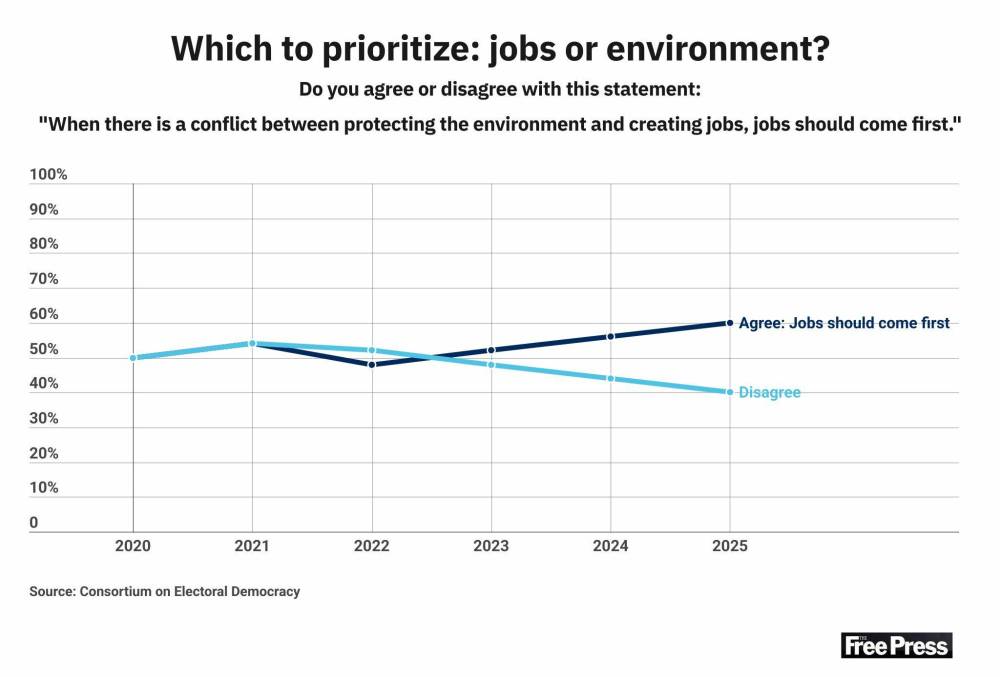
For the last five years, the survey has asked Canadians to agree or disagree with the statement: “When there is a conflict between protecting the environment and creating jobs, jobs should come first.”
Respondents were deadlocked in 2020, but more than half prioritized climate impacts in 2021 and 2022. Sentiments have flipped since 2023, with steadily more voters choosing jobs over the environment, reaching a 60-40 split in this year’s poll.
“Canadians need more immediate relief and they need that certainty and stability in their lives before they can look to things like long-term environmental strategy,” Sheppard said. “If people can’t manage their lives today, it makes it hard to be concerned about climate five years down the road from now.”
“Things like climate change are a slow-onset problem. Those things fly under our radar or get downgraded on the list of priorities.”–Ryan Bullock
Ryan Bullock, a professor of environmental studies and co-lead of the environment and society research group at the University of Winnipeg, has studied the rise of social movements like environmentalism.
He sees the current deprioritization of climate issues as part of a familiar trend: people are generally better at dealing with short-term emergencies.
“Things like climate change are a slow-onset problem,” Bullock said.
“Those things fly under our radar or get downgraded on the list of priorities. Even when informed people are sounding the alarm we tend to look past climate change and environmental issues because Donald Trump is the immediate threat we need to focus on.”
Six months ago, Sheppard would have said this year was, in some respect, another climate election.
Carbon taxes headlined the pre-campaign build up as Conservative Leader Pierre Poilievre built his party’s platform around opposition to the consumer price on carbon pollution — once the Liberal Party’s flagship climate policy — and secured widespread public support in the process.
And then the political landscape turned upside down: Prime Minister Justin Trudeau resigned in early January, Trump was sworn in as president and began levelling tariff and annexation threats; Mark Carney won the Liberal leadership race and immediately nixed the consumer carbon price, effectively nullifying Poilievre’s plan to frame the election as a referendum on climate policy.
“The carbon tax and Bill C-69 (2019 legislation mandating impact assessments for energy projects) are the only two things that have really received attention from a climate policy side,” Sheppard said.
While voters might not be as focused on climate change this year, they still expect their leaders to make progress.
Environmental concern at the polls
Here’s how Canadians — particularly Prairie voters — have ranked climate change in 2025 election polls
Here’s how Canadians — particularly Prairie voters — have ranked climate change in 2025 election polls
● A February Ipsos poll saw voters rank threats to the environment as the ninth most important election issue. Less than five per cent of Manitoba and Saskatchewan voters ranked it among their top three.
● A Nanos poll commissioned by CTV in early March came to similar conclusions: the environment ranked seventh among voter’s concerns nationwide and sixth among Prairie voters, but just three per cent of Prairie residents named it as their top election priority.
● In an April poll from Angus Reid, Canadians put environment and climate issues sixth overall on the list of key election issues, but Manitobans were less likely to consider climate change a priority. Just 11 per cent of Manitobans ranked it among their top three concerns, meaning it did not even rank among the province’s top-10 issues.
An Abacus poll conducted in September 2024 asked respondents whether the next prime minister should take dealing with climate change seriously. Nearly 80 per cent said yes.
“Canadians are going to hold whoever wins the election accountable because it’s something that’s very important to them,” Sheppard said.
Last week, more than 120 Canadian municipal politicians, including Winnipeg city councillor Sherri Rollins, signed an open letter urging federal leaders to take an “elbows up” approach to climate action.
The “Elbows Up For Climate Action” letter called on leaders to implement a national clean energy grid, build high-speed rail and electric transit infrastructure, build energy efficient homes, retrofit home-energy systems and invest in a national disaster response and recovery strategy.
“There’s an urgent need to shine a light on policy work that works for local government as it relates to climate action,” Rollins said in an interview. “It’s absent from the dialogue and the narrative of the election and it’s a really critical omission.”
Rollins understands there are a long list of pressing issues, affordability and housing in particular, facing her constituents. She believes the policies pitched in the open letter, for example building energy efficient housing or supporting home-energy retrofits, can create jobs, lower energy bills, provide a sense of long-term stability — and still reduce emissions.
“The social and economic challenge is the climate resiliency, climate justice challenge,” she said. “I believe the work is the same.”
Sheppard believes federal leadership hopefuls are still talking about climate change — just not in so many words.
“We’re hearing things like energy independence, resilient infrastructure and the critical mineral strategy — that’s all climate related, but they’re not discussing it very explicitly as climate policy or an environmental strategy,” he said.
Platforms still include programs like electric-vehicle incentives, home-energy retrofits and heat-pump incentives, but Sheppard said they’re being communicated as “cost-saving strategies rather than climate-saving strategies.”
“Parties are strategically staying away from the explicit discussion around climate and focusing more on how this impacts the top issues, while still getting at those climate policies.”–Eddie Sheppard
Similarly, when Carney announced plans to “protect Canada’s natural environment” last week, he only mentioned climate change once, instead framing his climate policies as a response to Trump threatening Canadian resources and an opportunity to bolster national identity around a shared love of nature.
Part of the reason, Sheppard suggests, is because climate change is still a divisive topic. As the race has shifted from near-certain Conservative victory to a nail-biting sprint for the line, candidates are being careful to avoid messaging that could alienate undecided voters.
“Parties are strategically staying away from the explicit discussion around climate and focusing more on how this impacts the top issues, while still getting at those climate policies.”
For Bullock, the U of W professor, the “savvy” campaign strategies to reframe environmental issues aren’t as important as the policies themselves.
Even as Canadians prepare to vote with economic and national security concerns top of mind, he said: “What’s at the base of our economic system? Our environment.”
julia-simone.rutgers@freepress.mb.ca
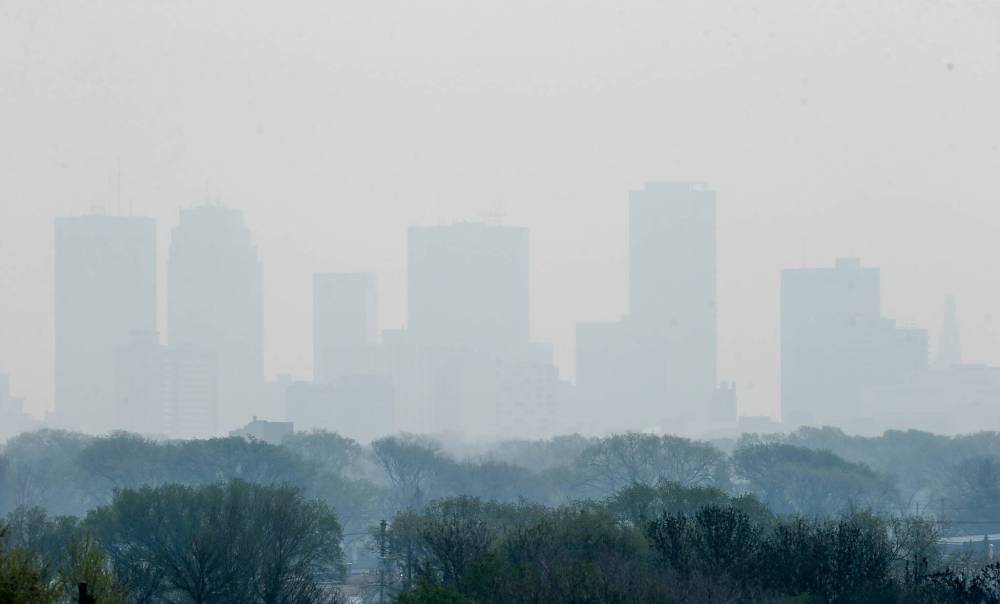
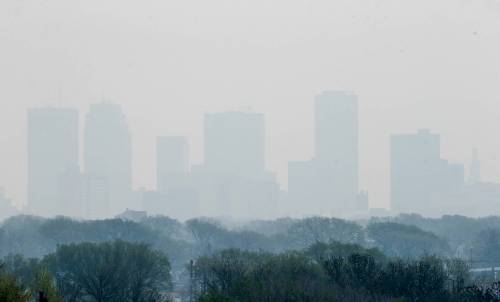
JOHN WOODS / FREE PRESS Smoke from a northern fire blows into Winnipeg Sunday, May 12, 2024.
Julia-Simone Rutgers is an investigative reporter who joined the Free Press in 2020. Read more about Julia-Simone.
Every piece of reporting Julia-Simone produces is reviewed by an editing team before it is posted online or published in print — part of the Free Press‘s tradition, since 1872, of producing reliable independent journalism. Read more about Free Press’s history and mandate, and learn how our newsroom operates.
Our newsroom depends on a growing audience of readers to power our journalism. If you are not a paid reader, please consider becoming a subscriber.
Our newsroom depends on its audience of readers to power our journalism. Thank you for your support.
Julia-Simone Rutgers is an investigative reporter who joined the Free Press in 2020. Read more about Julia-Simone.
Every piece of reporting Julia-Simone produces is reviewed by an editing team before it is posted online or published in print — part of the Free Press‘s tradition, since 1872, of producing reliable independent journalism. Read more about Free Press’s history and mandate, and learn how our newsroom operates.
Our newsroom depends on a growing audience of readers to power our journalism. If you are not a paid reader, please consider becoming a subscriber.
Our newsroom depends on its audience of readers to power our journalism. Thank you for your support.
Related Articles
Liberals win 4th mandate as NDP vote collapses and Singh announces he will resign










Advertisement Advertise With Us
Advertisement Advertise With Us