Hope floats in the Amazon as Bacuri, a young manatee, fights for survival
Advertisement
Read this article for free:
or
Already have an account? Log in here »
To continue reading, please subscribe:

Digital Subscription
One year of digital access for only $205*
- Enjoy unlimited reading on winnipegfreepress.com
- Read the E-Edition, our digital replica newspaper
- Access News Break, our award-winning app
- Play interactive puzzles
*First annual payment billed as $205.00 + GST for one year. This annual subscription will automatically renew at $233.00 + GST every 52 weeks (10% off the regular annual price of $259.35). Offer available to new and qualified returning subscribers only. Cancel any time.
To continue reading, please subscribe:
Add Free Press access to your Brandon Sun subscription for only an additional
$1 for the first 4 weeks*
- Enjoy unlimited reading on winnipegfreepress.com
- Read the E-Edition, our digital replica newspaper
- Access News Break, our award-winning app
- Play interactive puzzles
*Your next Brandon Sun subscription payment will increase by $1.00 and you will be charged $17.95 plus GST for four weeks. After four weeks, your payment will increase to $24.95 plus GST every four weeks.
Read unlimited articles for free today:
or
Already have an account? Log in here »
Hey there, time traveller!
This article was published 02/05/2025 (515 days ago), so information in it may no longer be current.
CAXIUANA NATIONAL FOREST, Brazil (AP) — Deep in silence, as if under a spell, children watch intently as Bacuri, a young Amazonian manatee, glides around a small plastic pool. When he surfaces for air, some of them exchange wide smiles. The soft rustle of rainforest leaves punctuated by bird song adds to the magic of the moment.
The children from riverside communities traveled for hours by boat just to meet Bacuri at the Ferreira Penna Scientific Base of the Emilio Goeldi Museum, Brazil’s oldest research institute in the Amazon. Despite their endangered status, manatees are still hunted and their meat illegally sold, and they are increasingly threatened by climate change. Environmentalists hope that by engaging local communities, Bacuri and others like him will be spared.
The Amazonian manatee is the region’s largest mammal but is rarely seen, much less up close. The reasons for this are twofold: The manatee has acute hearing and will vanish into the murky water at the slightest sound; and its population has dwindled after being overhunted for hundreds of years, mostly for its tough hides that were exported to Europe and Central America.
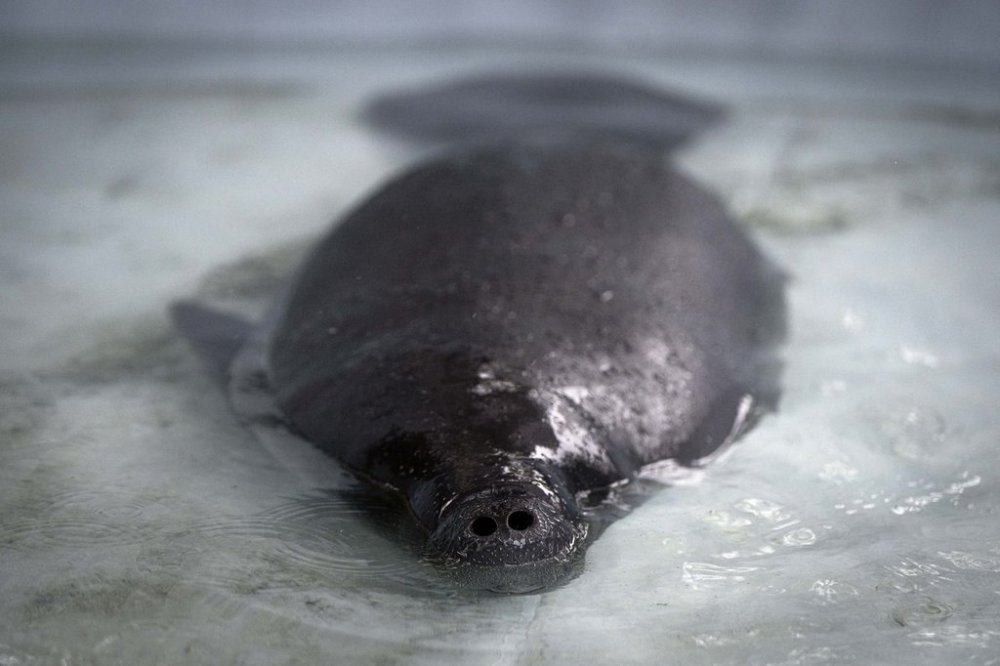
To help the manatee population recover, several institutions are rescuing orphaned manatee calves, rehabilitating them and reintroducing them to the wild.
Bacuri’s story
Bacuri weighed just 22 pounds (10 kilograms) — a fraction of the more than 900 pounds (400 kilograms) of an adult manatee — when he was rescued and taken to the federally protected Caxiuana National Forest. He was named after the local community that found him. Two years and several thousand milk bottles later, Bacuri has grown to about 130 pounds (60 kilos).
Three institutions are responsible for his care. The Goeldi Museum provides facilities and educates nearby communities. The federal Chico Mendes Institute for Biodiversity Conservation assigns two staffers for 15-day shifts to feed Bacuri three bottles of milk a day as well as chopped beets and carrots, and clean the pool every 48 hours. The nonprofit Instituto Bicho d’Agua — meaning institute of water animals in Portuguese — oversees veterinary care, dietary planning and caregiver training.
During their visit, the children learn that female manatees are pregnant for about a year then nurse their young for two more, feeding them from nipples behind their front flippers — the manatee equivalent of armpits. This long reproductive cycle is one reason the manatee population has not recovered from the commercial hunting that persisted until the mid-20th century.
They also learn the species is endangered and that they are the ones who must protect it.
“You are the main guardians,” biologist Tatyanna Mariúcha, head of the Ferreira Penna scientific base, tells the children, who spend the rest of the day drawing and making Play-Doh models of Bacuri.
Local knowledge is key
With its auditorium, dormitories, observation towers, cafeteria and laboratories, the research station — two hours by speedboat from Portel, the nearest city — stands in stark contrast to nearby communities comprising clusters of wooden houses on stilts where families rely on cassava farming, fishing and harvesting açaí berries. School field trips and community outreach aim to narrow the gap.
“Caxiuana is their home,” Mariúcha told The Associated Press. “We can’t just come here and do things without their consent.”
Local knowledge will play a key role when Bacuri is finally released. He is the only manatee calf under care at Caxiuana. Once he has fully transitioned to a plant-based diet, he’ll spend time in a river enclosure before his release. That site will be selected based on where residents say wild manatees feed and pass through.
If all goes as planned, Bacuri will be the first manatee released in the Caxiuana area. Two other calves rescued in poor health died in captivity, a sadly common outcome.
While subsistence hunting isn’t a major threat to the species, some fishermen still sell manatee meat illegally in nearby towns. Brazil banned hunting of all wild animals in 1967, with two exceptions: Indigenous peoples are allowed to hunt, and others can kill a wild animal to satisfy the hunger of the hunter or his family.
The impact of climate change
The threat of hunters has become harder to manage due to climate change, said Miriam Marmontel, a senior researcher at the Mamirauá Institute for Sustainable Development, hundreds of miles (kilometers) upstream along the Amazon River.
Dozens of dolphins died near Mamiraua in 2023, likely due to soaring water temperatures during a historic drought. Manatees avoided mass mortality then because they typically inhabit deep pools during the dry season, but recent droughts have dramatically reduced the water level, making manatees more vulnerable to poachers.
“As climate change accelerates, manatees may begin to suffer from heat stress too,” Marmontel said. “They also have a thermal limit, and eventually it may be crossed.”

That’s why reintroduction efforts are so important.
Around 60 rescued manatees are being cared for across the state of Para, where Caxiuana is located. Bicho d’Agua is caring for four in partnership with the Federal University of Para and Brazil’s environmental agency. One of the four, named Coral, was found near Obidos and airlifted 620 miles (1,000 kilometers) to the institute’s facility in Castanhal. She arrived dehydrated and with severe skin burns, likely from sun exposure.
“The population has declined so much that every hunted animal impacts the species,” Renata Emin, president of Bicho d’Agua, told AP. “That’s why any effort matters, not just because one individual may return to the wild and help rebuild the population but because of the community and government engagement it inspires.”
___
The Associated Press’ climate and environmental coverage receives financial support from multiple private foundations. AP is solely responsible for all content. Find AP’s standards for working with philanthropies, a list of supporters and funded coverage areas at AP.org.