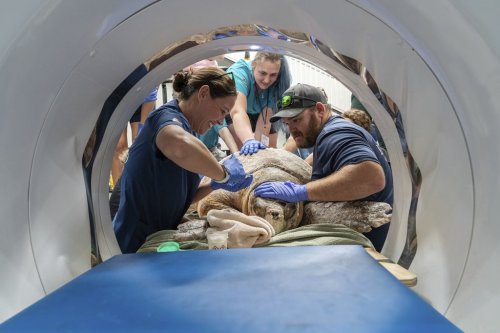
A 302-pound loggerhead sea turtle hit by a boat gets an oversize CT scan, with a surprise
Advertisement
Read this article for free:
or
Already have an account? Log in here »
To continue reading, please subscribe:

Digital Subscription
One year of digital access for only $205*
- Enjoy unlimited reading on winnipegfreepress.com
- Read the E-Edition, our digital replica newspaper
- Access News Break, our award-winning app
- Play interactive puzzles
*First annual payment billed as $205.00 + GST for one year. This annual subscription will automatically renew at $233.00 + GST every 52 weeks (10% off the regular annual price of $259.35). Offer available to new and qualified returning subscribers only. Cancel any time.
To continue reading, please subscribe:
Add Free Press access to your Brandon Sun subscription for only an additional
$1 for the first 4 weeks*
- Enjoy unlimited reading on winnipegfreepress.com
- Read the E-Edition, our digital replica newspaper
- Access News Break, our award-winning app
- Play interactive puzzles
*Your next Brandon Sun subscription payment will increase by $1.00 and you will be charged $17.95 plus GST for four weeks. After four weeks, your payment will increase to $24.95 plus GST every four weeks.
Read unlimited articles for free today:
or
Already have an account? Log in here »
Hey there, time traveller!
This article was published 24/05/2025 (503 days ago), so information in it may no longer be current.
JUNO BEACH, Fla. (AP) — A massive loggerhead sea turtle hit by a boat off Florida’s Atlantic coast arrived at a turtle hospital needing medical care, but at 302 pounds (137 kilograms), Pennywise was too large to fit their equipment.
So the veterinary team at the Loggerhead Marinelife Center in Juno Beach took her to nearby Jupiter Medical Center, hoping she could get a CT scan on a human machine. She was too big for that, as well.
They quickly came up with another plan: taking Pennywise to Palm Beach Equine Clinic in Wellington, where the scan was performed on equipment designed for horses.

“And, luckily, the horse-sized machine was big enough to fit this lady through,” Heather Barron, the chief science officer and veterinarian at Loggerhead, told The Associated Press.
Turns out, they also got a nice surprise: Images showed that Pennywise is carrying eggs.
“We hope we’ll be able to get her back out there into the wild as soon as possible so that she can lay those eggs,” Barron said.
Loggerheads, an endangered species, often lay multiple clutches during a season, she said.
Pennywise arrived at the center Monday, after a crew from Inwater Research Group found her floating in the Atlantic with significant blunt force trauma to her shell that had already started to heal.
The staff at the Juno Beach turtle center estimated that Pennywise’s injuries were about a month old. Barron said the imaging showed some damage to bones that surround the spinal cord. They have the turtle on high-powered antibiotics.
“Luckily, right now, her neurologic exam shows that all those nerves are intact. And that is a great sign for her. We’re very excited about that and we’ll just be rechecking to make sure that we have no progression of the disease, and as soon as we feel like that wound is healed well enough, she can go back out into the wild.”
Even so, Barron said, Pennywise’s story is a “textbook case of a turtle returning to the area for mating and nesting season, only to fall victim to an entirely preventable boat-strike injury.”
Because nesting season in Florida runs from March 1 to Oct. 31, officials at the sea turtle center are encouraging boaters to slow down and to be especially mindful in what they refer to as the Sea Turtle Protection Zone, which extends a mile (1.6 kilometers) off the coast.
___
Frisaro reported from Fort Lauderdale, Florida.